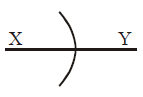
A concave spherical surface of radius of curvature 10 cm separates two medium X & Y of refractive index 4/3 & 3/2 respectively. If the object is placed along principal axis in medium X then :
1. image is always real
2. image is real if the object distance is greater than 90 cm
3. image is always virtual
4. image is virtual if the object distance is less than 90 cm
View Answer
An object is mounted on a wall. Its image of equal size is to be obtained on a parallel wall with the help of a convex lens placed between these walls. The lens is kept at distance \(x\) in front of the second wall. The required focal length of the lens will be
1. \(\frac{x}{2}\)
2. \(\frac{x}{4}\)
3. Less than \(\frac{x}{4}\)
4. \(\frac{x}{4}\) but less than \(\frac{x}{2}\)
View Answer
For an image of equal size, the magnification is \(m = -1\), which means the image distance \(v = x\) is equal to the object distance \(u = x\). Using the lens formula: \(\frac{1}{f} = \frac{1}{v} + \frac{1}{u} = \frac{2}{x} ⇒ f = \frac{x}{2}\).
A convex lens ‘A’ of focal length 20 cm and a concave lens ‘B’ of focal length 5 cm are kept along the same axis with a distance ‘\(d\)’ between them. If a parallel beam of light falling on ‘A’ leaves ‘B’ as a parallel beam, then the distance ‘\(d\)’ in cm will be
View Answer
For an incoming parallel beam to emerge parallel from the combination, the focus of the first lens must coincide with the virtual focus of the second lens. Thus, \(d = f_1 - |f_2| = 20 - 5 = 15\) cm.
Assertion (A): Biconvex lens can form virtual image of a virtual object.
Reason (R): Nature of lens depends on refractive index of surrounding.
1. (1) Both (A) & (R) are true and the (R) is the correct explanation of the (A)
2. (2) Both (A) & (R) are true but the (R) is not the correct explanation of the (A)
3. (3) (A) is true but (R) is false
4. (4) Both (A) and (R) are false
View Answer
A biconvex lens can form a virtual image of a virtual object. The nature of a lens (converging/diverging) depends on the refractive index of the lens material relative to the surrounding medium. Therefore, both A and R are true, and R is the correct explanation of A.
Assertion (A): In clear weather, sky appears to be blue not violet.
Reason (R): In clear atmosphere, light of shorter wavelength is scattered more as compared to light of longer wavelength.
1. (1) Both (A) & (R) are true and the (R) is the correct explanation of the (A)
2. (2) Both (A) & (R) are true but the (R) is not the correct explanation of the (A)
3. (3) (A) is true but (R) is false
4. (4) Both (A) and (R) are false
View Answer
Assertion (A) is true; violet light scatters most, but our eyes are more sensitive to blue. Reason (R) is true; Rayleigh scattering is inversely proportional to the fourth power of wavelength, scattering shorter wavelengths more effectively. Reason (R) correctly explains Assertion (A).
Assertion (A): During sunset and sunrise sun appears to be red.
Reason (R): During sunrise or sunset, sun emits electromagnetic radiations of comparatively higher wavelength only.
1. (1) Both (A) & (R) are true and the (R) is the correct explanation of the (A)
2. (2) Both (A) & (R) are true but the (R) is not the correct explanation of the (A)
3. (3) (A) is true but (R) is false
4. (4) Both (A) and (R) are false
View Answer
Assertion (A) is true; at sunrise/sunset, sunlight travels longer through the atmosphere, scattering away shorter wavelengths (blue) and leaving longer wavelengths (red). Reason (R) is false; the sun emits all wavelengths. The perceived color is due to atmospheric scattering, not selective emission.
Assertion (A): A virtual image can’t be caught on screen, yet we see a virtual image. We are obviously bringing it on to the screen, i.e. the retina.
Reason (R): The retina is a special type of screen present in the back of eye consisting of nerve fibre which can catch both real & virtual image.
1. (1) Both (A) & (R) are true and the (R) is the correct explanation of the (A)
2. (2) Both (A) & (R) are true but the (R) is not the correct explanation of the (A)
3. (3) (A) is true but (R) is false
4. (4) Both (A) and (R) are false
View Answer
Assertion (A) is true; virtual images cannot be projected onto a physical screen. Reason (R) is false; the retina, acting as a screen, can only detect real images formed by the eye's lens. Our brain interprets virtual images.
Assertion (A): In a magnifying glass, the angle subtended by an object at the eye is equal to the angle subtended by its virtual image at the eye. Still the magnifying glass provides angular magnification.
Reason (R): Magnifying glass produce a virtual magnified image of the object.
1. (1) Both (A) & (R) are true and the (R) is the correct explanation of the (A)
2. (2) Both (A) & (R) are true but the (R) is not the correct explanation of the (A)
3. (3) (A) is true but (R) is false
4. (4) Both (A) and (R) are false
View Answer
Assertion (A) is false. Angular magnification occurs precisely because the virtual image subtends a larger angle at the eye than the object alone. Reason (R) is true; a magnifying glass (convex lens) forms a virtual, upright, and magnified image.
Assertion (A): Although the surface of goggles lens are curved, it does not have any power.
Reason (R): In case of goggles, both the curved surfaces have equal radius of curvature and have centre of curvature on the same side
1. (1) Both (A) & (R) are true and the (R) is the correct explanation of the (A)
2. (2) Both (A) & (R) are true but the (R) is not the correct explanation of the (A)
3. (3) (A) is true but (R) is false
4. (4) Both (A) and (R) are false
View Answer
Protective goggle lenses do not alter vision, implying their optical power is zero. Thus, (A) is true.
The power of a lens is given by \(P = (n-1)(\frac{1}{R_1} - \frac{1}{R_2})\). If the surfaces have equal radii of curvature and their centers are on the same side (as in a meniscus lens where both surfaces curve in the same direction), then \(\frac{1}{R_1} - \frac{1}{R_2} = 0\), resulting in (P = 0). This explains why curved goggle lenses can have no power. Thus, (R) is true and is the correct explanation of (A).