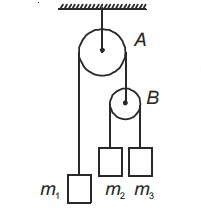
In the arrangement, shown in figure, pulleys A and B are massless and frictionless and threads are ideal. Block of mass m1 will remain at rest if:
1. \[ \frac{1}{m_{3}}=\frac{2}{m_{2}}+\frac{3}{m_{1}} \]
2. \[ m_{1}= m_{2}= m_{3} \]
3. \[ \frac{4}{m_{1}}=\frac{1}{m_{2}}+\frac{1}{m_{3}}\]
4. \[ \frac{1}{m_{1}}=\frac{1}{m_{2}}+\frac{1}{m_{3}}\]
View Answer
In the movable pulley system, tension in the string connecting m2 and m3 is:
Since this tension acts twice to balance
, we equate:
Cancelling
and rearranging gives:
A 1 kg object strikes a wall with velocity \(1\text{ ms}^{-1}\) at an angle of \(60^\circ\) with the wall and reflects at the same angle. If it remains in contact with wall for 0.1 s, then the force exerted on the wall is
1. \(10\sqrt{3}\text{ N}\)
2. \(20\sqrt{3}\text{ N}\)
3. \(30\sqrt{3}\text{ N}\)
4. Zero
View Answer
The angle with the normal is \(90^\circ - 60^\circ = 30^\circ\). The change in momentum perpendicular to the wall is \(\Delta p = 2mv\cos(30^\circ) = 2(1)(1)\left(\frac{\sqrt{3}}{2}\right) = \sqrt{3}\text{ kg m s}^{-1}\). Average force \(F = \frac{\Delta p}{\Delta t} = \frac{\sqrt{3}}{0.1} = 10\sqrt{3}\text{ N}\).
A \(3.0\text{ kg}\) mass is moving in a plane, with its x and y coordinates given by \(x = 24t^2 – 1\) and \(y = 3t^3 + 2\), where x and y are in meters and t is in second. Find the magnitude of the net force acting on this mass at \(t = 2\text{ sec}\).
1. \(120\text{ N}\)
2. \(150\text{ N}\)
3. \(180\text{ N}\)
4. \(210\text{ N}\)
View Answer
Differentiating position equations twice yields accelerations: \(a_x = 48\text{ m/s}^2\) and \(a_y = 18t\text{ m/s}^2\). At \(t = 2\text{ s}\), \(a_y = 36\text{ m/s}^2\). Total acceleration \(a = \sqrt{a_x^2 + a_y^2} = 60\text{ m/s}^2\). The net force is \(F = ma = 3.0 \times 60 = 180\text{ N}\).
A particle moves on a rough horizontal ground with some initial velocity say \(v_0\). If \(3/4^{\text{th}}\) of its kinetic energy is lost in friction in time \(t_0\). Then coefficient of friction between the particle and the ground is:
1. \(\frac{v_0}{2gt_0}\)
2. \(\frac{v_0}{4gt_0}\)
3. \(\frac{3v_0}{4gt_0}\)
4. \(\frac{v_0}{gt_0}\)
View Answer
Since \(3/4^{\text{th}}\) of kinetic energy is lost, the remaining kinetic energy is \(1/4^{\text{th}}\), meaning the final velocity \(v = v_0/2\). Using \(v = v_0 - at_0\) where \(a = \mu g\), we get \(v_0/2 = v_0 - \mu gt_0 ⇒ \mu = \frac{v_0}{2gt_0}\).
A uniform chain of length \( L \) is placed on a rough horizontal table with some part hanging below the table. If the length of the hanging part becomes \( \frac{2L}{5} \) then the chain starts sliding on the table.
The co-efficient of friction between the chain and the table is:
1. \( \frac{2}{5} \)
2. \( \frac{3}{5} \)
3. \( \frac{1}{3} \)
4. \( \frac{2}{3} \)
View Answer
The hanging part of length \( \frac{2L}{5} \) exerts a pulling force of \( \frac{2}{5} Mg \). The part on the table of length \( \frac{3L}{5} \) experiences a maximum friction force of \( \mu \frac{3}{5} Mg \). Equating the forces at the verge of sliding gives \( \mu = \frac{2}{3} \).
A 1 kg object strikes a wall with velocity \(1 \text{ms}^{-1}\) at an angle of \(60^\circ\) with the wall and reflects at the same angle. If it remains in contact with wall for 0.1 s, then the force exerted on the wall is
1. \(10\sqrt{3} \text{N}\)
2. \(20\sqrt{3} \text{N}\)
3. \(30\sqrt{3} \text{N}\)
4. Zero
View Answer
The component of velocity perpendicular to the wall is \(v_n = v sin 60^\circ = \frac{\sqrt{3}}{2} \text{m/s}\). The change in momentum is \(\Delta p = 2 m v_n = 2 \times 1 \times \frac{\sqrt{3}}{2} = \sqrt{3} \text{kg m/s}\). The force is \(F = \frac{\Delta p}{\Delta t} = \frac{\sqrt{3}}{0.1} = 10\sqrt{3} \text{N}\).