Friction - NEET Physics Questions
Question 1:

A block of mass M is placed on a fixed smooth inclined plane of inclination ‘A’ with the horizontal is at rest. The force exerted by the plane on the block has a magnitude:

1. Mg
2. Mg / cosA
3. Mg cosA
4. Mg tanA
View Answer

As the object on inclined plane is at rest net force acting on the object is zero. Force applied on object by earth is Mg. Resultant of Normal reaction and friction force will cancel gravitational force. So the force applied by inclined plane on block is Mg in vertically  upward direction.
Question 2:

Consider a car moving on a straight road with a speed of 10 ms-1. The distance at which car can be stopped is: [μ=0.5] 


1. 800 m
2. 10 m
3. 100 m
4. 400 m
View Answer

Friction force action on the object is f=μ.N= μ.mg

Retardation of the block is  a=μ.g = 0.5× 10 =5

Using equation of motion. Stopping distance = u^2/2a=(10 × 10)/( 2* 5)=10 m

Question 3:

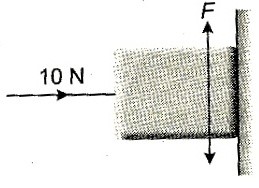
A horizontal force of 10 N is necessary to just hold a block stationary against a wall. The coefficient of friction between the block and the wall is 0.2. The weight of the block is

1. 20 N
2. 50 N
3. 100 N
4. 2 N
View Answer

Maximum Friction force action on an object is μN.

Here μ=0.2 and Normal reaction force will be equal to applied force i.e 10 N.,

So, friction force is 0.2*10 = 2N

Question 4:

A marble block of mass 2 kg lying on ice when given a velocity of 6 ms-1 is stopped by friction in 10 s. Then the coefficient of friction is

1. 0.02
2. 0.03
3. 0.06
4. 0.01
View Answer

Using equation of motion

v= u + at

⇒ 0= 6 + a ×10

⇒ a= -0.6 m/sec^2

Maximum Friction force is μN = μ mg so, a= μ.g

⇒ -0.6 = - μ. 10

⇒μ = 0.06 

Question 5:

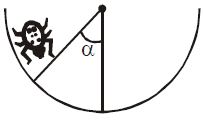
An insect crawls up a hemispherical surface very slowly (see the figure). The coefficient of friction between the insect and the surface is 1/3. If the line joining the centre of the hemispherical surface to the insect makes an angle a with the vertical, the maximum possible value of α is given by :

1. cot α = 3
2. tan α = 3
3. sec α = 3
4. cosec α = 3
View Answer

For Equilibrium,

⇒ μmg cos θ = mg sin θ 

⇒ μ = tan θ = 1/3 

⇒ cot θ = 3 

Question 6:

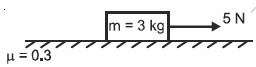
The value of frictional force on block in the given diagram is (Take g = 10 m/s²)

1. 4 N
2. 5 N
3. 6 N
4. 9 N
View Answer

Maximum friction force acting on the object will be uN= 0.3 * 30 = 9 N

But applied force is 5N so friction force acting on the object will be 5N

Question 7:

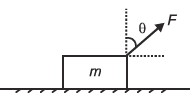
If block is at verge of motion, then select the correct option (where μ is the coefficient of friction)

neet friction based queestion

1. F = umg/sin θ
2. F = umg/( sin θ + u cosθ)
3. F = mg
4. F = umg
View Answer

If the angle θ\theta is with the vertical, then we need to adjust the force components accordingly:

  1. Normal Force:

    N=mgFcosθN = mg - F \cos \theta

  2. Friction Force:

    fs=μN=μ(mgFcosθ)f_s = \mu N = \mu (mg - F \cos \theta)

  3. Horizontal Component of Force:

    Fx=FsinθF_x = F \sin \theta

At the verge of motion:

Fsinθ=μ(mgFcosθ)F \sin \theta = \mu (mg - F \cos \theta)

Solving for FF:

F=μmgsinθ+μcosθF = \frac{\mu mg}{\sin \theta + \mu \cos \theta}

Question 8:

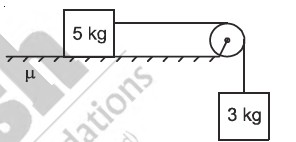
The minimum value of coefficient of friction (μ) such that block of mass ‘5 kg’ remains at rest is

1. 0.3
2. 0.4
3. 0.5
4. 0.6
View Answer

Given

m1=5m_1 = 5

kg,

m2=3m_2 = 3

kg, and

g=10g = 10

m/s²:

  • Tension:
    T=m2g=3×10=30T = m_2 g = 3 \times 10 = 30
     

    N

  • Friction force:
    f=μN=μ×50f = \mu N = \mu \times 50
     
  • At equilibrium:
    μ×50=30\mu \times 50 = 30
     

Solving,

μ=3050=0.6\mu = \frac{30}{50} = 0.6

.

Question 9:

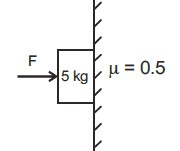
If the coefficient of friction between the block of mass 5 kg and wall is 0.5, then minimum force F required to hold the block with the wall is
(g = 10 m/s²)

1. 10 N
2. 100 N
3. 40 N
4. 50 N
View Answer

\[
\text{Given:} \quad m = 5 \text{ kg}, \quad g = 10 \text{ m/s}^2, \quad \mu = 0.5
\]

\text{Normal force:}
\[
N = F
\]

\text{Friction force:}
\[
f = \mu N = \mu F
\]

\text{For equilibrium:}
\[
\mu F = mg
\]

\text{Substituting values:}
\[
0.5 F = 5 \times 10
\]

\[
0.5 F = 50
\]

\[
F = \frac{50}{0.5} = 100 \text{ N}
\]

\textbf{Final Answer:}
\[
\mathbf{F = 100 N}
\]

Question 10:

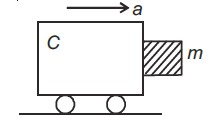
A block of mass m is in contact with the cart. The coefficient of static friction between the block and the cart is ü. The acceleration a of the cart that prevent the block from falling will be


neet pseudo force questions

1. a> (mg/ü)
2. a> (g/ü.m)
3. a ≥ (g/ü)
4. a ≤ (g/ü)
View Answer

The condition to prevent the block from falling is that the friction force must be at least equal to the weight of the block:

fsmgf_s \geq mg

Since static friction is given by fs=μNf_s = \mu N and the normal force is due to pseudo force N=maN = ma, we get:

μmamg\mu ma \geq mg

Dividing both sides by μm\mu m:

agμa \geq \frac{g}{\mu}

Thus, the required acceleration of the cart is agμa \geq \frac{g}{\mu}.