Which of the Following is Wrong about “Action and Reaction pair”
Action and Reaction forces cannot cancel each other to have zero resultant because they act on two different bodies
Which of the Following is Wrong about “Action and Reaction pair”
Action and Reaction forces cannot cancel each other to have zero resultant because they act on two different bodies
When a horse pulls a cart, the force that helps the horse to move forward is the force exerted by
Horse applies force on earth at certain angle. In turn earth apply force on horse horizontal component of this force helps the horse and cart to move forward.
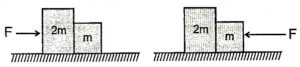
Two blocks are in contact on a frictionless table. One has mass m and the other 2 m. A force F is applied on 2 m as shown in the figure. Now the same force F is applied from the right on m. In the two cases respectively, the ratio of force of contact between the two blocks will be:

Acceleration of the blocks in both the case will be F/3m.

N1= m.a
N2= 2m.a
so N1/N2= 1/2
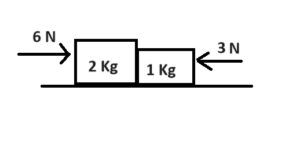
Two forces of 6N and 3N are acting on the two blocks of 2kg and 1 kg kept on frictionless floor. What is the force exerted on 2kg block by 1 kg block?
Net force is 6N-3N= 3N
Accleration of the system is 3N/3Kg = 1 m/s^2

Net Force on 1kg object is N1 - 3= 1*1 so, N1 = 4N
A block of mass M is placed on a fixed smooth inclined plane of inclination ‘A’ with the horizontal is at rest. The force exerted by the plane on the block has a magnitude:
As the object on inclined plane is at rest net force acting on the object is zero. Force applied on object by earth is Mg. Resultant of Normal reaction and friction force will cancel gravitational force. So the force applied by inclined plane on block is Mg in vertically upward direction.
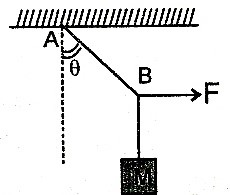
A mass M is suspended by a rope from a rigid support at A as shown in figure. Another rope is tied at the end B, and it is pulled horizontally with a force F. If the rope AB makes an angle θ with the vertical in equilibrium, then the tension in the string AB is:


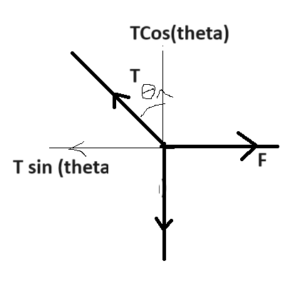
Let us see the Free body Diagram of the arrangement

For Equilibrium, T Cos θ = Mg and T Sin θ = F ;
As, T Sin θ = F ; T= F/ Sinθ
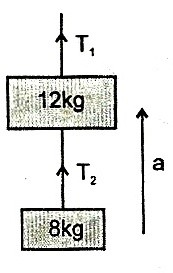
A body of mass 8 kg is hanging from another body of mass 12 kg. The combination is being pulled by a string with an acceleration of 2.2 ms-2. The tension T1 and T2 will be respectively: (use g = 9.8m/s2)

Taking both the objects as one system
T1- 20g=20a ⇒ T1= 20(g+a)=20*12= 240 N
Now taking lower object as a different system
T2-8g=8a ⇒T2=8(g+a)=8*12= 96N
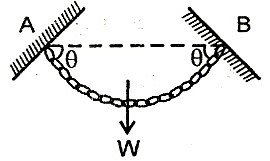
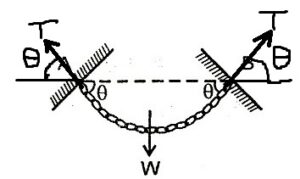
A flexible chain of weight W hangs between two fixed points A and B at the same level. The inclination of the chain with the horizontal at the two points of support is θ. What is the tension of the chain at the endpoint?


For Equilibrium in vertical direction
2T sin θ = W ⇒ T = W/(2 sin θ) = (W cosec θ) / 2
A fireman wants to slide down a rope. The rope can bear a tension of (3/4)th of the weight of the man. With what minimum acceleration should the fireman slide down:
According to the question, T=3mg/4
Using equations of motion, i.e. Fnet = m.a
⇒mg-T =ma
⇒mg-3mg/4= ma
⇒a =g/4
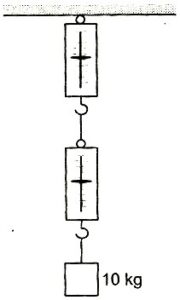
A block of mass 10 kg is suspended through two light spring balances as shown in figure

Always remember that spring balance measure Tension in the string in form of kg-wt. As tension in the string is 10 kg-wt.
Reading of Both the scales will read 10 kg