Constrained Motion - NEET Physics Questions
← Back to Laws of Motion

Constrained Motion

Question 1:

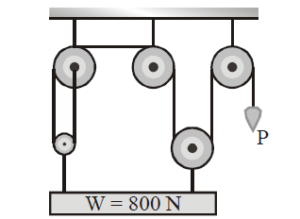
For the arrangement of pulleys shown in figure the effort (P) required to raise the given load (W) is
1. 200 N
2. 250 N
3. 800 N
4. 1000 N
View Answer

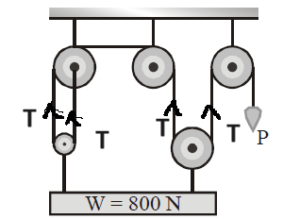
Net Force acting on the block in upward direction is 4T which will balance weight of the object. So, 

⇒ 4T= 800 N 

⇒T = 200 N
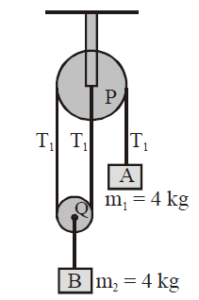
Question 2:

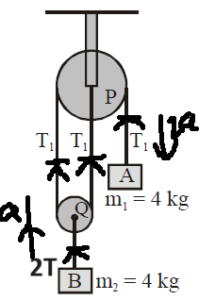
What are the acceleration of the blocks  A and B, shown in figure (in m/sec²)


1. 0,0
2. 4 m/s², 4 m/s²
3. 6 m/s², 3 m/s²
4. 4 m/s², 2 m/s²
View Answer

Writing equations of motion for the objects as,

40 - T = 4 × 2a     ---(i)

and 2T -40 = 4a    -----(ii)

Solving (i) and (ii)

a= 2 m/s²

So, acceleration of object A is 4 m/s² and for object B is 2 m/s²

Question 3:

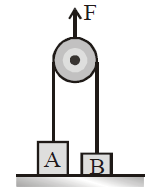
The masses of the bodies A and B in figure are 20 kg and 10 kg, respectively. They are initially at rest on the floor and are connected by a weightless string passing over a weightless and frictionless pulley. An upward force F is applied to the pulley. Find the acceleration a1 of body A and a2 of body B when F is 340 N :


1. a1 = 7 m/sec², a2 = 24 m/sec²
2. a1 = 0, a2 = 0
3. a1 = 1.5 m/sec², a2 = 7 m/sec²
4. a1 = 0 m/sec², a2 = 7 m/sec²
View Answer

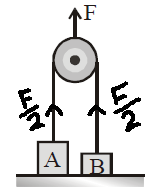
As F= 340 N. Force acting on object A in upward direction is F/2 i.e 170 N. This force is insufficient to pull the object upwards. (weight of A is greater than 170 N)

So, a1= 0 m/s²

Force acting on B in upward direction is 170 N and weight is 10g or 100 N. Net force in upward direction is 70 N. so,

a2= 7 m/s²

Question 4:

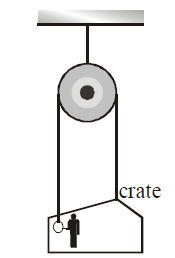
A painter is raising himself and the crate on which he stands with an acceleration of 5m/s² by a massless rope–and–pulley arrangement. Mass of painter is 100 kg and that of the crate is 50 kg. If g = 10 m/s², then :

1. Tension in the rope 2250 N
2. Tension in the rope is 1125 N
3. Force of contact between painter and the floor is 750 N
4. Force of contact between the painter and the floor is 500 N.
View Answer

Let us assume tension force in the wire is T. Then net force acting on man and crate in upward direction is 2T. Gravitational force acting in downward direction is (50+100) g = 1500 N. Writing equation of motion for the system.

2T- 1500 = 150 × a

⇒ 2T- 1500 = 150 × 5

⇒ 2T = 750 +1500 = 2250

⇒ T = 1125 N

Question 5:

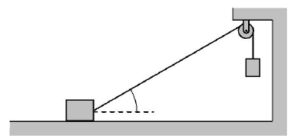
The block A is moving downward with constant velocity v0. Find the velocity of the block B, when the string makes an angle θ with the horizontal.


1. v0
2. v0 cos θ
3. v0 / cos θ
4. v0 sin θ
View Answer

When two objects are connected by a string component of velocity along the string remains equal.

v1 cosθ = v 0

⇒v1= v0/ cosθ


Question 6:

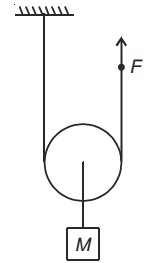
The force F needed to keep the block at equilibrium in given figure is (pulley and string are massless)

neet constrained motion questions

1. Mg/5
2. Mg/4
3. Mg/2
4. Mg/3
View Answer

For Equilibrium,

2F = Mg ⇒ F = Mg/2

Question 7:

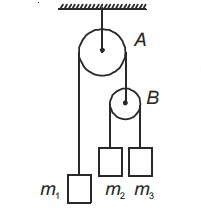
In the arrangement, shown in figure, pulleys A and B are massless and frictionless and threads are ideal. Block of mass m1 will remain at rest if: 


nlm constrained motion

1. \[ \frac{1}{m_{3}}=\frac{2}{m_{2}}+\frac{3}{m_{1}} \]
2. \[ m_{1}= m_{2}= m_{3} \]
3. \[ \frac{4}{m_{1}}=\frac{1}{m_{2}}+\frac{1}{m_{3}}\]
4. \[ \frac{1}{m_{1}}=\frac{1}{m_{2}}+\frac{1}{m_{3}}\]
View Answer

nlm constrained motion

In the movable pulley system, tension in the string connecting m2 and m3 is:

T=2m2m3gm2+m3T = \frac{2 m_2 m_3 g}{m_2 + m_3}

Since this tension acts twice to balance

m1m_1

, we equate:

2T=m1g4m2m3gm2+m3=m1g2T = m_1 g \Rightarrow \frac{4 m_2 m_3 g}{m_2 + m_3} = m_1 g

Cancelling

gg

and rearranging gives:

4m1=1m2+1m3\boxed{ \frac{4}{m_{1}} = \frac{1}{m_{2}} + \frac{1}{m_{3}} }

Question 8:

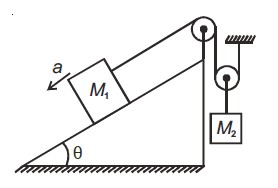
If acceleration of block m1 is a downward then acceleration of block m2 will be:

neet constraint motion questions

1. 2a upward
2. a upward
3. a/2 upward
4. 2a downward
View Answer


For ideal pulleys, the product of tension and acceleration remains constant:


T1a=T2a2T_1 a = T_2 a_2


Since

T2=2T1T_2 = 2T_1

, substitute to get:


T1a=2T1a2a2=a2T_1 a = 2T_1 a_2 \Rightarrow a_2 = \frac{a}{2}


So, M2 accelerates upward with a2\boxed{\text{So, } M_2 \text{ accelerates upward with } \frac{a}{2}}


Question 9:

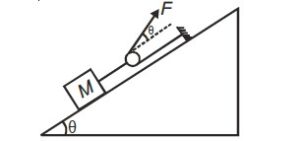
What is the minimum value of F needed so that block begins to move upward on frictionless incline plane as shown?

nlm constrainted motion quesiton 9

1. Mg tan(θ/2)
2. Mg cot(θ/2)
3. Mg.sinθ/(1+sinθ)
4. Mgsin(θ/2)
View Answer

🔹 Step-by-step:

  • Block of mass M is on a frictionless incline of angle
    \theta
     
  • Force
    FF
     

    is applied via a pulley system, split into two components:

    • One acts up along the incline: F
    • One acts horizontally, which when resolved along the incline becomes: F
      cosθF \cos \theta
       

Total upward force along incline =

F+FcosθF + F \cos \theta

Downward component of weight =

MgsinθMg \sin \theta


🔹 For the block to just start moving upward:

F+Fcosθ=Mgsinθ F(1+cosθ)=Mgsinθ F=Mgsinθ1+cosθF = \frac{Mg \sin \theta}{1 + \cos \theta}

Now use the identity:

sinθ1+cosθ=cot(θ2)\frac{\sin \theta}{1 + \cos \theta} = \cot\left(\frac{\theta}{2}\right)

 Final Answer:

F=Mgcot(θ2)\boxed{F = Mg \cot\left(\frac{\theta}{2}\right)}


Question 10:

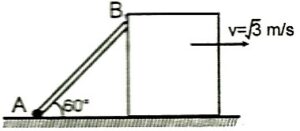
A rod AB is shown in figure. End A of the rod is fixed on the ground. Block is moving with velocity √3 m/s towards right. The velocity of end B of rod when rod makes an angle of 600 with the ground is:

1. √3 m/s
2. 2√3 m/s
3. √3/2 m/s
4. 3 m/s
View Answer