Laws of Motion - NEET Physics Questions
← All Chapters

Laws of Motion

Question 31: easy

A body of mass m is kept on a rough horizontal surface (coefficient of friction = μ). A horizontal force is applied on the body, but it does not move. The resultant of normal reaction and the frictional force acting on the object is given by F, where F is:

1. F = mg
2. F = μmg
3. F = mg + μmg
4. F ≤ mg(1 + μ2) 1/2
View Answer

The forces acting on the body are: Normal reaction (N=mg) (upward) and Friction force fμmg (opposing applied force)

The resultant force is:
F=N2+f2=mg2+(μmg)2=mg1+μ2F = \sqrt{N^2 + f^2} = \sqrt{mg^2 + (\mu mg)^2} = mg \sqrt{1 + \mu^2}

F \leq mg(1 + \mu^2)^{1/2}

Question 32: easy

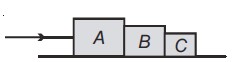
Three blocks A, B and C of masses 4 kg, 2 kg and 1 kg respectively, are in contact on a frictionless surface, as shown. If a force of 14 N is
applied on the 4 kg block, then the contact force between A and B is

connected body nlm

1. 18 N
2. 2 N
3. 8 N
4. 6 N
View Answer

The total mass of the system:

M=4+2+1=7 kgM = 4 + 2 + 1 = 7 \text{ kg}

The acceleration of the system:

a=Total ForceTotal Mass=147=2 m/s2a = \frac{\text{Total Force}}{\text{Total Mass}} = \frac{14}{7} = 2 \text{ m/s}^2

Now, considering block B and C together (mass =

2+1=32 + 1 = 3

kg), the force required to accelerate them:

FAB=(3×2)=6 NF_{AB} = (3 \times 2) = 6 \text{ N}

Thus, the contact force between A and B is 6 N.

Question 33: easy

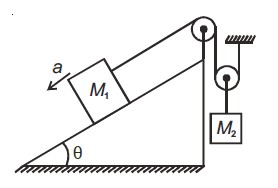
If acceleration of block m1 is a downward then acceleration of block m2 will be:

neet constraint motion questions

1. 2a upward
2. a upward
3. a/2 upward
4. 2a downward
View Answer


For ideal pulleys, the product of tension and acceleration remains constant:


T1a=T2a2T_1 a = T_2 a_2


Since

T2=2T1T_2 = 2T_1

, substitute to get:


T1a=2T1a2a2=a2T_1 a = 2T_1 a_2 \Rightarrow a_2 = \frac{a}{2}


So, M2 accelerates upward with a2\boxed{\text{So, } M_2 \text{ accelerates upward with } \frac{a}{2}}


Question 34: easy

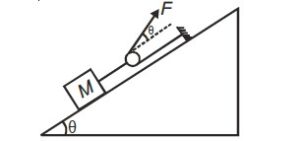
What is the minimum value of F needed so that block begins to move upward on frictionless incline plane as shown?

nlm constrainted motion quesiton 9

1. Mg tan(θ/2)
2. Mg cot(θ/2)
3. Mg.sinθ/(1+sinθ)
4. Mgsin(θ/2)
View Answer

🔹 Step-by-step:

  • Block of mass M is on a frictionless incline of angle
    \theta
     
  • Force
    FF
     

    is applied via a pulley system, split into two components:

    • One acts up along the incline: F
    • One acts horizontally, which when resolved along the incline becomes: F
      cosθF \cos \theta
       

Total upward force along incline =

F+FcosθF + F \cos \theta

Downward component of weight =

MgsinθMg \sin \theta


🔹 For the block to just start moving upward:

F+Fcosθ=Mgsinθ F(1+cosθ)=Mgsinθ F=Mgsinθ1+cosθF = \frac{Mg \sin \theta}{1 + \cos \theta}

Now use the identity:

sinθ1+cosθ=cot(θ2)\frac{\sin \theta}{1 + \cos \theta} = \cot\left(\frac{\theta}{2}\right)

 Final Answer:

F=Mgcot(θ2)\boxed{F = Mg \cot\left(\frac{\theta}{2}\right)}


Question 35: easy

A body in equilibrium will not have :

1. velocity
2. momentum
3. acceleration
4. All of the above
View Answer

For a body in equilibrium, the net external force acting on it is zero. According to Newton's second law, \(F_{\\text{net}} = ma = 0\), which means the acceleration of the body must be zero.

Question 36: easy

A vehicle of mass m is moving on a rough horizontal road with momentum P. If the coefficient of friction between the tyres and the road be \(\ \mu\), then the stopping distance is:

1. \(\frac{P}{2\mu mg}\)
2. \(\frac{P^2}{2\mu mg}\)
3. \(\frac{P}{2\mu m^2g}\)
4. \(\frac{P^2}{2\mu m^2g}\)
View Answer

The stopping distance is given by \(s = \frac{v^2}{2a}\), where the frictional retardation is \(a = \mu g\). Substituting the relation for momentum \(v = \frac{P}{m}\) into the formula yields \(s = \frac{P^2}{2\mu m^2g}\).

Question 37: easy

A projectile is thrown at a speed of \(100\text{ m/s}\) at an angle of \(37^\circ\) above the horizontal. At the highest point the projectile breaks into two parts of mass ratio \(1 : 3\), the smaller coming to rest. Find the speed of the second piece.

1. \(320/3\text{ m/s}\)
2. \(310/3\text{ m/s}\)
3. \(800/3\text{ m/s}\)
4. \(1120/3\text{ m/s}\)
View Answer

At the highest point, velocity is horizontal: \(v_x = u\cos(37^\circ) = 100 \times 0.8 = 80\text{ m/s}\). By conservation of linear momentum along the horizontal: \(m v_x = m_1 v_1 + m_2 v_2\). Here \(m_1 = m/4\) (comes to rest, \(v_1 = 0\)) and \(m_2 = 3m/4\). Thus, \(m(80) = \frac{3m}{4} v_2\), which gives \(v_2 = \frac{320}{3}\text{ m/s}\).

Question 38: easy

A large force \(f\) acts on a particle of mass \(m\) for a short time \(t\). The impulse imparted to the particle is given by

1. \(ft^2\)
2. \(\frac{f}{t}\)
3. \(\frac{f}{t^2}\)
4. \(ft\)
View Answer

Impulse is defined as the product of the average force and the short time interval over which it acts, i.e., \(\text{Impulse} = f \times t\).

Question 39: easy

A block of mass \(20\text{ kg}\) is placed on a rough horizontal surface, and it is acted upon by a horizontal force of \(40\text{ N}\). If the coefficient of friction is \(0.2\), then the acceleration of the block is

1. \(2\text{ m/s}^2\)
2. \(3\text{ m/s}^2\)
3. Zero
4. \(1\text{ m/s}^2\)
View Answer

The maximum limiting frictional force is \(f_{max} = \mu m g = 0.2 \times 20 \times 10 = 40\text{ N}\) (using \(g = 10\text{ m/s}^2\)). Since the applied force of \(40\text{ N}\) is equal to the limiting friction, the net horizontal force on the block is zero, resulting in zero acceleration.

Question 40: easy

A ball of mass \(0.15\text{ kg}\) is dropped from a height \(10\text{ m}\), strikes the ground and rebounds to the same height. The magnitude of impulse imparted to the ball is (\(g = 10\text{ m/s}^2\)) nearly

1. 1.4 kg m/s
2. 0 kg m/s
3. 4.2 kg m/s
4. 2.1 kg m/s
View Answer

The velocity of the ball just before striking the ground is \(u = \sqrt{2gh} = \sqrt{2 \times 10 \times 10} = 14.14\text{ m/s}\). Since it rebounds to the same height, its velocity just after is \(v = 14.14\text{ m/s}\) upwards. The change in momentum is \(Delta p = m(v - (-u)) = 2mu = 2 \times 0.15 \times 14.14 \approx 4.24\text{ kg m/s}\).