Laws of Motion - NEET Physics Questions
← All Chapters

Laws of Motion

Question 21: moderate

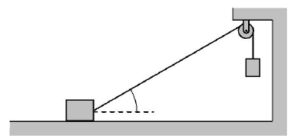
The block A is moving downward with constant velocity v0. Find the velocity of the block B, when the string makes an angle θ with the horizontal.
 

1. v0
2. v0 cos θ
3. v0 / cos θ
4. v0 sin θ
View Answer

When two objects are connected by a string component of velocity along the string remains equal.

v1 cosθ = v 0

⇒v1= v0/ cosθ
 

Question 22: moderate

Which of the following option is correct regarding given statements :-
(I) It is possible for an object to have motion in the absence of forces on the object.
(II) It is possible to have forces on an object in the absence of motion of the object.

1. Only (I) is correct
2. Only (II) is correct
3. Both (I) & (II) are correct
4. neither (I) nor (II) is correct
View Answer

Statement  I is correct because in absence of force object can move with constant velocity.

Statement II is correct because if many forces act on an object such that resultant is zero, the object will be in static equilibrium

Question 23: moderate

An object experiences no acceleration which of the following can NOT be true for the object 

1. A single force acts on the object
2. No forces act on the object
3. Forces act on the object, but the forces cancel
4. All of the above
View Answer

If only one force acts on the object it will be the net force. So the object will accelerate and it can't be at rest

Question 24: moderate

In a general debate on topic “normal reaction and mg never form action and reaction pair” a number
of students  took part :-
(I) Navneet said – Action and reaction forces should be of same nature
(II) Anand said – Action and reaction forces act on two different bodies here, normal reaction and mg both are acting on the block.
(III) Meenakshi said – Action and Reaction forces balance each other. So, normal reaction and mg should be action and reaction pair.

Mark correct option as your judgement 

1. All are correct
2. Only III is correct
3. Both (I) & (II) are correct
4. All are incorrect
View Answer

The correct option is:

(II) Anand is correct.

Explanation:
Action and reaction forces act on two different bodies, as per Newton's third law. Normal reaction and gravitational force (mg) both act on the same block, so they cannot form an action-reaction pair.

Question 25: moderate

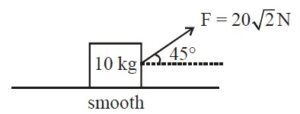
Acceleration of the block is :

1. 1 m/s²
2. 2 m/s²
3. 3 m/s²
4. 4 m/s²
View Answer

Horizontal component of force is F cosθ = 20√2 cos 45° = 20√2 × 1/√2 = 20 N.

So, Horizontal acceleration =  20N / 10kg  = 2m/s²

Question 26: moderate

A hammer of man 1 kg moving with a speed of 6 m/sec strikes a wall and comes to rest in 0.1 sec find average retarding force that stops the hammer :

1. 40 N
2. 50 N
3. 60 N
4. None of these
View Answer

According to Newtons second law of motion, Force is time rate of change in momentum.

So, F = change in momentum / time

F= m (vf-vi)/t= 1 kg (0-6)/0.1= -60 N

Question 27: moderate

A 5 kg block is resting on a frictionless plane, it is struck by a Jet, releasing water at the rate of 4 kg/sec emerging with a speed of 5 m/sec. Calculate the initial acceleration of block :

1. 4 m/sec²
2. 3 m/sec²
3. 5 m/sec²
4. 8 m/sec²
View Answer

Force acting on the object is F = v.(dm/dt)= 5×4 = 20 N

so Acceleration is a= F/m = 20/5 = 4 m/s²

Question 28: moderate

A body of mass 1 kg is acted upon by two perpendicular forces of 8 N and 6 N, find the magnitude of acceleration :

1. 10 m/sec²
2. 6 m/sec²
3. 8 m/sec²
4. 20 m/sec²
View Answer

Resultant force on the object will be F= (8² + 6²)½= 10 N

So, acceleration is a = F/m = 10/1 = 10 m/s²

Question 29: moderate

A small block slides without friction down an inclined plane starting from rest. Let Sn be the distance travelled from time t = n – 1 to t = n. Then Sn/Sn+1 is :

1. 2n-1/2n
2. 2n+1/2n-1
3. 2n-1/2n+1
4. 2n/2n+1
View Answer

Sn = u + a/2(2n-1) = a/2(2n-1)

Sn+1 = u + a/2(2(n+1)-1) = a/2(2n+1)

Sn / Sn+1 = (2n-1)/(2n+1)

Question 30: moderate

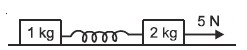
Two blocks of masses 1 kg and 2 kg are connected with massless spring as shown. If the acceleration of 1 kg block is 1 m/s² towards right then the acceleration of 2 kg block is: 

NLM Question NEET Physics

1. 2 m/s²
2. 1 m/s²
3. 3 m/s²
4. 5 m/s²
View Answer

Spring force acting on 1 kg block is F = m.a = 1 N

NLM Question NEET Physics

Same spring force will act on 2 kg block in opposite direction. Thus net force acting on 2 kg block is 5N - 1 N = 4N

Acceleration of the block will be 4 N/2 kg = 2 m/s²