A trolley of mass 8 kg is standing on a frictionless surface inside which an object of mass 2 kg is suspended. A constant force F starts acting on the trolley as a result of which the string stood at an angle of 370 from the vertical (bob at rest relative to trolley) Then:
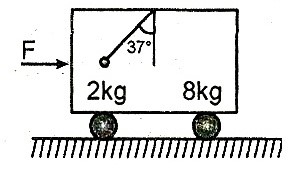
1. acceleration of the trolley is 40/3 m/sec.sec
2. force applied is 60 N
3. force applied is 75 N
4. force applied is 25 N
View Answer
Using concept of Pseudo force
a= g tanθ
⇒ a = g tan 37 = 10 ×3/4= 7.5 m/s^2
Using Equation of motion
⇒Fnet = 10×2.5 = 25 N
Consider the following two statements:
(A) Linear momentum of a system of particles is zero
(B) Kinetic energy of a system of particles is zero
Then:
1. A does not imply B and B does not imply A
2. A implies B but B does not imply A
3. A does not imply B but B implies A
4. A implies B and B implies A
View Answer
When kinetic energy of the system is zero, speed of objects will be zero so momentum will always be zero.
Whereas momentum being a vector quantity may be zero when directions of velocities cancel each other. so speed and kinetic energy may of may not be zero when momentum is zero
A rocket of mass 6000 kg is set for vertical firing. If the exhaust speed be 1 km/s how much gas must be ejected to give the rocket an upward acceleration of 20 m/s² (neglect gravity) :-
1. 45 kg/sec
2. 90 kg/sec
3. 120 kg/sec
4. 12 × 10 ^4 kg/sec
View Answer
According to Newtons second law of motion
F= v. dm/dt
so, acceleration = v. (dm/dt)/m
⇒ 20 m/s² = 1000 ×(dm/dt)/6000
⇒dm/dt = 120 kg/sec
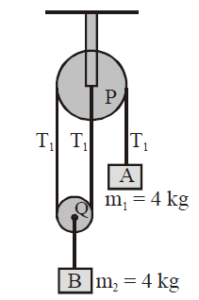
What are the acceleration of the blocks A and B, shown in figure (in m/sec²)
1. 0,0
2. 4 m/s², 4 m/s²
3. 6 m/s², 3 m/s²
4. 4 m/s², 2 m/s²
View Answer
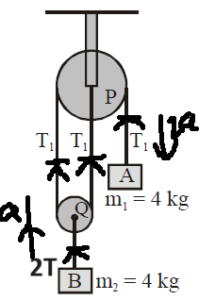
Writing equations of motion for the objects as,
40 - T = 4 × 2a ---(i)
and 2T -40 = 4a -----(ii)
Solving (i) and (ii)
a= 2 m/s²
So, acceleration of object A is 4 m/s² and for object B is 2 m/s²
The masses of the bodies A and B in figure are 20 kg and 10 kg, respectively. They are initially at rest on the floor and are connected by a weightless string passing over a weightless and frictionless pulley. An upward force F is applied to the pulley. Find the acceleration a1 of body A and a2 of body B when F is 340 N :
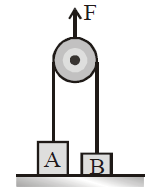
1. a1 = 7 m/sec², a2 = 24 m/sec²
2. a1 = 0, a2 = 0
3. a1 = 1.5 m/sec², a2 = 7 m/sec²
4. a1 = 0 m/sec², a2 = 7 m/sec²
View Answer
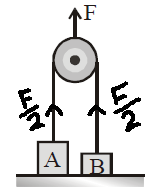
As F= 340 N. Force acting on object A in upward direction is F/2 i.e 170 N. This force is insufficient to pull the object upwards. (weight of A is greater than 170 N)
So, a1= 0 m/s²
Force acting on B in upward direction is 170 N and weight is 10g or 100 N. Net force in upward direction is 70 N. so,
a2= 7 m/s²