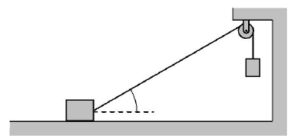
What are the acceleration of the blocks A and B, shown in figure (in m/sec²)
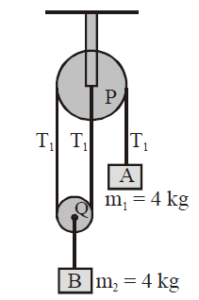
1. 0,0
2. 4 m/s², 4 m/s²
3. 6 m/s², 3 m/s²
4. 4 m/s², 2 m/s²
View Answer
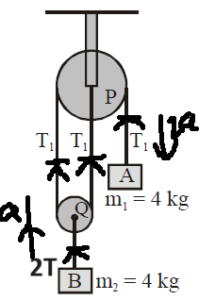
Writing equations of motion for the objects as,
40 - T = 4 × 2a ---(i)
and 2T -40 = 4a -----(ii)
Solving (i) and (ii)
a= 2 m/s²
So, acceleration of object A is 4 m/s² and for object B is 2 m/s²
The masses of the bodies A and B in figure are 20 kg and 10 kg, respectively. They are initially at rest on the floor and are connected by a weightless string passing over a weightless and frictionless pulley. An upward force F is applied to the pulley. Find the acceleration a1 of body A and a2 of body B when F is 340 N :
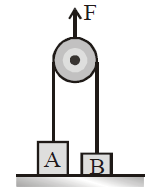
1. a1 = 7 m/sec², a2 = 24 m/sec²
2. a1 = 0, a2 = 0
3. a1 = 1.5 m/sec², a2 = 7 m/sec²
4. a1 = 0 m/sec², a2 = 7 m/sec²
View Answer
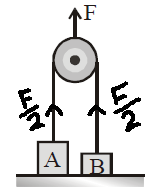
As F= 340 N. Force acting on object A in upward direction is F/2 i.e 170 N. This force is insufficient to pull the object upwards. (weight of A is greater than 170 N)
So, a1= 0 m/s²
Force acting on B in upward direction is 170 N and weight is 10g or 100 N. Net force in upward direction is 70 N. so,
a2= 7 m/s²
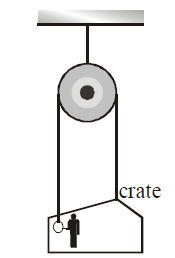
A painter is raising himself and the crate on which he stands with an acceleration of 5m/s² by a massless rope–and–pulley arrangement. Mass of painter is 100 kg and that of the crate is 50 kg. If g = 10 m/s², then :
1. Tension in the rope 2250 N
2. Tension in the rope is 1125 N
3. Force of contact between painter and the floor is 750 N
4. Force of contact between the painter and the floor is 500 N.
View Answer
Let us assume tension force in the wire is T. Then net force acting on man and crate in upward direction is 2T. Gravitational force acting in downward direction is (50+100) g = 1500 N. Writing equation of motion for the system.
2T- 1500 = 150 × a
⇒ 2T- 1500 = 150 × 5
⇒ 2T = 750 +1500 = 2250
⇒ T = 1125 N
Which of the following option is correct regarding given statements :-
(I) It is possible for an object to have motion in the absence of forces on the object.
(II) It is possible to have forces on an object in the absence of motion of the object.
1. Only (I) is correct
2. Only (II) is correct
3. Both (I) & (II) are correct
4. neither (I) nor (II) is correct
View Answer
Statement I is correct because in absence of force object can move with constant velocity.
Statement II is correct because if many forces act on an object such that resultant is zero, the object will be in static equilibrium
An object experiences no acceleration which of the following can NOT be true for the object
1. A single force acts on the object
2. No forces act on the object
3. Forces act on the object, but the forces cancel
4. All of the above
View Answer
If only one force acts on the object it will be the net force. So the object will accelerate and it can't be at rest
Generally it is said “Normal reaction always acts perpendicular to the surface of contact” :
1. The statement is always correct
2. The statement is some times correct
3. The statement is correct
4. I can not comment, the way you have designed the question made me speech less.
View Answer
Normal reaction force is always normal ( Perpendicular ) to the surface.
In a general debate on topic “normal reaction and mg never form action and reaction pair” a number
of students took part :-
(I) Navneet said – Action and reaction forces should be of same nature
(II) Anand said – Action and reaction forces act on two different bodies here, normal reaction and mg both are acting on the block.
(III) Meenakshi said – Action and Reaction forces balance each other. So, normal reaction and mg should be action and reaction pair.
Mark correct option as your judgement
1. All are correct
2. Only III is correct
3. Both (I) & (II) are correct
4. All are incorrect
View Answer
The correct option is:
(II) Anand is correct.
Explanation:
Action and reaction forces act on two different bodies, as per Newton's third law. Normal reaction and gravitational force (mg) both act on the same block, so they cannot form an action-reaction pair.