Electrostatics - NEET Physics Questions
← All Chapters

Electrostatics

Question 11: difficult

It is required to hold equal charges q in equilibrium at the corners of a square. What charge when placed at the centre of the square will do this ?

1. \[ -\frac{q}{2}\left( 1+2\sqrt{2} \right)\]
2. \[ \frac{q}{2}\left( 1+2\sqrt{2} \right)\]
3. \[ \frac{q}{4}\left( 1+2\sqrt{2} \right)\]
4. \[ -\frac{q}{4}\left( 1+2\sqrt{2} \right)\]
View Answer

To hold equal charges \(q\) in equilibrium at the corners of a square, we need to place a charge \(Q\) at the center of the square such that the net force on each corner charge due to other charges is balanced.

1. Force due to corner charges:
Each charge \(q\) at the corners experiences repulsive forces due to the other three corner charges. The net force from these three charges is:
\[
F_{\text{corners}} = q \cdot \frac{1}{4\pi\varepsilon_0} \left( \frac{2}{a^2} + \frac{\sqrt{2}}{a^2} \right) = \frac{q^2}{4\pi\varepsilon_0 a^2} \left( 2 + \sqrt{2} \right),
\]
where \(a\) is the side of the square.

2. Force due to center charge \(Q\):
The attractive force due to the central charge \(Q\) on each corner charge is:
\[
F_{\text{center}} = \frac{1}{4\pi\varepsilon_0} \cdot \frac{qQ}{r^2},
\]
where \(r = \frac{a}{\sqrt{2}}\) is the distance from the center to a corner. Substituting \(r\):
\[
F_{\text{center}} = \frac{qQ}{4\pi\varepsilon_0 \cdot \frac{a^2}{2}} = \frac{2qQ}{4\pi\varepsilon_0 a^2}.
\]

3. Equilibrium condition:
For equilibrium, \(F_{\text{corners}} = F_{\text{center}}\):
\[
\frac{q^2}{4\pi\varepsilon_0 a^2} \left( 2 + \sqrt{2} \right) = \frac{2qQ}{4\pi\varepsilon_0 a^2}.
\]

4. Solve for \(Q\):
\[
Q = \frac{q}{2} \left( 2 + \sqrt{2} \right).
\]
Since \(Q\) is opposite in sign to \(q\), the final charge is:
\[
Q = -\frac{q}{4} \left( 1 + 2\sqrt{2} \right).
\]

Thus, the required charge at the center is:

\[
Q = -\frac{q}{4} \left( 1 + 2\sqrt{2} \right).
\]
Question 12: difficult

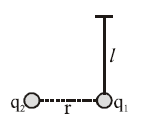
An isolated charge q1 of mass m is suspended freely by a thread of length l. Another charge q2 is brought near it (r >>l). When q1 is equilibrium, tension in thread will be :

1. mg
2. >mg
3. <mg
4. none of these
View Answer

Solution Outline:

1. Forces Acting on \( q_1 \):
- Gravitational Force: \( F_g = mg \), acting vertically downward.
- Electrostatic Force: \( F_e = \frac{k |q_1 q_2|}{r^2} \), acting horizontally toward \( q_2 \).

2. Resultant Tension \( T \)
Since \( q_1 \) is in equilibrium, the tension \( T \) in the thread must balance both the gravitational and electrostatic forces. The tension will act diagonally, with components to counteract both the vertical \( mg \) and horizontal \( F_e \) forces.

3. Calculating \( T \):
Using vector addition, we find \( T \) as:
\[
T = \sqrt{(mg)^2 + \left( \frac{k |q_1 q_2|}{r^2} \right)^2}
\]

Since \( \frac{k |q_1 q_2|}{r^2} \) is a positive quantity, \( T \) is indeed greater than \( mg \).

Conclusion:
The correct answer is:
\[
T > mg
\]

Question 13: difficult

Two pith balls each with mass m are suspended from insulating threads. When the pith balls are given equal positive charge Q, they hang in equilibrium as shown. We now increase the charge on the left pith ball from Q to 2Q while leaving its mass essentiality unchanged. Which of the following diagrams best represents the new equilibrium configuration?

1.
2.
3.
4.
View Answer

From Newton's Third Law of Motion forces acting on both the charges are equal.

\[ tan \theta = \frac{F}{mg} \]

So angle made by them with vertical will also be equal. But the value of θ will increase because force is increasing due to increase in charge.

Question 14: difficult

Four charges q1 = lμC, q2 = 2μC , q3 = 3μC and q4 = 4μC are placed at (0, 0, 0), (1m, 0, 0) (0, 1m, 0) and (0, 0, 1m) respectively. Let\( \overrightarrow{F_{i}} \)be the net force acting on i^{th} charge of the given charges then \( \Sigma \overrightarrow{F_{i}} = ……… :\)

1. 0.018 N
2. 0.02 N
3. 0.036 N
4. zero
View Answer

To find \(\sum \overrightarrow{F_i}\), the vector sum of forces acting on each charge in the system, we can apply Newton's third law:

1. Newton's Third Law:
- For any pair of charges, the force exerted by one charge on another is equal in magnitude and opposite in direction to the force exerted by the second charge on the first.

2. Net Force on System:
- Since each pair of charges in the system exerts equal and opposite forces on each other, all internal forces cancel out in pairs.

3. Resultant Force:
- As a result, the net force on the entire system of charges is zero.

Conclusion:

The total force \(\sum \overrightarrow{F_i} = 0\).

Question 15: difficult

Two equal negative charges each –q, are placed at points (0, a) and (0,–a) on y–axis. A positive charge q is released from point (2a, 0). This charge will be :

1. execute SHM about the origin
2. oscillate but not execute SHM
3. move towards origin and will become stationary
4. execute SHM along y-axis
View Answer

To analyze the motion of the positive charge \( +q \) released from point \( (2a, 0) \), let's consider the forces acting on it due to the two fixed negative charges \( -q \) at points \( (0, a) \) and \( (0, -a) \).

Solution Steps:

1. Symmetry of Forces:
- Each negative charge \( -q \) exerts an attractive force on \( +q \) along the line joining them.
- Due to symmetry, the vertical components of these forces (along the y-axis) will cancel out, while the horizontal components (along the x-axis) will add up, pulling \( +q \) toward the y-axis.

2. Resultant Force Direction:
- The resultant force always points toward the y-axis but varies with distance from it.
- The force does not follow a linear restoring force law (i.e., it’s not proportional to displacement), which is required for simple harmonic motion (SHM).

3. Motion of \( +q \):
- The charge \( +q \) will oscillate back and forth across the y-axis due to the attractive forces from the two fixed charges.
- However, since the force is not proportional to displacement, the motion is **not SHM**.

Conclusion:
The positive charge \( +q \) will oscillate but will not execute SHM.

Question 16: difficult

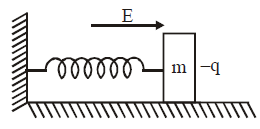
A block of mass m containing a net negative charge –q is placed on a frictionless horizontal table and is connected to a wall through an
unstretched spring of spring constant k. If the horizontal electric field E parallel to the spring is switched on, then the maximum compression
of the spring is :-

1. \sqrt{qE/k}
2. 2qE/k
3. qE/k
4. zero
View Answer
Question 17: difficult

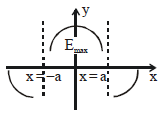
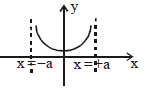
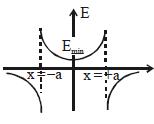
As shown in the figure a positive charge +q is placed at x = –a and negative charge –q is placed at x = + a. Then choose the curve which shows variation of E along the x-axis :

1.
2.
3.
4. none of these
View Answer

The figure represents the electric field (E) along the \(x\)-axis due to a dipole consisting of a positive charge (\(+q\)) at \(x = -a\) and a negative charge (\(-q\)) at \(x = +a\).

The electric field due to such a dipole varies as follows:

1. Near \(x = -a\): The field is dominated by the positive charge, so it points away from \(x = -a\).
2. Near \(x = +a\): The field is dominated by the negative charge, so it points toward \(x = +a\).
3. Between \(x = -a\) and \(x = +a\): The contributions from both charges partially cancel out, leading to a local minimum in the field magnitude.
4. Far from the charges (\(|x| \gg a\)): The field behaves approximately as a dipole field, decreasing as \(1/x^3\).

The attached graph correctly shows these features:
- A local minimum in \(E\) between \(x = -a\) and \(x = +a\), at the midpoint where the dipole effect is weakest.
- The field magnitude diverges near \(x = -a\) and \(x = +a\) due to the proximity to the charges.
- Symmetry around the origin is preserved, as the system is symmetric about \(x = 0\).

Question 18: difficult

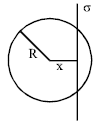
An infinite, uniformly charged sheet with surface charge density σ cuts through a spherical Gaussian surface of radius R at a distance x from its center, as shown in the figure. The electric flux Φ through the Gaussian surface is :

1. \[ \frac{\pi R^{2}\sigma}{\varepsilon_{0}}\]
2. \[ \frac{2\pi \left( R^{2}-x^{2} \right)\sigma}{\varepsilon_{0}}\]
3. \[ \frac{\pi \left( R-x \right)^{2}\sigma}{\varepsilon_{0}}\]
4. \[ \frac{\pi \left( R^{2}-x^{2} \right)\sigma}{\varepsilon_{0}}\]
View Answer

The electric flux \(\Phi\) through the Gaussian surface can be found using Gauss's law:

\[
\Phi = \frac{q_{\text{enc}}}{\epsilon_0}
\]

Here, \(q_{\text{enc}}\) is the charge enclosed by the spherical Gaussian surface.

Since the infinite sheet has a uniform surface charge density \(\sigma\), the charge enclosed is the product of \(\sigma\) and the area of the sheet that lies inside the sphere. The area of the sheet within the sphere is the area of the circle formed by the intersection, which has a radius \(r\) determined by the geometry of the sphere and the plane.

1. The radius of the intersection circle is \(r = \sqrt{R^2 - x^2}\).
2. The area of this circle is \(A = \pi r^2 = \pi (R^2 - x^2)\).

Thus, the enclosed charge is:

\[
q_{\text{enc}} = \sigma A = \sigma \pi (R^2 - x^2).
\]

Substituting this into Gauss's law:

\[
\Phi = \frac{\sigma \pi (R^2 - x^2)}{\epsilon_0}.
\]

So, the electric flux through the Gaussian surface is:

\[
\Phi = \frac{\sigma \pi (R^2 - x^2)}{\epsilon_0}.
\]

Question 19: difficult

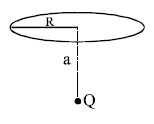
A point charge Q is located on the axis of a disc of radius R at a distance a from the plane of the disc. If one fourth (1/4th) of the flux from the charge passes through the disc, then find the relation between a & R.


1. a = R/2
2. \[ a =\frac{R}{\sqrt{3}}\]
3. a = R
4. \[ a =\frac{R}{\sqrt{2}}\]
View Answer

To solve the problem using the formula:

\[
\Phi = \frac{Q}{2\varepsilon_0} \left(1 - \cos\theta\right),
\]

where \(\theta\) is the half-angle subtended by the disc at the charge, follow these steps:

1. The flux through the disc is given to be one-fourth of the total flux:
\[
\Phi = \frac{1}{4} \cdot \frac{Q}{\varepsilon_0}.
\]

Substituting this into the formula:
\[
\frac{1}{4} \cdot \frac{Q}{\varepsilon_0} = \frac{Q}{2\varepsilon_0} \left(1 - \cos\theta\right).
\]

2. Simplify:
\[
\frac{1}{4} = \frac{1}{2} \left(1 - \cos\theta\right).
\]

3. Multiply through by 2:
\[
\frac{1}{2} = 1 - \cos\theta.
\]

4. Solve for \(\cos\theta\):
\[
\cos\theta = 1 - \frac{1}{2} = \frac{1}{2}.
\]

5. Using the geometry, \(\cos\theta = \frac{a}{\sqrt{a^2 + R^2}}\). Substituting:
\[
\frac{a}{\sqrt{a^2 + R^2}} = \frac{1}{2}.
\]

6. Square both sides:
\[
\frac{a^2}{a^2 + R^2} = \frac{1}{4}.
\]

7. Rearrange:
\[
4a^2 = a^2 + R^2.
\]

\[
3a^2 = R^2.
\]

8. Solve for \(a\):
\[
a = \frac{R}{\sqrt{3}}.
\]

Thus, the relation is:

\[
a = \frac{R}{\sqrt{3}}.
\]

Question 20: difficult

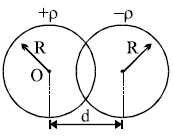
There are two non-conducting spheres having uniform volume charge densities ρ and –ρ . Both spheres have equal radius R. The spheres are
now laid down such that they overlaps as shown in the figure. The electric field \(\overrightarrow{E}\) in the overlap region is

1. non uniform
2. zero
3. \[ \frac{\rho}{3\epsilon_{0}}\overrightarrow{d}\]
4. \[ \frac{\rho}{3\epsilon_{0}}\overrightarrow{r}\]
View Answer

To calculate the electric field in the overlap region, we use the principle of superposition of electric fields. Let's analyze:

Step 1: Electric field due to one sphere
For a uniformly charged non-conducting sphere, the electric field inside the sphere at a distance \(\vec{r}\) from the center is:

\[
\vec{E}_{\text{sphere}} = \frac{\rho}{3\epsilon_0} \vec{r}
\]

Here:
- \(\rho\) is the charge density of the sphere,
- \(\epsilon_0\) is the permittivity of free space,
- \(\vec{r}\) is the position vector from the center of the sphere.

Step 2: Contribution of both spheres in the overlap region
- For the positively charged sphere (\(+\rho\)), the electric field at any point in the overlap region is directed **away** from its center, proportional to \(\vec{r}_1\) (distance from its center).
- For the negatively charged sphere (\(-\rho\)), the electric field at any point in the overlap region is directed **toward** its center, proportional to \(\vec{r}_2\) (distance from its center).

Thus, the net electric field is the vector sum:

\[
\vec{E}_{\text{net}} = \frac{\rho}{3\epsilon_0} \vec{r}_1 + \frac{-\rho}{3\epsilon_0} \vec{r}_2
\]

Step 3: Relation between \(\vec{r}_1\), \(\vec{r}_2\), and \(\vec{d}\)
In the overlap region, \(\vec{r}_1 - \vec{r}_2 = \vec{d}\), where \(\vec{d}\) is the displacement vector between the centers of the two spheres.

Substitute this into the expression for \(\vec{E}_{\text{net}}\):

\[
\vec{E}_{\text{net}} = \frac{\rho}{3\epsilon_0} (\vec{r}_1 - \vec{r}_2) = \frac{\rho}{3\epsilon_0} \vec{d}
\]

Final Answer:

The electric field in the overlap region is:

\[
{\frac{\rho}{3\epsilon_0} \vec{d}}
\]