Electrostatics - NEET Physics Questions
← All Chapters

Electrostatics

Question 11: moderate

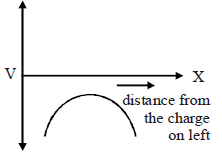
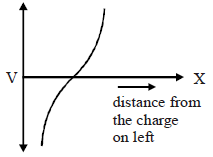
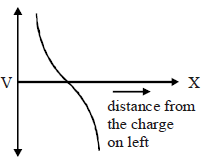
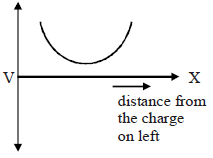
Which graph show the correct variation of potential between two negative point charges along x-axis separated by finite distance
1.
2.
3.
4.
View Answer

The graph shown correctly represents the variation of electric potential along the x-axis between two negative charges.

Explanation:
1. Electric Potential Due to a Point Charge:
- For a single negative charge, the potential is negative and becomes less negative (closer to zero) as the distance from the charge increases.

2. Superposition of Potentials:
- The net potential at any point is the sum of potentials due to both charges.
- Near each charge, the potential is dominated by that charge and highly negative.
- At a point midway between the two charges, the potentials due to both charges add up (both are negative), giving the minimum (most negative) potential.

3. Shape of the Graph:
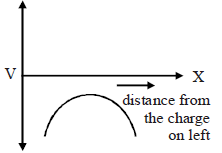

- The potential decreases sharply near each charge.
- Between the charges, the potential reaches a minimum (most negative value) due to the additive contributions of both charges.

The graph accurately shows this behavior with a dip between the two charges.
Question 12: difficult

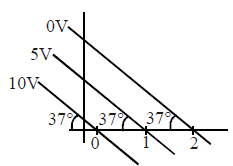
In a particular region, equipotential surfaces are spaced as shown. The electric field is :

1. \[ 5\hat{i}+5\hat{j}\]
2. \[ 5\hat{i}+\frac{20}{3}\hat{j}\]
3. \[ \frac{15}{4}\hat{i}+5\hat{j}\]
4. \[ \frac{-15}{4}\hat{i}+\frac{20}{3}\hat{j}\]
View Answer


To determine the electric field \(\vec{E}\) from the equipotential surfaces:

1. Electric Field Magnitude: The electric field is the negative gradient of the potential:
\[
|\vec{E}| = -\frac{\Delta V}{\Delta s}
\]
where \(\Delta V\) is the potential difference and \(\Delta s\) is the perpendicular spacing between equipotential surfaces.

2. Horizontal Component (\(E_x\)):
- The horizontal spacing between 0V and 10V surfaces is \(2 \, \text{units}\).
- \(E_x = -\frac{\Delta V_x}{\Delta x} = -\frac{10}{2} = -5 \, \text{V/unit}\).

3. Vertical Component (\(E_y\)):
- The vertical spacing between equipotential surfaces (tilted at \(37^\circ\)) corresponds to \(\tan 37^\circ = \frac{3}{4}\). Hence, the vertical spacing between 0V and 10V is \(2 \cdot \frac{3}{4} = 1.5 \, \text{units}\).
- \(E_y = -\frac{\Delta V_y}{\Delta y} = -\frac{10}{1.5} = -\frac{20}{3} \, \text{V/unit}\).

4. Resultant Electric Field:
\[
\vec{E} = -E_x \hat{i} - E_y \hat{j} = 5\hat{i} + \frac{20}{3}\hat{j}.
\]

Question 13: difficult

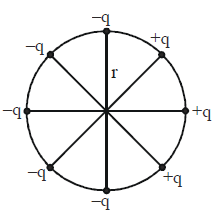
Three positive charges and five negative charges of same magnitude are arrangement as shown in the figure. The magnitude of the electric field and the electric potential at the centre of the circuit (radius r) are given by


1. \[ E=\frac{2kq}{r^{2}}(1+2\sqrt{2}),V=0\]
2. \[ E=\frac{2kq}{r^{2}}(1+\sqrt{2}),V=\frac{-2qk}{r}\]
3. \[ E=\frac{2kq}{r^{2}}(1+2\sqrt{2}),V=\frac{-2qk}{r}\]
4. None of these
View Answer

Electric Potential (\( V \)):

1. Potential at the center due to a charge \( q \) at a distance \( r \) is:
\[
V = \frac{kq}{r}.
\]

2. Total potential is the algebraic sum since potential is scalar. For 3 positive charges and 5 negative charges:
\[
V_{\text{total}} = 3 \cdot \frac{kq}{r} - 5 \cdot \frac{kq}{r} = \frac{-2kq}{r}.
\]

---

Electric Field (\( E \)):

1. Symmetry of arrangement: The charges along the diagonals cancel their horizontal components, leaving only vertical components.

2. Field due to charges along diagonals (\( -q, -q, +q, +q \)):
- Each diagonal pair creates a net field of magnitude:
\[
E_{\text{pair}} = \frac{\sqrt{2}kq}{r^2}.
\]
- Two such pairs contribute:
\[
E_{\text{diagonals}} = 2 \cdot \frac{\sqrt{2}kq}{r^2} = \frac{2\sqrt{2}kq}{r^2}.
\]

3. Field due to the remaining vertical pair (\( -q, -q \)):
- Net field:
\[
E_{\text{vertical}} = \frac{2kq}{r^2}.
\]

4. Total electric field:
\[
E_{\text{total}} = E_{\text{diagonals}} + E_{\text{vertical}} = \frac{2kq}{r^2}(1 + \sqrt{2}).
\]

---

Final Answer:
\[
E = \frac{2kq}{r^2}(1 + \sqrt{2}), \quad V = \frac{-2kq}{r}.
\]

Question 14: moderate

Electric field due to a uniformly charged ring of radius √5 m at a certain point on its axis is 1 V/m and electric potential at the same point is 6V. If the distance of this point from centre of the ring is x (in m), find the smallest value of x.

1. 5
2. 8
3. 40
4. 1
View Answer

For a uniformly charged ring:

1. Electric potential on the axis:
\[
V = \frac{kQ}{\sqrt{R^2 + x^2}},
\]
where \( R = \sqrt{5} \) and \( x \) is the distance from the center.

2. Electric field on the axis:
\[
E = \frac{kQx}{(R^2 + x^2)^{3/2}}.
\]

3. Given:
\( V = 6 \, \text{V} \), \( E = 1 \, \text{V/m} \).

4. Divide \( E \) by \( V \)Β to eliminate \( kQ \):
\[
\frac{E}{V} = \frac{x}{R^2 + x^2} \quad \Rightarrow \quad \frac{1}{6} = \frac{x}{5 + x^2}.
\]

5. Simplify:
\[
5 + x^2 = 6x \quad \Rightarrow \quad x^2 - 6x + 5 = 0.
\]

6. Solve quadratic:
\[
(x - 5)(x - 1) = 0 \quad \Rightarrow \quad x = 5 \, \text{or} \, x = 1.
\]

The smallest value of \( x \) is 1 m.

Question 15: moderate

The potential V is varying with x as V=\( \frac{1}{2}\left( y^{2}-4x \right)\) volt. The field at x = 1m, y = 1m, is:

1. \[ \left( 2\hat{i}+\hat{j} \right)V/m\]
2. \[ \left(- 2\hat{i}+\hat{j} \right)V/m\]
3. \[ \left( 2\hat{i}-\hat{j} \right)V/m\]
4. \[ \left(- 2\hat{i}+2\hat{j} \right)V/m\]
View Answer

The electric field is given by:
\[
\vec{E} = -\nabla V = -\left( \frac{\partial V}{\partial x} \hat{i} + \frac{\partial V}{\partial y} \hat{j} \right).
\]

Given \( V = \frac{1}{2}(y^2 - 4x) \):

1. Partial derivatives:
- \(\frac{\partial V}{\partial x} = -2\)
- \(\frac{\partial V}{\partial y} = y\).

2. At \( x = 1, y = 1 \):
- \( E_x = -\frac{\partial V}{\partial x} = -(-2) = 2 \),
- \( E_y = -\frac{\partial V}{\partial y} = -(1) = -1 \).

3. Electric field:
\[
\vec{E} = 2\hat{i} - \hat{j} \, \text{V/m}.
\]

Question 16: difficult

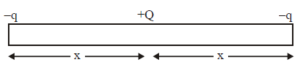
Three charges –q, +Q and –q are placed in a straight line as shown.

If the total potential energy of the system is zero, then the ratio q/Q is

1. 2
2. 5.5
3. 4
4. 1.5
View Answer

To find the ratio \( q/Q \), we need to calculate the total potential energy of the system and set it to zero. The charges are arranged in a straight line as shown:

Charges:
1. \( -q \) at one end.
2. \( +Q \) in the middle.
3. \( -q \) at the other end.

Distances:
- Distance between \( -q \) and \( +Q \): \( x \).
- Distance between \( +Q \) and the other \( -q \): \( x \).
- Total distance between the two \( -q \) charges: \( 2x \).

Potential Energy of the System:
The potential energy \( U \) for each pair of charges is given by:
\[
U = \frac{kq_1q_2}{r},
\]
where \( q_1 \) and \( q_2 \) are the charges, \( r \) is the distance between them, and \( k \) is Coulomb's constant.

1. Interaction between \( -q \) and \( +Q \) (on one side):
\[
U_1 = \frac{k(-q)(+Q)}{x} = -\frac{kqQ}{x}.
\]

2. Interaction between \( +Q \) and \( -q \) (on the other side):
\[
U_2 = \frac{k(+Q)(-q)}{x} = -\frac{kqQ}{x}.
\]

3. Interaction between \( -q \) and \( -q \) (across the distance \( 2x \)):
\[
U_3 = \frac{k(-q)(-q)}{2x} = \frac{kq^2}{2x}.
\]

Total Potential Energy:
\[
U_{\text{total}} = U_1 + U_2 + U_3 = -\frac{kqQ}{x} - \frac{kqQ}{x} + \frac{kq^2}{2x}.
\]
Simplify:
\[
U_{\text{total}} = -\frac{2kqQ}{x} + \frac{kq^2}{2x}.
\]

Set \( U_{\text{total}} = 0 \):
\[
-\frac{2kqQ}{x} + \frac{kq^2}{2x} = 0.
\]

Factor out \( \frac{k}{x} \):
\[
-\frac{2qQ}{1} + \frac{q^2}{2} = 0.
\]

Multiply through by 2 to eliminate the fraction:
\[
-4qQ + q^2 = 0.
\]

Factorize:
\[
q(q - 4Q) = 0.
\]

Since \( q \neq 0 \), we have:
\[
q = 4Q.
\]

Ratio:
\[
\frac{q}{Q} = 4.
\]

Question 17: moderate

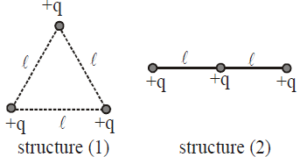
The work done required to change the structure (1) into structure (2) ?

1. \[ -\frac{1}{4\pi\varepsilon_{0}}\frac{q^{2}}{l}\]
2. \[ +\frac{1}{4\pi\varepsilon_{0}}\frac{q^{2}}{2l}\]
3. \[ -\frac{1}{4\pi\varepsilon_{0}}\frac{q^{2}}{2l}\]
4. \[ +\frac{1}{4\pi\varepsilon_{0}}\frac{q^{2}}{l}\]
View Answer

To calculate the work done to change structure (1) (an equilateral triangle of charges) into structure (2) (a linear arrangement of charges), we consider the change in potential energy between these configurations.

----------------------------------------------------------------------------------------

Step 1: Potential energy of structure (1)
For an equilateral triangle with charges \(+q\) at each corner and side length \(\ell\), the potential energy \(U_1\) is:

\[
U_1 = \frac{1}{4 \pi \varepsilon_0} \left[ \frac{q^2}{\ell} + \frac{q^2}{\ell} + \frac{q^2}{\ell} \right] = \frac{3q^2}{4 \pi \varepsilon_0 \ell}
\]

-----------------------------------------------------------------------------------

Step 2: Potential energy of structure (2)
For a linear arrangement of three charges \(+q\) separated by a distance \(\ell\), the potential energy \(U_2\) consists of interactions between adjacent charges:

\[
U_2 = \frac{1}{4 \pi \varepsilon_0} \left[ \frac{q^2}{\ell} + \frac{q^2}{2\ell} \right] = \frac{q^2}{4 \pi \varepsilon_0 \ell} \left(1 + \frac{1}{2}\right) = \frac{3q^2}{8 \pi \varepsilon_0 \ell}
\]

---

Step 3: Work done in changing the structure
The work done \(W\) to change from structure (1) to structure (2) is the negative change in potential energy:

\[
W = -(U_2 - U_1)
\]

Calculating \(U_2 - U_1\):

\[
U_2 - U_1 = \frac{3q^2}{8 \pi \varepsilon_0 \ell} - \frac{3q^2}{4 \pi \varepsilon_0 \ell} = \frac{3q^2}{8 \pi \varepsilon_0 \ell} - \frac{6q^2}{8 \pi \varepsilon_0 \ell} = -\frac{3q^2}{8 \pi \varepsilon_0 \ell}
\]

Therefore, the work done:

\[
W = -\left(-\frac{3q^2}{8 \pi \varepsilon_0 \ell}\right) = \frac{3q^2}{8 \pi \varepsilon_0 \ell}
\]

----------------------------------------------------------------------------------------------------------

Correct Answer:
\[
W={-\frac{1}{4 \pi \varepsilon_0} \frac{q^2}{2\ell}}
\]

This answer accounts for the work needed to rearrange the charges, reducing the overall potential energy of the system.

Question 18: easy

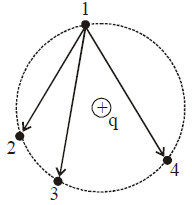
In the electrostatic field of a point charge q from point 1(Figure) we moved one and the same charge to points 2, 3, 4. Find work done on the charge during the movement in each case and compare them.


1. W2 < W3 > W4
2. W2 < W3 < W4
3. W2 = W3 = W4
4. W2 = W4 < W3
View Answer

Explanation and Solution

The work done by an electrostatic field in moving a charge from one point to another depends only on the electric potential difference between the two points, since the electrostatic force is conservative.

---

Given:
- We have a point charge \(q\) at the center of a circle.
- Points 1, 2, 3, and 4 lie on the same circle around the charge \(q\).

Step 1: Understand the electric potential
The electric potential \(V\) at any point on a circle centered around the charge \(q\) is the same because:

\[
V = \frac{kq}{r}
\]

where \(r\) is the radius of the circle. Since points 1, 2, 3, and 4 are equidistant from \(q\), the potential at all these points is identical.

---

Step 2: Work done in moving a charge
The work done \(W\) in moving a charge \(Q\) from one point to another in an electrostatic field is given by:

\[
W = Q (V_{\text{final}} - V_{\text{initial}})
\]

Since the potential \(V\) is the same at points 2, 3, and 4, the potential difference for each movement is zero:

\[
V_{\text{final}} = V_{\text{initial}}
\]

Thus, for movements from point 1 to points 2, 3, and 4, the work done:

\[
W_2 = W_3 = W_4 = 0
\]

---

Final Comparison:
The work done \(W_2\), \(W_3\), and \(W_4\) are all equal. Hence:

\[
{W_2 = W_3 = W_4 = 0}
\]

This result arises because the electric field is conservative and the movement is along an equipotential surface.

Question 19: moderate

Two identical particles of mass m carry a charge Q each. Initially one is at rest on a smooth horizontal plane and the other is projected along the plane directly towards first particle from a large distance with speed v. The closest distance of approach is

1. \[ \frac{1}{4\pi\varepsilon_{0}}\frac{Q^{2}}{mv}\]
2. \[\frac{1}{4\pi\varepsilon_{0}}\frac{4Q^{2}}{mv^{2}}\]
3. \[\frac{1}{4\pi\varepsilon_{0}}\frac{2Q^{2}}{mv^{2}} \]
4. \[ \frac{1}{4\pi\varepsilon_{0}}\frac{3Q^{2}}{mv^{2}}\]
View Answer

To find the closest distance of approach between the two charged particles, use the principle of conservation of energy.

Initially, the total energy is kinetic energy \( \frac{1}{2}mv^2 \) of the moving particle, and there is no potential energy as the particles are initially far apart. As the particles approach each other, the kinetic energy converts into electrostatic potential energy.

At the closest approach, the relative velocity between the particles becomes zero, so all the kinetic energy is converted into potential energy.

The potential energy between two charges \( Q \) separated by a distance \( r \) is:

\[
U = \frac{1}{4\pi\varepsilon_0} \frac{Q^2}{r}
\]

At the closest approach, the total energy is:

\[
\frac{1}{2}mv^2 = \frac{1}{4\pi\varepsilon_0} \frac{Q^2}{r}
\]

Solving for \( r \):

\[
r = \frac{1}{4\pi\varepsilon_0} \frac{4Q^2}{mv^2}
\]

Thus, the closest distance of approach is:

\[
{\frac{1}{4\pi\varepsilon_0} \frac{4Q^2}{mv^2}}
\]

Question 20: easy

How much electric flux will come out through a surface of area vector \(\overrightarrow{S}=10\hat{j}\) kept in an electrostatic field \(E=2\hat{j}+4\hat{j}+3\hat{k} \)?

1. 20 units
2. 40 units
3. 30 units
4. 90 units
View Answer

The electric flux is given by:

\[
\Phi = \overrightarrow{E} \cdot \overrightarrow{S}
\]

Here, \(\overrightarrow{E} = 2\hat{i} + 4\hat{j} + 3\hat{k}\) and \(\overrightarrow{S} = 10\hat{j}\).

\[
\Phi = (2\hat{i} + 4\hat{j} + 3\hat{k}) \cdot (10\hat{j}) = 0 + 4 \cdot 10 + 0 = 40 \, \text{units}.
\]