Electromagnetic Induction - NEET Physics Questions
← All Chapters

Electromagnetic Induction

Question 51: moderate

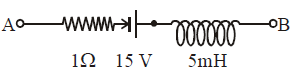
The network shown in the figure is a part of a complete circuit. If at a certain instant the current i is 5 A and is decreasing at the rate of 10³A/s then \(V_{B}-V_{A}\) is :
1. 5 V
2. 10 V
3. 15 V
4. 20 V
View Answer
Question 52: moderate

An ideal coil of 10H is connected in series with a resistance of 5Ω and a battery of 5V. 2 seconds after the connection is made, the current flowing in amperes in the circuit is :

1. (1 - e)
2. e
3. \[e^{-1}\]
4. \[\left( 1-e^{-1} \right)\]
View Answer
Question 53: moderate

In step-down transformer of turn ratio 6 : 1, an alkali accumulator of 12 V; 3A is connected to the primary. Then the voltage developed in its secondary is :

1. 2V
2. 72V
3. 2/3 V
4. zero
View Answer

The voltage developed in the secondary is zero.

A transformer operates on the principle of mutual induction, which requires a changing magnetic flux produced by Alternating Current (AC). Since an alkali accumulator provides Direct Current (DC), the magnetic flux remains constant, and no electromotive force (EMF) is induced in the secondary coil.

Question 54: easy

The expression for magnetic induction inside a solenoid of length \(L\) carrying a current \(I\) and having \(N\) number of turns is:

1. \(\frac{\mu_0 N}{4\pi L I}\)
2. \(\mu_0 N I\)
3. \(\frac{\mu_0}{4\pi} N L I\)
4. \(\mu_0 \frac{N}{L} I\)
View Answer

Magnetic field inside a long solenoid is given by \(B = \mu_0 n I\), where \(n = \frac{N}{L}\) is the number of turns per unit length. Therefore, \(B = \mu_0 \frac{N}{L} I\).

Question 55: easy

A coil has 200 turns and area of \(70\text{ cm}^2\). The magnetic field perpendicular to the plane of the coil is \(0.3\text{ Wb m}^{-2}\) and takes \(0.1\text{ s}\) to rotate through \(180^\circ\). The value of the induced E.M.F. will be:

1. \(8.4\text{ V}\)
2. \(84\text{ V}\)
3. \(42\text{ V}\)
4. \(4.2\text{ V}\)
View Answer

Change in flux \(\Delta \Phi = 2NBA = 2 \times 200 \times 0.3 \times (70 \times 10^{-4}) = 0.84\text{ Wb}\). Induced EMF is \(e = \frac{\Delta \Phi}{\Delta t} = \frac{0.84}{0.1} = 8.4\text{ V}\).

Question 56: easy

If a current is passed through a spring then the spring will:

1. expand
2. compress
3. remains same
4. none of these
View Answer

Current flows in the same direction in adjacent turns of the spring. Since parallel currents in the same direction attract each other, the turns of the spring are pulled closer, causing the spring to compress.

Question 57: easy

In a step up transformer, the voltage in the primary is \(220\text{ V}\) and the current is \(5\text{ A}\). The secondary voltage is found to be \(22000\text{ V}\). The current in the secondary coil (neglect losses) is:

1. \(5\text{ A}\)
2. \(50\text{ A}\)
3. \(500\text{ A}\)
4. \(0.05\text{ A}\)
View Answer

In an ideal transformer, input power equals output power: \(V_p I_p = V_s I_s\). Therefore, \(I_s = \frac{V_p I_p}{V_s} = \frac{220 \times 5}{22000} = 0.05\text{ A}\).

Question 58: easy

An aeroplane in which the distance between the tips of the wings is \(50\text{ m}\) is flying horizontally with a speed of \(360\text{ km/hr}\) over a place where the vertical component of earth’s magnetic field is \(2 \times 10^{-4}\text{ Wbm}^{-2}\). The potential difference between the tips of the wings would be:

1. \(0.1\text{ V}\)
2. \(1.0\text{ V}\)
3. \(0.2\text{ V}\)
4. \(0.01\text{ V}\)
View Answer

Induced EMF is \(e = B_v l v\). Converting speed: \(v = 360\text{ km/h} = 100\text{ m/s}\). Thus, \(e = (2 \times 10^{-4}) \times 50 \times 100 = 1.0\text{ V}\).

Question 59: easy

A current of \(2\text{ A}\) is increasing at a rate of \(4\text{ A/s}\) through a coil of inductance \(2\text{ H}\). The energy stored in the inductor per unit time in given instant is:

1. \(2\text{ J/s}\)
2. \(1\text{ J/s}\)
3. \(16\text{ J/s}\)
4. \(4\text{ J/s}\)
View Answer

Formula for rate of change of energy in an inductor is \(\frac{dU}{dt} = LI\frac{dI}{dt}\). Given \(L = 2\text{ H}\), \(I = 2\text{ A}\), and \(\frac{dI}{dt} = 4\text{ A/s}\), we get \(\frac{dU}{dt} = 2 \times 2 \times 4 = 16\text{ J/s}\).

Question 60: easy

Two coils of self inductance \(2\text{ mH}\) and \(8\text{ mH}\) are placed so close together that the effective flux in one coil is completely linked with the other. The mutual inductance between these coils is:

1. \(16\text{ mH}\)
2. \(10\text{ mH}\)
3. \(6\text{ mH}\)
4. \(4\text{ mH}\)
View Answer

For complete coupling, the coupling coefficient \(k = 1\). The mutual inductance is given by \(M = k\sqrt{L_1 L_2} = \sqrt{2 \times 8} = 4\text{ mH}\).