Capacitors - NEET Physics Questions
Question 1: moderate

A parallel plate capacitor has a capacity C. The separation between the plates is doubled and a dielectric medium is introduced between the plates. If the capacity now becomes 2C, the dielectric constant of the medium is :

1. 2
2. 1
3. 4
4. 8
View Answer

Let’s solve the problem step by step:

Given:

  • Initial capacitance:
    CC
     
  • The separation between the plates is doubled, and a dielectric medium is inserted.
  • The new capacitance becomes
    2C2C
     

    .

Step 1: Capacitance formula

The capacitance of a parallel plate capacitor is given by:


C=ε0AdC = \frac{\varepsilon_0 A}{d}


where:


  • CC
     

    is the capacitance,


  • ε0\varepsilon_0
     

    is the permittivity of free space,


  • AA
     

    is the area of the plates, and


  • dd
     

    is the separation between the plates.

Step 2: Effect of doubling the separation and adding a dielectric

When the separation

dd

is doubled, the capacitance would normally decrease by a factor of 2 (since capacitance is inversely proportional to

dd

).

Now, when a dielectric of dielectric constant

KK

is inserted, the capacitance increases by a factor of

KK

. So, the new capacitance

CC'

is:


C=Kε0A2d=KC2C' = K \cdot \frac{\varepsilon_0 A}{2d} = K \cdot \frac{C}{2}


We are told that the new capacitance is

2C2C

, so:


KC2=2CK \cdot \frac{C}{2} = 2C


Step 3: Solve for KK


K=4K = 4


Final Answer:

The dielectric constant of the medium is 4.
Question 2: moderate

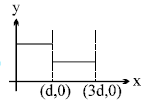
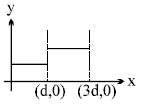
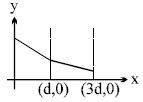
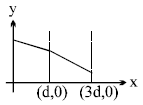
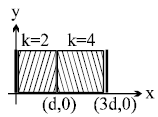
A parallel plate capacitor has two layers of dielectric as shown in figure. This capacitor is connected across a battery. The graph which shows the variation of electric field (E) and distance (x) from left plate.

1.
2.
3.
4.
View Answer

Given Information:

  1. Parallel plate capacitor: Contains two dielectric layers.
    • First layer (
      k=2k=2
       

      ) extends from 00 

      to dd 

      .

    • Second layer (
      k=4k=4
       

      ) extends from dd 

      to 3d3d 

      .

  2. Capacitor is connected to a battery: This means the potential difference
    VV
     

    across the plates is fixed.

Key Concepts:

  1. Electric Field in a Dielectric:
    • The electric field
      EE
       

      in a dielectric is inversely proportional to the dielectric constant kk 

      : E=σε0kE = \frac{\sigma}{\varepsilon_0 k} 

      where σ\sigma 

      is the surface charge density.

  2. Continuity of Potential:
    • Since the potential
      VV
       

      is constant across the capacitor, the sum of the potential drops across the two dielectric layers must equal VV 

      . For a uniform electric field in each region: V=E1d+E22dV = E_1 \cdot d + E_2 \cdot 2d 

      where E1E_1 

      and E2E_2 

      are the electric fields in the regions with k=2k=2 

      and k=4k=4 

      , respectively.

  3. Relation Between Fields:
    • The electric displacement
      D=ε0kE\mathbf{D} = \varepsilon_0 k E
       

      must be continuous across the boundary of the dielectrics: k1E1=k2E2k_1 E_1 = k_2 E_2 

      Substituting k1=2k_1 = 2 

      and k2=4k_2 = 4 

      , we find: 2E1=4E2E2=E122E_1 = 4E_2 \quad \Rightarrow \quad E_2 = \frac{E_1}{2} 

Explanation of the Graph:

  1. Region 1 (
    0x<d0 \leq x < d
     

    ):

    • In this region, the dielectric constant
      k=2k=2
       

      , so the electric field E1E_1 

      is relatively stronger compared to the next region.

  2. Region 2 (
    dx3dd \leq x \leq 3d
     

    ):

    • Here,
      k=4k=4
       

      , and since E2=E12E_2 = \frac{E_1}{2} 

      , the electric field is halved.

Thus, the electric field decreases discontinuously at

x=dx = d

due to the change in the dielectric constant, leading to the stepwise graph shown in the second figure.

Question 3: moderate

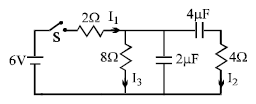
In the circuit shown in the figure, the switch S is initially open and the capacitor is initially uncharged. I1, I2 and I3 represent the current in the resistance 2Ω, 4Ω and 8Ω respectively.

1. Just after the switch S is closed, I1 = 3A, I2 = 3A and I3 = 0
2. Just after the switch S is closed, I1 = 3A, I2 = 0 and I3 = 0
3. long time after the switch S is closed, I1 = 0.6 A, I2 = 0 and I3 = 0
4. long after the switch S is closed, I1 = I2 = I3 = 0.6 A.
View Answer

Here's the short solution for the circuit:

  1. Just after the switch is closed:
    • The capacitors act as open circuits because they are initially uncharged (capacitor voltage cannot change instantaneously).
    • This means no current flows through the branches containing the capacitors.
  2. Current Distribution:
    • The total resistance in the circuit is only the sum of the resistors in the main loop (2Ω + 8Ω), as the branches with capacitors are effectively open.
    • Total resistance =
      2Ω+8Ω=10Ω2\Omega + 8\Omega = 10\Omega
       

      .

    • Current
      I1=VoltageResistance=6V2Ω+8Ω=0.6AI_1 = \frac{\text{Voltage}}{\text{Resistance}} = \frac{6V}{2\Omega + 8\Omega} = 0.6A
       

      .

  3. Branch currents:

    • I3=0I_3 = 0
       

      since the capacitor branch is open.


    • I2=0I_2 = 0
       

      for the same reason as above.

Final Answer:

  • \( I_1 = 0.6 A, \ I_2 = 0\)
Question 4: moderate

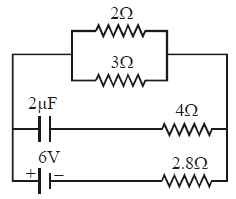
In the figure shown, the capacity of the condenser C is 2μF. The current in 2Ω resistor in steady state:

1. 9 A
2. 0.9 A
3. 1/9 A
4. 1/0.9 A
View Answer

In steady state no current flows through the capacitor so, current through 4 ohm resistor will be zero.

In absence of 4 ohm resistor, total resistance of circuit is (1.2+2.8)= 4 ohm.

Total current given by battery = 6/4=1.5 Ampere.

In parallel combination current divides in reverse ratio of resistors: (3/5)*1.5= 0.9 Ampere

Question 5: moderate

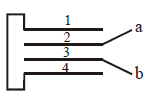
Four metallic plates, each with a surface area of one side A, are placed at a distance d from each other. The plates are connected as shown in the adjoining figure. Then the capacitance of the system between a and b is :

1. \[\frac{3\varepsilon_{0A}}{d}\]
2. \[\frac{2\varepsilon_{0A}}{d}\]
3. \[\frac{2}{3}\frac{\varepsilon_{0A}}{d}\]
4. \[\frac{3}{2}\frac{\varepsilon_{0A}}{d}\]
View Answer
Question 6: moderate

A capacitor is charged by connecting a battery across its plates. It stores energy U. Now the battery is disconnected and another identical capacitor is connected across it, then the energy stored by both capacitors of the system will be

1. U
2. U/2
3. 2U
4. 3/2U
View Answer

To solve this, we will use the concept of common potential and energy conservation. Let's derive it step-by-step:

  1. Initial Energy Stored in Capacitor 1
    Let the initial capacitance of the first capacitor be CC 

    , and the battery's voltage be VV 

    .
    The energy stored in the capacitor is: 

    U=12CV2U = \frac{1}{2} C V^2 

  2. When the second capacitor is connected
    After disconnecting the battery, an identical capacitor (with capacitance CC 

    ) is connected across the first one. The total charge remains conserved because the battery is removed. Let the final voltage be VfV_f 

    .Total charge initially:


    Qinitial=CVQ_{\text{initial}} = CVAfter connecting the second capacitor, the total capacitance becomes:


    Ctotal=C+C=2CC_{\text{total}} = C + C = 2CCommon potential

    VfV_f:


    Vf=Total chargeTotal capacitance=CV2C=V2V_f = \frac{\text{Total charge}}{\text{Total capacitance}} = \frac{CV}{2C} = \frac{V}{2} 

  3. Final Energy Stored in Both Capacitors
    The final energy stored in the system is the sum of the energy in both capacitors: 

    Ufinal=12CVf2+12CVf2=CVf2U_{\text{final}} = \frac{1}{2} C V_f^2 + \frac{1}{2} C V_f^2 = C V_f^2Substituting

    Vf=V2V_f = \frac{V}{2}:


    Ufinal=C(V2)2=CV24U_{\text{final}} = C \left( \frac{V}{2} \right)^2 = C \frac{V^2}{4}Simplifying:


    Ufinal=12CV212=U2U_{\text{final}} = \frac{1}{2} \cdot C V^2 \cdot \frac{1}{2} = \frac{U}{2} 

Thus, the final energy stored in the system is

U2\frac{U}{2}

.

Question 7: moderate

A parallel plate capacitor is charged by a battery and after charging the capacitor, battery is disconnected and decrease the distance between the plates then which following statement is correct ?

1. electric field is not constant
2. potential difference is increased
3. decrease the capacitance
4. decrease the stored energy
View Answer

When the distance between the plates of a charged capacitor is decreased after disconnecting the battery, the following happens:

  1. Charge remains constant: Since the battery is disconnected, the charge
    QQ
     

    on the plates does not change.

  2. Capacitance increases: The capacitance of a parallel plate capacitor is given by: 

    C=ε0AdC = \frac{\varepsilon_0 A}{d}where

    ddis the distance between the plates. As

    dddecreases,

    CCincreases.

  3. Potential difference decreases: The voltage
    VV
     

    across the capacitor is related by: 

    V=QCV = \frac{Q}{C}Since

    QQis constant and

    CCincreases,

    VVdecreases.

  4. Potential energy decreases: The energy stored in a capacitor is: 

    U=12Q2CU = \frac{1}{2} \frac{Q^2}{C}As

    CCincreases,

    UUdecreases because

    Q2Q^2is constant.

Thus, the potential energy decreases when the distance between the plates is reduced.

Question 8: moderate

A capacitor of capacitance 2μF is charged to 10V and another capacitor of capacitance 3μF is charged to 20V. Now their opposite polarities

1. 540 μJ
2. 60 μJ
3. 270 μJ
4. 320 μJ
View Answer

To solve this problem, let's analyze the situation step by step:


1. Initial Charges on Capacitors

The charge on each capacitor is given by

Q=CVQ = CV

:

  • For the first capacitor (
    C1=2μF,V1=10VC_1 = 2 \, \mu\text{F}, V_1 = 10 \, \text{V}
     

    ): 

    Q1=C1V1=2×10610=20μCQ_1 = C_1 V_1 = 2 \times 10^{-6} \cdot 10 = 20 \, \mu\text{C} 

  • For the second capacitor (
    C2=3μF,V2=20VC_2 = 3 \, \mu\text{F}, V_2 = 20 \, \text{V}
     

    ): 

    Q2=C2V2=3×10620=60μCQ_2 = C_2 V_2 = 3 \times 10^{-6} \cdot 20 = 60 \, \mu\text{C} 


2. Connecting Capacitors with Opposite Polarity

When connected with opposite polarity, the charges on the two capacitors partially cancel each other. The net charge is:


Qnet=Q2Q1=60μC20μC=40μCQ_{\text{net}} = Q_2 - Q_1 = 60 \, \mu\text{C} - 20 \, \mu\text{C} = 40 \, \mu\text{C}


The equivalent capacitance of the two capacitors in parallel is:


Ceq=C1+C2=2μF+3μF=5μFC_{\text{eq}} = C_1 + C_2 = 2 \, \mu\text{F} + 3 \, \mu\text{F} = 5 \, \mu\text{F}


3. Final Energy Stored in the System

The energy stored in a capacitor is given by:


U=12Qnet2CeqU = \frac{1}{2} \frac{Q_{\text{net}}^2}{C_{\text{eq}}}


Substitute the values:


U=12(40×106)25×106U = \frac{1}{2} \cdot \frac{(40 \times 10^{-6})^2}{5 \times 10^{-6}}


U=121600×10125×106U = \frac{1}{2} \cdot \frac{1600 \times 10^{-12}}{5 \times 10^{-6}}


U=12320×106=160×106JU = \frac{1}{2} \cdot 320 \times 10^{-6} = 160 \times 10^{-6} \, \text{J}


U=540μJU = 540 \, \mu\text{J}


Final Answer:

The final energy stored in the system is 540 μJ.

Question 9: moderate

A parallel plate capacitor has capacitance C. If charge Q is given to one plate and another plate is kept uncharged. The potential difference between the plates is

1. zero
2. Q/C
3. Q/2C
4. Can't be determined
View Answer

To derive the potential difference between the plates when one plate is given a charge

QQ

and the other plate is uncharged, let's go step by step:


1. Induced Charge on the Opposite Plate

When a charge

QQ

is placed on one plate, the other uncharged plate will develop an induced charge of

Q-Q

(due to electrostatic induction). This creates an electric field between the plates.


2. Net Capacitance of the System

For a parallel plate capacitor, the capacitance is given by:


C=ε0AdC = \frac{\varepsilon_0 A}{d}


However, we are not dealing with the conventional capacitor configuration here. Instead, only one plate is directly charged while the other has an induced charge.

The effective charge separation across the plates is the same, but the field contributions are halved because the uncharged plate contributes only via induction. This effectively makes the potential difference behave as if the charge on the capacitor were shared equally across its plates.


3. Potential Difference

The potential difference

VV

across the plates is related to the charge

QQ

by:


V=QeffectiveCV = \frac{Q_{\text{effective}}}{C}


Here, the effective charge separation contributes as if the charge on each plate were effectively halved due to induction:


Qeffective=Q2Q_{\text{effective}} = \frac{Q}{2}


Substitute

QeffectiveQ_{\text{effective}}

into the equation for

VV

:


V=Q2CV = \frac{\frac{Q}{2}}{C}


V=Q2CV = \frac{Q}{2C}


Final Answer:

The potential difference between the plates is:


V=Q2CV = \frac{Q}{2C}


Question 10: moderate

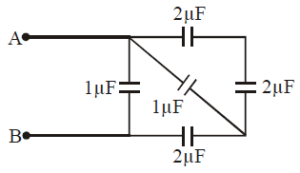
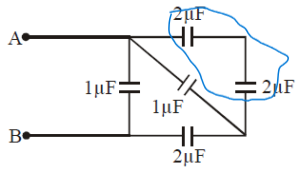
Total capacity of the system of capacitors shown in the following figure between the points A and B is:

1. 1 μF
2. 2 μF
3. 3 μF
4. 4 μF
View Answer

Combination of Capacitors simple questions

The Circled capacitors are in Series so , Their equivalent capacitance is 1 μF . Then it is in parallel with 1 μF capacitor. The circuit will keep on reducing.