Two spherical conductors A1 and A2 of radii r1 and r2 are placed concentrically in air. The two are connected by a copper A wire as shown in figure. Then the equivalent capacitance of the system is :
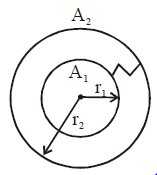
1. \[\frac{4\pi\varepsilon_{0}Kr_{1}r_{2}}{r_{2}-r_{1}}\]
2. \[4\pi\varepsilon_{0}(r_{2}+r_{1})\]
3. \[4\pi\varepsilon_{0}r_{2}\]
4. \[4\pi\varepsilon_{0}r_{1}\]
View Answer
The problem involves two spherical conductors
and
connected by a copper wire. Let’s analyze and compute the equivalent capacitance of the system.
Given:
Key Concepts:
- Potential Difference Between the Spheres: The two conductors are connected by a wire, meaning they are at the same potential. As a result, the electric field exists only between the two spheres.
- Capacitance of a Single Isolated Sphere: If only
existed as a spherical conductor, its capacitance would be:
- Why the System is Equivalent to an Isolated Sphere: Since
is connected to
via a conducting wire, any charge added to
immediately flows to
, making the system behave as if there is only one conductor of radius
.
Equivalent Capacitance:
Thus, the capacitance of the system is:
Final Answer:
The equivalent capacitance of the system is:
Two metallic charged spheres whose radii are \( 20\text{cm} \) and \( 10\text{cm} \) respectively, have each \( 150\ \mu\text{C} \) positive charge. The common potential after they are connected by a conducting wire is
1. \( 9 \times 10^6\text{ volts} \)
2. \( 4.5 \times 10^6\text{ volts} \)
3. \( 1.8 \times 10^7\text{ volts} \)
4. \( 13.5 \times 10^6\text{ volts} \)
View Answer
The total charge is \( Q = 150 \mu\text{C} + 150 \mu\text{C} = 300 \mu\text{C} \). The total capacitance is \( C = 4piepsilon_0(R_1 + R_2) = \frac{0.3}{9 \times 10^9}\text{ F} \). The common potential is \( V = \frac{Q}{C} = \frac{300 \times 10^{-6} \times 9 \times 10^9}{0.3} = 9 \times 10^6\text{ V} \).
Assertion (A): Circuits containing high capacity capacitors, charged to high voltage should be handled with caution, even when the current in the circuit is switched off.
Reason (R): When an isolated capacitor is touched by hand or any other part of the human body, there is an easy path to the ground available for the discharge of the capacitor.
1. (1) Both (A) & (R) are true and the (R) is the correct explanation of the (A)
2. (2) Both (A) & (R) are true but the (R) is not the correct explanation of the (A)
3. (3) (A) is true but (R) is false
4. (4) Both (A) and (R) are false
View Answer
Assertion (A): High capacity capacitors charged to high voltage store significant energy (\(E = \frac{1}{2}CV^2\)). This energy can be lethal if discharged through a person, even after the power supply is off, as they retain charge for a long time. So (A) is true.
Reason (R): The human body acts as a conductor, providing a low-resistance path for the stored charge to discharge, often to the ground. This path can be dangerous. So (R) is true.nReason (R) provides the correct explanation for the danger mentioned in Assertion (A).
Assertion (A): When outer grounded shell of a two charged concentric shell system is removed, the capacitance of system decreases.
Reason (R): Electric field will spread in vast region till infinity.
1. Both (A) & (R) are true and the (R) is the correct explanation of the (A)
2. Both (A) & (R) are true but the (R) is not the correct explanation of the (A)
3. (A) is true but (R) is false
4. Both (A) and (R) are false
View Answer
For a concentric spherical capacitor, capacitance is \( C = \frac{4\pi\epsilon_0 ab}{b-a} \). When the outer shell (radius \( b \)) is removed, it becomes a single isolated sphere of radius \( a \), and its capacitance is \( C' = 4\pi\epsilon_0 a \). Since \( \frac{b}{b-a} > 1 \), \( C > C' \), so capacitance decreases. The electric field now extends to infinity, which explains the decrease in capacitance. Thus, (A) is true and (R) is a correct explanation.
Assertion (A): In a system of two concentric shell of inner radius \(a\) and outer radius \(b\). If outer is grounded and inner shell is given charge has less capacitance than inner has grounded and outer is given charge.
Reason (R): Electric field is zero outside outer shell when inner shell is grounded.
1. Both (A) & (R) are true and the (R) is the correct explanation of the (A)
2. Both (A) & (R) are true but the (R) is not the correct explanation of the (A)
3. (A) is true but (R) is false
4. Both (A) and (R) are false
View Answer
A: True. For inner charged, outer grounded, \(C_1 = 4\pi\epsilon_0 \frac{ab}{b-a}\). For inner grounded, outer charged, \(C_2 = 4\pi\epsilon_0 \frac{b^2}{b-a}\). Since \(b>a\), \(C_1 < C_2\).\nR: False. If the outer shell is given charge, there will be a net charge creating an external electric field.\nTherefore, (A) is true and (R) is false.
Assertion (A): It is not possible to make a spherical conductor of capacitor one farad.
Reason (R): It is possible for earth as its radius is \( 6400 \text{ km} \).
1. Both (A) & (R) are true and the (R) is the correct explanation of the (A)
2. Both (A) & (R) are true but the (R) is not the correct explanation of the (A)
3. (A) is true but (R) is false
4. Both (A) and (R) are false
View Answer
Assertion (A) is true. For an isolated sphere, \( C = 4\pi \epsilon_0 R ). For \( C=1 \text{ F} \), \( R \approx 9 \times 10^9 \text{ m} \), which is astronomically large. Reason (R) is false. Earth's capacitance is \( C \approx 711 \mu\text{F} ), far less than 1 Farad.