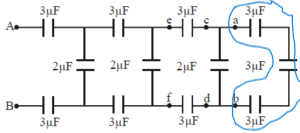
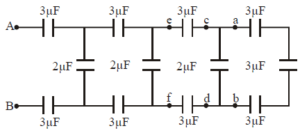
The resultant capcitance between A and B in the figure is :


For Such Question start solving from the farthest point. The circuit will keep on reducing.
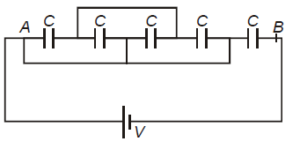
The resultant capcitance between A and B in the figure is :


For Such Question start solving from the farthest point. The circuit will keep on reducing.
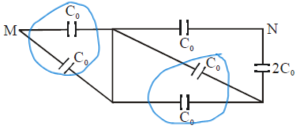
Consider the figure, equivalent capacitance between A and B is

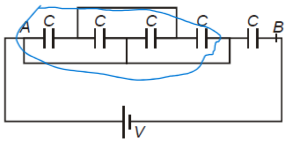
Capacitors circled in the diagram are short circuited so, they can be removed from the circuit.
Minimum number of 8 μF and 250 V capacitors used to make a combination of 16 μF and 1000 V are:
To solve this, we determine the combination of capacitors required to achieve the desired capacitance and voltage.
,
,
To achieve
, multiple capacitors must be connected in series because the voltage across a series combination adds up. The number of capacitors required in series is:
Thus, 4 capacitors in series are required to handle 1000 V.
The effective capacitance of
capacitors in series is given by:
So, a series of 4 capacitors provides
.
To achieve
, multiple such series groups must be connected in parallel because capacitance in parallel adds up. The number of such series groups required is:
Thus, 8 series groups are required.
Each series group contains 4 capacitors, and there are 8 such groups. Therefore, the total number of capacitors is:
The minimum number of capacitors required is:
A parallel plate capacitor of capacitance C consists of two identical plates A and B. A charge q is given to plate A and charge –q is given to plate B. The space between plates is vacuum. The separation between plates is d. The electric intensity at a point situated between plates is :
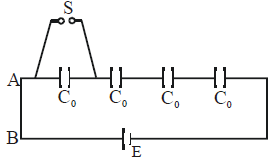
In the given figure, find the charge flowing through section AB when switch S is closed:

When Switch is open Ceq= C/4 Charge given by the Battery is CE/4.
When Switch is open Ceq= C/3 Charge given by the Battery is CE/3.
Extra Charge flowing through the circuit it = \( \frac{CE}{3}-\frac{CE}{4}= \frac{CE}{12}\)
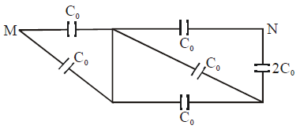
The equivalent capacitance between points M and N is:

Two identical parallel plate capacitors A and B are connected in series with a battery of 100 V. A slab of dielectric constant K = 3 is inserted between the plates of capacitor A. Then, the potential difference across the capacitors will be, respectively:
Here’s a shorter solution:
(total battery voltage)
for capacitor
and
(because of the dielectric in
)
(no dielectric in
)
The voltage is divided in proportion to the inverse of capacitances:
A parallel plate capacitor has plates of area A and separation d and is charged to a potential difference V. The charging battery is then disconnected and the plates are pulled apart until their separation is 2d. What is the work required to separated the plates?
To calculate the work required to separate the plates of the capacitor, let’s analyze the situation step by step:
on the plates remains constant.
The charge stored in the capacitor is given by:
where
is the capacitance:
Thus, the charge is:
The energy stored in the capacitor is:
Substituting
:
Initially, the energy is:
When the separation is increased to
, the capacitance decreases to:
The energy becomes:
Since the charge
is constant and
:
Substitute
and
:
The work done to separate the plates is equal to the increase in energy:
Substitute the values:
The work required to separate the plates is:
Ten capacitors are joined in parallel and charged with a battery up to a potential V. They are then disconnected from the battery and joined in series. Then, the potential of this combination will be:
Let's analyze the problem step by step and derive why the potential difference is 10 V.
When the 10 capacitors, each with capacitance
, are connected in parallel:
is:
After disconnecting the battery, the capacitors are joined in series:
stored on the series combination remains the same (as charge is conserved):
The potential difference across a capacitor or combination of capacitors is related to the charge
and capacitance
:
Substitute
and
:
Thus, the potential across the series combination is
,.
The potential of the series combination is:
Seven capacitors, each of capacitance 2 μF, are to be combined to obtain a capacitance of 10/11 μF. Which of the following combinations is possible?
We need to check each option separately. We 5 capacitors are connected in parallel, 2 capacitors are connected in series.
Ceq= (5C×C/2)/ (5C+C/2)= 5C/11 = 5×2/11 = 10/11 μF.