A capacitor of capacitance C is initially charged to a potential difference of V volt. Now it is connected to a battery of 2V Volt with opposite polarity. The ratio of heat generated to the final energy stored in the capacitor will be
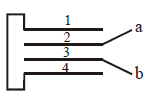
Four metallic plates, each with a surface area of one side A, are placed at a distance d from each other. The plates are connected as shown in the adjoining figure. Then the capacitance of the system between a and b is :

A capacitor is charged by connecting a battery across its plates. It stores energy U. Now the battery is disconnected and another identical capacitor is connected across it, then the energy stored by both capacitors of the system will be
To solve this, we will use the concept of common potential and energy conservation. Let's derive it step-by-step:
- Initial Energy Stored in Capacitor 1
Let the initial capacitance of the first capacitor be, and the battery's voltage be
.
The energy stored in the capacitor is: - When the second capacitor is connected
After disconnecting the battery, an identical capacitor (with capacitance) is connected across the first one. The total charge remains conserved because the battery is removed. Let the final voltage be
.Total charge initially:
After connecting the second capacitor, the total capacitance becomes:
Common potential
:
- Final Energy Stored in Both Capacitors
The final energy stored in the system is the sum of the energy in both capacitors:Substituting
:
Simplifying:
Thus, the final energy stored in the system is
.
A parallel plate capacitor is charged by a battery and after charging the capacitor, battery is disconnected and decrease the distance between the plates then which following statement is correct ?
When the distance between the plates of a charged capacitor is decreased after disconnecting the battery, the following happens:
- Charge remains constant: Since the battery is disconnected, the charge
on the plates does not change.
- Capacitance increases: The capacitance of a parallel plate capacitor is given by:
where
is the distance between the plates. As
decreases,
increases.
- Potential difference decreases: The voltage
across the capacitor is related by:
Since
is constant and
increases,
decreases.
- Potential energy decreases: The energy stored in a capacitor is:
As
increases,
decreases because
is constant.
Thus, the potential energy decreases when the distance between the plates is reduced.
A parallel plate capacitor is made by stacking n equally spaced plates connected alternatively. If the capacitance between any two adjacent plates is ‘C’ then the resultant capacitance is
In a parallel plate capacitor made by stacking
equally spaced plates connected alternatively:
Key Points:
- The plates connected alternatively form a series of capacitors.
- If there are
plates, the number of gaps (capacitors in series) between them is
.
For capacitors in series:
The total capacitance
is given by:
However, because the plates are connected alternatively, these effectively act as
capacitors in parallel.
For capacitors in parallel:
The equivalent capacitance is:
Thus, the resultant capacitance is
.
A battery is used to charge a parallel plate capacitor till the potential difference between the plates becomes equal to the electromotive force of the battery. The ratio of the energy stored in the capacitor and the work done by the battery will be
To find the ratio of the energy stored in the capacitor to the work done by the battery, let's break it down step by step:
1. Energy Stored in the Capacitor
The energy
stored in a capacitor is given by:
where
is the capacitance, and
is the voltage across the capacitor (equal to the EMF of the battery once fully charged).
2. Work Done by the Battery
The work done by the battery
is equal to the total charge delivered multiplied by the voltage:
The charge
stored in the capacitor is:
So, the work done becomes:
3. Ratio of Energy Stored to Work Done
Now, the ratio of the energy stored in the capacitor to the work done by the battery is:
Final Answer:
The ratio is
.
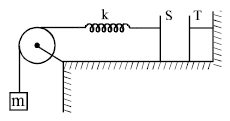
The plates S and T of an uncharged parallel plate capacitor are connected across a battery. The battery is then disconnected and the charged plates are now connected in a system as shown in the figure. The system shown is in equilibrium. All the strings are insulating and massless. The magnitude of charge on one of the capacitor plates is: [Area of plates = A]

To solve this, let us analyze the situation and derive the required expression for the charge:
1. Setup of the System
- The parallel plate capacitor is initially charged, and the battery is disconnected.
- One plate of the capacitor is connected to a spring, and the other is attached to a mass
.
- The capacitor plates attract each other due to the opposite charges, generating an electrostatic force.
2. Equilibrium Condition
In equilibrium, the upward force due to the spring's tension balances the downward gravitational force acting on the mass
:
This tension
is equal to the electrostatic force
between the plates of the capacitor:
3. Force Balance
At equilibrium:
Substitute
:
4. Solve for
Rearranging for
:
Taking the square root:
Final Answer:
The magnitude of the charge on one of the capacitor plates is:
A capacitor of capacitance 2μF is charged to 10V and another capacitor of capacitance 3μF is charged to 20V. Now their opposite polarities
To solve this problem, let's analyze the situation step by step:
1. Initial Charges on Capacitors
The charge on each capacitor is given by
:
- For the first capacitor (
):
- For the second capacitor (
):
2. Connecting Capacitors with Opposite Polarity
When connected with opposite polarity, the charges on the two capacitors partially cancel each other. The net charge is:
The equivalent capacitance of the two capacitors in parallel is:
3. Final Energy Stored in the System
The energy stored in a capacitor is given by:
Substitute the values:
Final Answer:
The final energy stored in the system is 540 μJ.
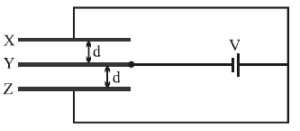
Consider the arrangement of three plates X, Y and Z each of area A and separation d. The energy stored in the system when the plates are fully charged is:

To solve for the energy stored in the system of three plates (X, Y, Z), let's break the system into simpler components:
1. System Description
- The arrangement forms two capacitors:
- Capacitor 1: Between plates X and Y.
- Capacitor 2: Between plates Y and Z.
- Each capacitor has the same plate area
and plate separation
.
The capacitance of a parallel plate capacitor is given by:
Thus, the capacitance of each capacitor is:
2. Effective Capacitance
The two capacitors are in parallel because plate Y is connected to the battery on one side and plate X and Z are on the opposite side. For capacitors in parallel, the effective capacitance is:
3. Energy Stored in the System
The energy stored in a capacitor is:
Substitute
:
Final Answer:
The energy stored in the system is:
A parallel plate capacitor has capacitance C. If charge Q is given to one plate and another plate is kept uncharged. The potential difference between the plates is
To derive the potential difference between the plates when one plate is given a charge
and the other plate is uncharged, let's go step by step:
1. Induced Charge on the Opposite Plate
When a charge
is placed on one plate, the other uncharged plate will develop an induced charge of
(due to electrostatic induction). This creates an electric field between the plates.
2. Net Capacitance of the System
For a parallel plate capacitor, the capacitance is given by:
However, we are not dealing with the conventional capacitor configuration here. Instead, only one plate is directly charged while the other has an induced charge.
The effective charge separation across the plates is the same, but the field contributions are halved because the uncharged plate contributes only via induction. This effectively makes the potential difference behave as if the charge on the capacitor were shared equally across its plates.
3. Potential Difference
The potential difference
across the plates is related to the charge
by:
Here, the effective charge separation contributes as if the charge on each plate were effectively halved due to induction:
Substitute
into the equation for
:
Final Answer:
The potential difference between the plates is: