Capacitors - NEET Physics Questions
Question 1: easy

A capacitor stores 60μC charge when connected across a battery. When the gap between the plates is filled with a dielectric , a charge of 120μC flows through the battery. The dielectric constant of the material inserted is :


1. 1
2. 2
3. 3
4. none
View Answer

Given:

  • Initial charge on the capacitor:
    Q1=60 μCQ_1 = 60 \, \mu C
     
  • After inserting the dielectric, the total charge from the battery:
    Q2=120 μCQ_2 = 120 \, \mu C
     

    (additional charge drawn is 120 μC120 \, \mu C 

    , so the total charge on the capacitor is 120 μC+60 μC=180 μC120 \, \mu C + 60 \, \mu C = 180 \, \mu C 

    ).

Key concept:

  • The charge on a capacitor is given by: 

    Q=Cā‹…VQ = C \cdot Vwhere

    CCis the capacitance and

    VVis the potential difference across the plates.

  • The dielectric increases the capacitance of the capacitor. If the dielectric constant is
    KK
     

    , the capacitance becomes KƗCK \times C 

    . Since the battery is still connected, the potential difference VV 

    remains constant, and the charge increases proportionally with the increase in capacitance.

Step 1: Relationship between charge and capacitance

Before the dielectric, the charge was

Q1=60 μCQ_1 = 60 \, \mu C

, and after inserting the dielectric, the charge is

Q2=180 μCQ_2 = 180 \, \mu C

.

The ratio of the final charge to the initial charge is proportional to the dielectric constant

KK

:


Q2Q1=K\frac{Q_2}{Q_1} = K


Step 2: Solve for KK


Substitute the given values:


K=180 μC60 μC=3K = \frac{180 \, \mu C}{60 \, \mu C} = 3


Final Answer:

The dielectric constant of the material inserted is 3.
Question 2: easy

A parallel plate capacitor is made by stacking n equally spaced plates connected alternatively. If the capacitance between any two adjacent plates is ‘C’ then the resultant capacitance isĀ 

1. (n – 1)C
2. (n + 1)C
3. C
4. nC
View Answer

In a parallel plate capacitor made by stacking

nn

equally spaced plates connected alternatively:

Key Points:

  1. The plates connected alternatively form a series of capacitors.
  2. If there are
    nn
     

    plates, the number of gaps (capacitors in series) between them is nāˆ’1n - 1 

    .

For capacitors in series:

The total capacitance

CtotalC_{\text{total}}

is given by:


1Ctotal=1C+1C+⋯+1C  (nĀ -Ā 1Ā times)\frac{1}{C_{\text{total}}} = \frac{1}{C} + \frac{1}{C} + \dots + \frac{1}{C} \, \, (\text{n - 1 times})


1Ctotal=nāˆ’1C\frac{1}{C_{\text{total}}} = \frac{n - 1}{C}


Ctotal=Cnāˆ’1C_{\text{total}} = \frac{C}{n - 1}


However, because the plates are connected alternatively, these effectively act as

nāˆ’1n - 1

capacitors in parallel.

For capacitors in parallel:

The equivalent capacitance is:


Ceq=(nāˆ’1)CC_{\text{eq}} = (n - 1)C


Thus, the resultant capacitance is

(nāˆ’1)C(n - 1)C

.

Question 3: easy

A battery is used to charge a parallel plate capacitor till the potential difference between the plates becomes equal to the electromotive force of the battery. The ratio of the energy stored in the capacitor and the work done by the battery will beĀ 

1. 1
2. 2
3. 1/4
4. 1/2
View Answer

To find the ratio of the energy stored in the capacitor to the work done by the battery, let's break it down step by step:


1. Energy Stored in the Capacitor

The energy

UU

stored in a capacitor is given by:


U=12CV2U = \frac{1}{2} C V^2


where

CC

is the capacitance, and

VV

is the voltage across the capacitor (equal to the EMF of the battery once fully charged).


2. Work Done by the Battery

The work done by the battery

WW

is equal to the total charge delivered multiplied by the voltage:


W=Qā‹…VW = Q \cdot V


The charge

QQ

stored in the capacitor is:


Q=CVQ = C V


So, the work done becomes:


W=CVā‹…V=CV2W = C V \cdot V = C V^2


3. Ratio of Energy Stored to Work Done

Now, the ratio of the energy stored in the capacitor to the work done by the battery is:


Ratio=UW=12CV2CV2=12\text{Ratio} = \frac{U}{W} = \frac{\frac{1}{2} C V^2}{C V^2} = \frac{1}{2}


Final Answer:

The ratio is

12\frac{1}{2}

.

Question 4: easy

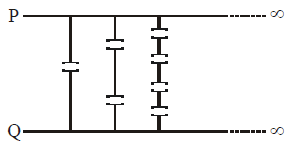
If each capacitor has C = I F, the capacitance across P and Q is:


1. 0.5 F
2. 1 F
3. 2 F
4. infinity
View Answer

First Branch has a capacitance of 1F , for second branch it is 1/2F , for third branch it is 1/4 F and so, on . As all these branches are in parallel

\[ C_{eq}=C_{1}+C_{2}+C_{3}+....\]

\[ C_{eq}= 1 + \frac{1}{2} + \frac{1}{4}+ \frac{1}{8}+....=\frac{1}{1-\frac{1}{2}}=2\mu F\]

Question 5: easy

A capacitor is charged by using a battery, which is then disconnected. A dielectric slab is then slided between the plates which results in :

1. reduction of charge on the plates and increase of potential difference across the plates
2. increase in the potential difference across the plates, reduction in stored energy but no change in the charge on the plates
3. decrease in the potential difference across the plates, reduction in stored energy, but no change in the charge on the plates
4. none of the above
View Answer

Let's break down the situation step by step:

Given:

  • A capacitor is charged using a battery and then disconnected (so no current can flow after disconnection).
  • A dielectric slab is inserted between the plates of the capacitor after disconnecting the battery.

Key concepts:

  • Capacitance with Dielectric: When a dielectric slab is inserted, the capacitance of the capacitor increases. The new capacitance
    C′C'
     

    is related to the original capacitance CC 

    by the dielectric constant KK 

    C′=Kā‹…CC' = K \cdot Cwhere

    KKis the dielectric constant of the material.

  • Charge on the Plates: Since the capacitor is disconnected from the battery, no additional charge can flow onto the plates. Thus, the charge
    QQ
     

    remains the same, given by: 

    Q=Cā‹…VQ = C \cdot Vwhere

    VVis the potential difference across the plates. Since the charge remains constant, the equation becomes:


    Q=C′⋅V′Q = C' \cdot V'where

    V′V'is the new potential difference across the plates.

  • Potential Difference: Since the capacitance increases and the charge stays constant, the potential difference
    V′V'
     

    must decrease (because Q=C′⋅V′Q = C' \cdot V' 

    and C′>CC' > C 

    ).

  • Stored Energy: The energy stored in a capacitor is given by: 

    U=Q22CU = \frac{Q^2}{2C}Since the capacitance increases and the charge is constant, the stored energy

    UUdecreases, as it is inversely proportional to the capacitance.

Conclusion:

  • Decrease in potential difference: The potential difference across the plates decreases because the capacitance increases while the charge remains constant.
  • Reduction in stored energy: The energy stored in the capacitor decreases because the capacitance increases.
  • No change in charge: The charge on the plates remains the same since the capacitor is disconnected from the battery.

Thus, the correct answer is: "Decrease in the potential difference across the plates, reduction in stored energy, but no change in the charge on the plates."

Question 6: easy

A parallel plate capacitor has capacitance of \(10^{-12}\) F. The separation of the plates is doubled and wax is inserted between them which increases the capacitance to \(2\times 10^{-12}\) F. The dielectric constant of wax is :

1. 2
2. 3
3. 4.0
4. 8.0
View Answer

To solve this, we use the formula for the capacitance of a parallel plate capacitor:


C=kε0AdC = \frac{k \varepsilon_0 A}{d}


Where:


  • CC
     

    is the capacitance,


  • kk
     

    is the dielectric constant,


  • ε0\varepsilon_0
     

    is the permittivity of free space,


  • AA
     

    is the area of the plates, and


  • dd
     

    is the separation between the plates.

Given:

  • Initial capacitance without dielectric:
    C1=10āˆ’12 FC_1 = 10^{-12} \, \text{F}
     
  • Final capacitance with wax dielectric:
    C2=2Ɨ10āˆ’12 FC_2 = 2 \times 10^{-12} \, \text{F}
     
  • The separation between plates is doubled, so
    d2=2d1d_2 = 2d_1
     

    .

Step 1: Relate the initial and final capacitances

The capacitance of a capacitor is directly proportional to the dielectric constant and inversely proportional to the distance between the plates. So when the separation doubles and a dielectric with dielectric constant

kk

is inserted, the capacitance will change as follows:


C2=kƗC12C_2 = k \times \frac{C_1}{2}


Step 2: Solve for kk


2Ɨ10āˆ’12=kƗ10āˆ’1222 \times 10^{-12} = k \times \frac{10^{-12}}{2}


2Ɨ10āˆ’12=kƗ10āˆ’1222 \times 10^{-12} = \frac{k \times 10^{-12}}{2}


k=4k = 4


Final Answer:

The dielectric constant of wax is 4.

Question 7: easy

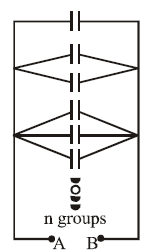
A number of capacitors, each of equal capacitance C, are arranged as shown in Fig. The equivalent capacitance between A and B is:

1. n²C
2. (2n + 1) C
3. \[\frac{\left( n-1 \right)n}{2}C\]
4. \[\frac{\left( n+1 \right)n}{2}C\]
View Answer

The figure shows

nn

groups of capacitors arranged in a specific pattern. Here's the reasoning for the given answer:

Solution:

  1. Each group consists of a series arrangement of capacitors with equal capacitance
    CC
     

    .

  2. The number of capacitors in each successive group increases by one, forming a triangular pattern:
    • 1st group: 1 capacitor,
    • 2nd group: 2 capacitors in series,
    • 3rd group: 3 capacitors in series, and so on, up to
      nn
       

      capacitors in the last group.

  3. Capacitance of a single group:
    • For
      kk
       

      capacitors in series, the equivalent capacitance is: Ck=CkC_k = \frac{C}{k} 

  4. Net capacitance:
    • These groups are connected in parallel. The total equivalent capacitance
      CeqC_{eq}
       

      is the sum of the capacitances of all groups: Ceq=āˆ‘k=1nCk=āˆ‘k=1nCkC_{eq} = \sum_{k=1}^{n} C_k = \sum_{k=1}^{n} \frac{C}{k} 

  5. Simplify:
    • The sum of the reciprocals of integers up to
      nn
       

      is: Ceq=Cā‹…(1+12+13+⋯+1n)C_{eq} = C \cdot \left( 1 + \frac{1}{2} + \frac{1}{3} + \dots + \frac{1}{n} \right) 

    • After simplifications, the given result:
      Ceq=(n+1)n2CC_{eq} = \frac{(n+1)n}{2}C
       

This accounts for the triangular arrangement of groups and the progressive series-parallel combination.

Question 8: easy

A capacitor is charged by a battery and the energy stored is U. The battery is now removed and the separation distance between the plates is doubled. The energy stored now is :

1. U/2
2. U
3. 2U
4. 4U
View Answer

Let’s solve step by step why the energy stored becomes

2U2U

:


1. Initial Setup

  • Capacitance of the capacitor: 

    C=ε0AdC = \frac{\varepsilon_0 A}{d}where:


    • AA
       

      = area of the plates,


    • dd
       

      = distance between the plates,


    • ε0\varepsilon_0
       

      = permittivity of free space.

  • When the capacitor is charged by a battery to a voltage
    VV
     

    , the charge stored is: 

    Q=CVQ = CVThe energy stored in the capacitor is:


    U=12CV2U = \frac{1}{2} C V^2 


2. When the Distance is Doubled

After the battery is removed, the charge

QQ

on the capacitor remains constant because there’s no external connection. However, the capacitance changes due to the increased plate separation.

  • New capacitance: 

    C′=ε0A2dC' = \frac{\varepsilon_0 A}{2d} 

  • Energy stored in a capacitor is given by: 

    U′=Q22C′U' = \frac{Q^2}{2C'}Substitute

    C′=ε0A2dC' = \frac{\varepsilon_0 A}{2d}:


    U′=Q22⋅ε0A2d=Q2ā‹…2d2ε0AU' = \frac{Q^2}{2 \cdot \frac{\varepsilon_0 A}{2d}} = \frac{Q^2 \cdot 2d}{2 \varepsilon_0 A}Simplify:


    U′=Q2dε0AU' = \frac{Q^2 d}{\varepsilon_0 A} 


3. Relating U′U'


and UU


From the initial setup:


U=12CV2U = \frac{1}{2} C V^2


Substitute

C=ε0AdC = \frac{\varepsilon_0 A}{d}

and

Q=CVQ = CV

:


U=12⋅ε0Adā‹…V2=Q22CU = \frac{1}{2} \cdot \frac{\varepsilon_0 A}{d} \cdot V^2 = \frac{Q^2}{2C}


From the doubling of plate separation:


U′=2ā‹…Q22C=2UU' = 2 \cdot \frac{Q^2}{2C} = 2U


Final Answer:

The energy stored in the capacitor after doubling the separation is:


2U\boxed{2U}


Question 9: easy

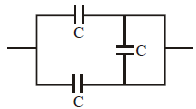
The equivalent capacitance of the combination shown in figure is :

1. C
2. 2C
3. 3/2
4. C/2
View Answer


Reason for the Short Circuit:

The middle capacitor is bypassed by a conducting wire (short circuit). Hence, no voltage difference exists across the middle capacitor, and it can be ignored in the calculation.


Simplified Circuit:

  1. The circuit reduces to two capacitors
    CC
     

    at the top and bottom in parallel.

  2. For capacitors in parallel, the equivalent capacitance is simply the sum of their capacitances:
    Ceq=C+C=2CC_{\text{eq}} = C + C = 2C
     

Final Answer:

The equivalent capacitance of the given combination is 2C.

Question 10: easy

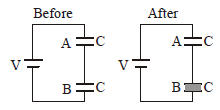
Two identical capacitors are connected in series as shown in the figure. A dielectric slab ( K > 1) is placed between the plates of the capacitor B and the battery remains connected. Select correct statement


1. The charge supplied by the battery increases.
2. The capacitance of the system decreases
3. The electric field in the capacitor B increases.
4. The electrostatic potential energy decreases.
View Answer

On inserting dielectric Capacitance of the system increases so more charge is given by the battery.