Capacitor With Dielectrics - NEET Physics Questions
← Back to Capacitors

Capacitor With Dielectrics

Question 1: moderate

A parallel plate capacitor has a capacity C. The separation between the plates is doubled and a dielectric medium is introduced between the plates. If the capacity now becomes 2C, the dielectric constant of the medium is :

1. 2
2. 1
3. 4
4. 8
View Answer

Let’s solve the problem step by step:

Given:

  • Initial capacitance:
    CC
     
  • The separation between the plates is doubled, and a dielectric medium is inserted.
  • The new capacitance becomes
    2C2C
     

    .

Step 1: Capacitance formula

The capacitance of a parallel plate capacitor is given by:


C=ε0AdC = \frac{\varepsilon_0 A}{d}


where:


  • CC
     

    is the capacitance,


  • ε0\varepsilon_0
     

    is the permittivity of free space,


  • AA
     

    is the area of the plates, and


  • dd
     

    is the separation between the plates.

Step 2: Effect of doubling the separation and adding a dielectric

When the separation

dd

is doubled, the capacitance would normally decrease by a factor of 2 (since capacitance is inversely proportional to

dd

).

Now, when a dielectric of dielectric constant

KK

is inserted, the capacitance increases by a factor of

KK

. So, the new capacitance

CC'

is:


C=Kε0A2d=KC2C' = K \cdot \frac{\varepsilon_0 A}{2d} = K \cdot \frac{C}{2}


We are told that the new capacitance is

2C2C

, so:


KC2=2CK \cdot \frac{C}{2} = 2C


Step 3: Solve for KK


K=4K = 4


Final Answer:

The dielectric constant of the medium is 4.
Question 2: difficult

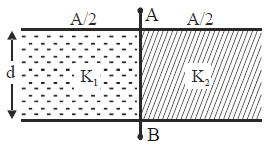
A parallel plate condenser is filled with two dielectrics as shown in figure. Area of each plate is A metre² and the separation is d metre. The dielectric constants are K1 and K2 respectively. Its capacitance in farad will be :


1. \[\frac{\varepsilon_{0A}}{d}\left( K_{1} +K_{2}\right)\]
2. \[\frac{\varepsilon_{0A}}{d}\frac{\left( K_{1} +K_{2}\right)}{2}\]
3. \[\frac{\varepsilon_{0A}}{d}2\left( K_{1} +K_{2}\right)\]
4. \[\frac{\varepsilon_{0A}}{d}\frac{\left( K_{1} -K_{2}\right)}{2}\]
View Answer

Both the parts can be taken as separate capacitors connected in parallel.

So, C=C1+ C2=\(\frac{\varepsilon_{0A}}{d}\frac{\left( K_{1} +K_{2}\right)}{2}\)

Question 3: moderate

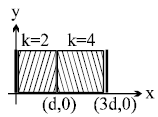
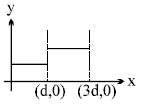
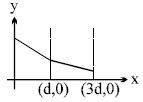
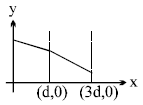
A parallel plate capacitor has two layers of dielectric as shown in figure. This capacitor is connected across a battery. The graph which shows the variation of electric field (E) and distance (x) from left plate.

1.
2.
3.
4.
View Answer

Given Information:

  1. Parallel plate capacitor: Contains two dielectric layers.
    • First layer (
      k=2k=2
       

      ) extends from 00 

      to dd 

      .

    • Second layer (
      k=4k=4
       

      ) extends from dd 

      to 3d3d 

      .

  2. Capacitor is connected to a battery: This means the potential difference
    VV
     

    across the plates is fixed.

Key Concepts:

  1. Electric Field in a Dielectric:
    • The electric field
      EE
       

      in a dielectric is inversely proportional to the dielectric constant kk 

      : E=σε0kE = \frac{\sigma}{\varepsilon_0 k} 

      where σ\sigma 

      is the surface charge density.

  2. Continuity of Potential:
    • Since the potential
      VV
       

      is constant across the capacitor, the sum of the potential drops across the two dielectric layers must equal VV 

      . For a uniform electric field in each region: V=E1d+E22dV = E_1 \cdot d + E_2 \cdot 2d 

      where E1E_1 

      and E2E_2 

      are the electric fields in the regions with k=2k=2 

      and k=4k=4 

      , respectively.

  3. Relation Between Fields:
    • The electric displacement
      D=ε0kE\mathbf{D} = \varepsilon_0 k E
       

      must be continuous across the boundary of the dielectrics: k1E1=k2E2k_1 E_1 = k_2 E_2 

      Substituting k1=2k_1 = 2 

      and k2=4k_2 = 4 

      , we find: 2E1=4E2E2=E122E_1 = 4E_2 \quad \Rightarrow \quad E_2 = \frac{E_1}{2} 

Explanation of the Graph:

  1. Region 1 (
    0x<d0 \leq x < d
     

    ):

    • In this region, the dielectric constant
      k=2k=2
       

      , so the electric field E1E_1 

      is relatively stronger compared to the next region.

  2. Region 2 (
    dx3dd \leq x \leq 3d
     

    ):

    • Here,
      k=4k=4
       

      , and since E2=E12E_2 = \frac{E_1}{2} 

      , the electric field is halved.

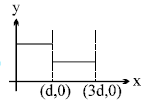
Thus, the electric field decreases discontinuously at

x=dx = d

due to the change in the dielectric constant, leading to the stepwise graph shown in the second figure.

Question 4: easy

A capacitor stores 60μC charge when connected across a battery. When the gap between the plates is filled with a dielectric , a charge of 120μC flows through the battery. The dielectric constant of the material inserted is :


1. 1
2. 2
3. 3
4. none
View Answer

Given:

  • Initial charge on the capacitor:
    Q1=60μCQ_1 = 60 \, \mu C
     
  • After inserting the dielectric, the total charge from the battery:
    Q2=120μCQ_2 = 120 \, \mu C
     

    (additional charge drawn is 120μC120 \, \mu C 

    , so the total charge on the capacitor is 120μC+60μC=180μC120 \, \mu C + 60 \, \mu C = 180 \, \mu C 

    ).

Key concept:

  • The charge on a capacitor is given by: 

    Q=CVQ = C \cdot Vwhere

    CCis the capacitance and

    VVis the potential difference across the plates.

  • The dielectric increases the capacitance of the capacitor. If the dielectric constant is
    KK
     

    , the capacitance becomes K×CK \times C 

    . Since the battery is still connected, the potential difference VV 

    remains constant, and the charge increases proportionally with the increase in capacitance.

Step 1: Relationship between charge and capacitance

Before the dielectric, the charge was

Q1=60μCQ_1 = 60 \, \mu C

, and after inserting the dielectric, the charge is

Q2=180μCQ_2 = 180 \, \mu C

.

The ratio of the final charge to the initial charge is proportional to the dielectric constant

KK

:


Q2Q1=K\frac{Q_2}{Q_1} = K


Step 2: Solve for KK


Substitute the given values:


K=180μC60μC=3K = \frac{180 \, \mu C}{60 \, \mu C} = 3


Final Answer:

The dielectric constant of the material inserted is 3.

Question 5: easy

A capacitor is charged by using a battery, which is then disconnected. A dielectric slab is then slided between the plates which results in :

1. reduction of charge on the plates and increase of potential difference across the plates
2. increase in the potential difference across the plates, reduction in stored energy but no change in the charge on the plates
3. decrease in the potential difference across the plates, reduction in stored energy, but no change in the charge on the plates
4. none of the above
View Answer

Let's break down the situation step by step:

Given:

  • A capacitor is charged using a battery and then disconnected (so no current can flow after disconnection).
  • A dielectric slab is inserted between the plates of the capacitor after disconnecting the battery.

Key concepts:

  • Capacitance with Dielectric: When a dielectric slab is inserted, the capacitance of the capacitor increases. The new capacitance
    CC'
     

    is related to the original capacitance CC 

    by the dielectric constant KK 

    C=KCC' = K \cdot Cwhere

    KKis the dielectric constant of the material.

  • Charge on the Plates: Since the capacitor is disconnected from the battery, no additional charge can flow onto the plates. Thus, the charge
    QQ
     

    remains the same, given by: 

    Q=CVQ = C \cdot Vwhere

    VVis the potential difference across the plates. Since the charge remains constant, the equation becomes:


    Q=CVQ = C' \cdot V'where

    VV'is the new potential difference across the plates.

  • Potential Difference: Since the capacitance increases and the charge stays constant, the potential difference
    VV'
     

    must decrease (because Q=CVQ = C' \cdot V' 

    and C>CC' > C 

    ).

  • Stored Energy: The energy stored in a capacitor is given by: 

    U=Q22CU = \frac{Q^2}{2C}Since the capacitance increases and the charge is constant, the stored energy

    UUdecreases, as it is inversely proportional to the capacitance.

Conclusion:

  • Decrease in potential difference: The potential difference across the plates decreases because the capacitance increases while the charge remains constant.
  • Reduction in stored energy: The energy stored in the capacitor decreases because the capacitance increases.
  • No change in charge: The charge on the plates remains the same since the capacitor is disconnected from the battery.

Thus, the correct answer is: "Decrease in the potential difference across the plates, reduction in stored energy, but no change in the charge on the plates."

Question 6: easy

A parallel plate capacitor has capacitance of \(10^{-12}\) F. The separation of the plates is doubled and wax is inserted between them which increases the capacitance to \(2\times 10^{-12}\) F. The dielectric constant of wax is :

1. 2
2. 3
3. 4.0
4. 8.0
View Answer

To solve this, we use the formula for the capacitance of a parallel plate capacitor:


C=kε0AdC = \frac{k \varepsilon_0 A}{d}


Where:


  • CC
     

    is the capacitance,


  • kk
     

    is the dielectric constant,


  • ε0\varepsilon_0
     

    is the permittivity of free space,


  • AA
     

    is the area of the plates, and


  • dd
     

    is the separation between the plates.

Given:

  • Initial capacitance without dielectric:
    C1=1012FC_1 = 10^{-12} \, \text{F}
     
  • Final capacitance with wax dielectric:
    C2=2×10¹²FC_2 = 2 \times 10^{-12} \, \text{F}
     
  • The separation between plates is doubled, so
    d2=2d1d_2 = 2d_1
     

    .

Step 1: Relate the initial and final capacitances

The capacitance of a capacitor is directly proportional to the dielectric constant and inversely proportional to the distance between the plates. So when the separation doubles and a dielectric with dielectric constant

kk

is inserted, the capacitance will change as follows:


C2=k×C12C_2 = k \times \frac{C_1}{2}


Step 2: Solve for kk


2×1012=k×101222 \times 10^{-12} = k \times \frac{10^{-12}}{2}


2×1012=k×101222 \times 10^{-12} = \frac{k \times 10^{-12}}{2}


k=4k = 4


Final Answer:

The dielectric constant of wax is 4.

Question 7: moderate

Two identical parallel plate capacitors A and B are connected in series with a battery of 100 V. A slab of dielectric constant K = 3 is inserted between the plates of capacitor A. Then, the potential difference across the capacitors will be, respectively:

1. 25 V, 75 V
2. 75 V, 25 V
3. 20 V, 80 V
4. 50 V, 50 V
View Answer

Here’s a shorter solution:

Given:


  • V=100VV = 100 \, \text{V}
     

    (total battery voltage)

  • Dielectric constant
    K=3K = 3
     

    for capacitor AA 

  • Identical capacitors
    AA
     

    and BB 

Step 1: Capacitance


  • CA=3C0C_A = 3C_0
     

    (because of the dielectric in AA 

    )


  • CB=C0C_B = C_0
     

    (no dielectric in BB 

    )

Step 2: Total capacitance in series:


1Ceq=1CA+1CB=13C0+1C0=43C0\frac{1}{C_{\text{eq}}} = \frac{1}{C_A} + \frac{1}{C_B} = \frac{1}{3C_0} + \frac{1}{C_0} = \frac{4}{3C_0}


Ceq=3C04C_{\text{eq}} = \frac{3C_0}{4}


Step 3: Voltage division:

The voltage is divided in proportion to the inverse of capacitances:


VA=CBCA+CB×100=C03C0+C0×100=14×100=25VV_A = \frac{C_B}{C_A + C_B} \times 100 = \frac{C_0}{3C_0 + C_0} \times 100 = \frac{1}{4} \times 100 = 25 \, \text{V}


VB=10025=75VV_B = 100 - 25 = 75 \, \text{V}


Final Answer:


  • VA=25VV_A = 25 \, \text{V}
     

  • VB=75VV_B = 75 \, \text{V}
     
Question 8: moderate

A parallel plate capacitor with air between the plates has a capacitance of 9 pF. The separation between its plates is ‘d’. The space between the plates is now filled with two dielectrics. One of the dielectrics has dielectric constant k1 = 3 and thickness d/3 while the other one has dielectric constant k2 = 6 and thickness 2d/3. Capacitance of the capacitor is now :

1. 45 pF
2. 40.5 pF
3. 20.25 pF
4. 1.8 pF
View Answer

Given:

  • Initial capacitance with air as the dielectric:
    C=9pFC = 9 \, \text{pF}
     
  • Dielectric constants:
    k1=3k_1 = 3
     

    , k2=6k_2 = 6 

  • Thicknesses of the dielectrics:
    d1=d3d_1 = \frac{d}{3}
     

    and d2=2d3d_2 = \frac{2d}{3} 

Step-by-step solution:

1. Capacitance formula:

The capacitance of a parallel plate capacitor is:


C=kε0AdC = \frac{k \varepsilon_0 A}{d}


Where:


  • kk
     

    is the dielectric constant,


  • ε0\varepsilon_0
     

    is the permittivity of free space,


  • AA
     

    is the area of the plates,


  • dd
     

    is the separation between the plates.

When we insert dielectrics in series, we treat the system as two capacitors in series with different dielectric constants.

2. Capacitance of each section:

  • For the dielectric with
    k1=3k_1 = 3
     

    and thickness d1=d3d_1 = \frac{d}{3} 

    , the capacitance C1C_1 

    is:


C1=k1ε0Ad1=3ε0Ad/3=9ε0AdC_1 = \frac{k_1 \varepsilon_0 A}{d_1} = \frac{3 \varepsilon_0 A}{d/3} = \frac{9 \varepsilon_0 A}{d}


  • For the dielectric with
    k2=6k_2 = 6
     

    and thickness d2=2d3d_2 = \frac{2d}{3} 

    , the capacitance C2C_2 

    is:


C2=k2ε0Ad2=6ε0A2d/3=9ε0AdC_2 = \frac{k_2 \varepsilon_0 A}{d_2} = \frac{6 \varepsilon_0 A}{2d/3} = \frac{9 \varepsilon_0 A}{d}


3. Total capacitance:

The total capacitance of the system is found by treating the two capacitances in series. For capacitors in series, the total capacitance

CtotalC_{\text{total}}

is given by:


1Ctotal=1C1+1C2\frac{1}{C_{\text{total}}} = \frac{1}{C_1} + \frac{1}{C_2}


Substitute

C1=C2=9ε0AdC_1 = C_2 = \frac{9 \varepsilon_0 A}{d}

:


1Ctotal=19ε0Ad+19ε0Ad=29ε0Ad\frac{1}{C_{\text{total}}} = \frac{1}{\frac{9 \varepsilon_0 A}{d}} + \frac{1}{\frac{9 \varepsilon_0 A}{d}} = \frac{2}{\frac{9 \varepsilon_0 A}{d}}


Thus,


Ctotal=9ε0A2dC_{\text{total}} = \frac{9 \varepsilon_0 A}{2d}


4. Relating to the original capacitance:

The original capacitance with air as the dielectric is:


C=ε0AdC = \frac{\varepsilon_0 A}{d}


Therefore, the total capacitance becomes:


Ctotal=92C=4.5C=4.5×9pF=40.5pFC_{\text{total}} = \frac{9}{2} C = 4.5 C = 4.5 \times 9 \, \text{pF} = 40.5 \, \text{pF}


Final Answer:

The total capacitance with the two dielectrics is 40.5 pF.

Thus, 40.5 pF is the correct answer.

Question 9: moderate

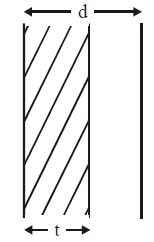
An isolated parallel-plate capacitor consists of two metal plates of area A and separation d. A slab of thickness t and dielectric constant K = 2 is inserted between the plates with its faces parallel to the plates and having the same surface area as that of the plates as shown

The capacitance of the system is :


1. \[\frac{\varepsilon_{0}A}{\left( d-\frac{t}{2} \right)}\]
2. \[\frac{\varepsilon_{0}A}{\left( d+\frac{t}{2} \right)}\]
3. \[\frac{\varepsilon_{0}A}{d-t}\]
4. \[\frac{\varepsilon_{0}A}{d+t}\]
View Answer

The question involves calculating the capacitance of a parallel-plate capacitor when a dielectric slab of thickness

tt

and dielectric constant

K=2K = 2

is partially inserted between the plates.

The short solution is based on treating the system as a combination of two capacitors in series:

  1. Capacitor 1 (region with dielectric): The thickness of this region is
    tt
     

    , and the capacitance is given by: 

    C1=ε0AKt=2ε0AtC_1 = \frac{\varepsilon_0 A K}{t} = \frac{2\varepsilon_0 A}{t} 

  2. Capacitor 2 (region without dielectric): The thickness of this region is
    dtd - t
     

    , and the capacitance is: 

    C2=ε0AdtC_2 = \frac{\varepsilon_0 A}{d - t} 

Since the two regions are in series, the equivalent capacitance is given by:


1C=1C1+1C2\frac{1}{C} = \frac{1}{C_1} + \frac{1}{C_2}


Substituting

C1C_1

and

C2C_2

:


1C=t2ε0A+dtε0A\frac{1}{C} = \frac{t}{2\varepsilon_0 A} + \frac{d - t}{\varepsilon_0 A}


Simplifying:


1C=t+2(dt)2ε0A=2dt2ε0A\frac{1}{C} = \frac{t + 2(d - t)}{2\varepsilon_0 A} = \frac{2d - t}{2\varepsilon_0 A}


Therefore:


C=2ε0A2dtC = \frac{2\varepsilon_0 A}{2d - t}


When the dielectric slab thickness is

t=d2t = \frac{d}{2}

, the capacitance simplifies to:


C=ε0Adt2C = \frac{\varepsilon_0 A}{d - \frac{t}{2}}


This matches the given answer. Let me know if further clarification is needed!

Question 10: moderate

A parallel plate air capacitor of capacitance C is connected to a cell of emf V and then disconnected from it. A dielectric slab of dielectric constant K, which can just fill the air gap of the capacitor, is now inserted in it. Which of the following is incorrect ?

1. The energy stored in the capacitor decreases K times
2. The change in energy stored is \( \frac{1}{2}CV^{2}\left( \frac{1}{K}-1 \right)\)
3. The charge on the capacitor is not conserved
4. The potential difference between the plates decreases K times.
View Answer

The incorrect statement is "The charge on the capacitor is not conserved".

Here’s the explanation:

  1. Initially, when the capacitor is connected to the battery with emf
    VV
     

    , it stores a charge

    Qinitial=C×VQ_{\text{initial}} = C \times V 

    , where

    CC 

    is the capacitance of the air capacitor.

  2. After disconnecting the capacitor from the battery, the charge on the capacitor is conserved because the capacitor is isolated. No charge can flow in or out.
  3. When the dielectric slab of dielectric constant
    KK
     

    is inserted, the capacitance of the capacitor increases to

    K×CK \times C 

    , but the charge remains the same because the capacitor is disconnected from the battery. The charge is now distributed on the new capacitance, and the voltage across the plates decreases.

  4. The statement "charge is not conserved" is incorrect because charge is conserved in this isolated system. The only change is in the voltage across the capacitor due to the increased capacitance.

Thus, charge on the capacitor is conserved and the incorrect statement is the one claiming otherwise.