Charging and Discharging of Capacitors - NEET Physics Questions
← Back to Capacitors

Charging and Discharging of Capacitors

Question 1: moderate

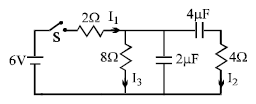
In the circuit shown in the figure, the switch S is initially open and the capacitor is initially uncharged. I1, I2 and I3 represent the current in the resistance 2Ω, 4Ω and 8Ω respectively.
1. Just after the switch S is closed, I1 = 3A, I2 = 3A and I3 = 0
2. Just after the switch S is closed, I1 = 3A, I2 = 0 and I3 = 0
3. long time after the switch S is closed, I1 = 0.6 A, I2 = 0 and I3 = 0
4. long after the switch S is closed, I1 = I2 = I3 = 0.6 A.
View Answer

Here's the short solution for the circuit:

  1. Just after the switch is closed:
    • The capacitors act as open circuits because they are initially uncharged (capacitor voltage cannot change instantaneously).
    • This means no current flows through the branches containing the capacitors.
  2. Current Distribution:
    • The total resistance in the circuit is only the sum of the resistors in the main loop (2Ω + 8Ω), as the branches with capacitors are effectively open.
    • Total resistance =
      2Ω+8Ω=10Ω2\Omega + 8\Omega = 10\Omega
       

      .

    • Current
      I1=VoltageResistance=6V2Ω+8Ω=0.6AI_1 = \frac{\text{Voltage}}{\text{Resistance}} = \frac{6V}{2\Omega + 8\Omega} = 0.6A
       

      .

  3. Branch currents:

    • I3=0I_3 = 0
       

      since the capacitor branch is open.


    • I2=0I_2 = 0
       

      for the same reason as above.

Final Answer:

  • \( I_1 = 0.6 A, \ I_2 = 0\)
Question 2: difficult

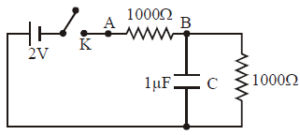
When the key K is pressed at t = 0, which of the following statements about the current I in the resistor AB of the given circuit is true ?

1. I = 2 mA at all t
2. I oscillates between 1 mA and 2 mA
3. I = 1 ma at all t
4. at t = 0, I = 2mA and with time it goes to 1 mA
View Answer

At t =0 capacitor behaves as closed circuit to the 1000 ohm resistor connected in parallel with capacitor will get short circuited.

current  through the other resistor = 2/1000 = 2mA

At t = infinite capacitor behaves as open circuit so equivalent resistance becomes R=1000+1000 = 2000 Ohm

current  through the  resistor = 2/2000 = 1 mA

Question 3: moderate

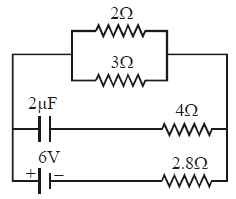
In the figure shown, the capacity of the condenser C is 2μF. The current in 2Ω resistor in steady state:

1. 9 A
2. 0.9 A
3. 1/9 A
4. 1/0.9 A
View Answer

In steady state no current flows through the capacitor so, current through 4 ohm resistor will be zero.

In absence of 4 ohm resistor, total resistance of circuit is (1.2+2.8)= 4 ohm.

Total current given by battery = 6/4=1.5 Ampere.

In parallel combination current divides in reverse ratio of resistors: (3/5)*1.5= 0.9 Ampere

Question 4: difficult

A capacitor is charged from a cell with the help of a resistor. The circuit has a time constant τ. The capacitor collects 10% of the steady charge at time t given by :

1. τln(1.1)
2. τ ln (10/9)
3. τ ln (0.9)
4. τ ln (0.1)
View Answer

The charging of a capacitor through a resistor is described by the following equation:


Q(t)=Qmax(1et/τ)Q(t) = Q_{\text{max}} \left( 1 - e^{-t/\tau} \right)


Where:


  • Q(t)Q(t)
     

    is the charge on the capacitor at time tt 

    ,


  • QmaxQ_{\text{max}}
     

    is the maximum (steady-state) charge the capacitor can hold,


  • τ\tau
     

    is the time constant, τ=RC\tau = R \cdot C 

    , where RR 

    is the resistance and CC 

    is the capacitance,


  • tt
     

    is the time.

Step 1: Given condition (10% of steady charge)

We are told that at time

tt

, the capacitor has collected 10% of the steady charge, so:


Q(t)=0.1QmaxQ(t) = 0.1 \cdot Q_{\text{max}}


Step 2: Substitute into the charging equation

Substitute

Q(t)=0.1QmaxQ(t) = 0.1 \cdot Q_{\text{max}}

into the charging formula:


0.1Qmax=Qmax(1et/τ)0.1 \cdot Q_{\text{max}} = Q_{\text{max}} \left( 1 - e^{-t/\tau} \right)


Cancel

QmaxQ_{\text{max}}

from both sides:


0.1=1et/τ0.1 = 1 - e^{-t/\tau}


Step 3: Solve for tt


Rearrange the equation to solve for

et/τe^{-t/\tau}

:


et/τ=10.1=0.9e^{-t/\tau} = 1 - 0.1 = 0.9


Take the natural logarithm of both sides:


tτ=ln(0.9)-\frac{t}{\tau} = \ln(0.9)


t=τln(0.9)t = -\tau \ln(0.9)


Using the fact that

ln(0.9)=ln(10/9)\ln(0.9) = -\ln(10/9)

:


t=τln(109)t = \tau \ln\left(\frac{10}{9}\right)


Final Answer:

The time at which the capacitor has collected 10% of the steady charge is

t=τln(109)t = \tau \ln\left(\frac{10}{9}\right)

.

Question 5: moderate

The electric field between the plates of a parallel-plate capacitor of capacitance \(2.0~\mu\text{F}\) drops to one third of its initial value in \(4.4~\mu\text{s}\) when the plates are connected by a thin wire. Find the resistance of the wire.

1. \(0.5~\Omega\)
2. \(0.1~\Omega\)
3. \(2~\Omega\)
4. \(1~\Omega\)
View Answer

The electric field in a discharging capacitor drops as \(E = E_0 e^{-t/RC}\). Given \(E = E_0/3\), we have \(RC = \frac{t}{\ln 3}\). Solving for \(R = \frac{4.4 \times 10^{-6}}{2.0 \times 10^{-6} \times 1.1} = 2~\Omega\).

Question 6: moderate

A \(5.0~\mu\text{F}\) capacitor having a charge of \(20~\mu\text{C}\) is discharged through a wire of resistance \(5.0~\Omega\). Find the heat dissipated in the wire between 25 to 50 \(\mu\text{s}\) after the connections are made.

1. \(40\left(\frac{1}{e^2} - \frac{1}{e^4}\right)~\mu\text{J}\)
2. \(40\left(\frac{1}{e} - \frac{1}{e^2}\right)~\mu\text{J}\)
3. \(40\left(\frac{1}{e^2} - \frac{1}{e^3}\right)~\mu\text{J}\)
4. None of these
View Answer

The remaining energy in the capacitor is \(U(t) = \frac{q_0^2}{2C}e^{-2t/tau}\), where \(tau = RC = 25~\mu\text{s}\). The heat dissipated is \(H = U(t_1) - U(t_2) = \frac{q_0^2}{2C}\left(e^{-2} - e^{-4}\right)\) where \(frac{q_0^2}{2C} = 40~\mu\text{J}\).

Question 7: easy

A capacitor is completely filled with a leaky dielectric. The capacitor is charged. It discharges with a time constant \(\tau = \rho k \epsilon_0\). The capacitor can be (Symbols have their usual meaning)

1. Parallel plate capacitor
2. Cylindrical capacitor
3. Spherical capacitor
4. Any of these
View Answer

For any capacitor geometry, capacitance is proportional to \(k\epsilon_0\) and resistance is proportional to resistivity \(\rho\), such that the shape factors cancel in \(\tau = RC = \rho k \epsilon_0\).

Question 8: difficult

A capacitor is connected to a \(12~\text{V}\) battery through a resistance of \(10~Omega\). It is found that the potential difference across the capacitor rises to \(4.0~\text{V}\) in \(1~\mu\text{s}\). Find the capacitance of the capacitor. (Take : \(ln \frac{3}{2} = 0.4\))

1. \(0.5~\mu\text{F}\)
2. \(0.25~\mu\text{F}\)
3. \(5.0~\mu\text{F}\)
4. \(1.0~\mu\text{F}\)
View Answer

Using \(V = V_0(1 - e^{-t/RC})\), we get \(4 = 12(1 - e^{-t/RC})⇒ e^{-t/RC} = 2/3\). Taking the natural logarithm, \(\frac{t}{RC} = \ln(1.5) = 0.4\), which yields \(C = \frac{10^{-6}}{10 \times 0.4} = 0.25~\mu\text{F}\).

Question 9: moderate

Let C be the capacitance of a capacitor discharging through a resistor R. Suppose \(t_1\) is the time taken for the energy stored in the capacitor to reduce to half its initial value and \(t_2\) is the time taken for the charge to reduce to one-fourth its initial value. Then the ratio \(t_1/t_2\) will be :

1. 2
2. 1
3. 1/2
4. ⇒1/4
View Answer

Energy is \(U \propto q^2 \propto e^{-2t/RC}\), so \(e^{-2t_1/RC} = 1/2 ⇒ t_1 = \frac{RC\ln 2}{2}\). Charge is \(q \propto e^{-t/RC}\), so \(e^{-t_2/RC} = 1/4 t_2 = 2RC\ln 2\). Thus, the ratio \(t_1/t_2 = 1/4\).

Question 10: difficult

A resistor ‘R’ and \(2~\mu\text{F}\) capacitor in series is connected through a switch to \(200~\text{V}\) direct supply. Across the capacitor is a neon bulb that lights up at \(120~\text{V}\). Calculate the value of R to make the bulb light up \(5~\text{s}\) after the switch has been closed. \((log_{10} 2.5 = 0.4)\)

1. \(2.7 \times 10^6~\Omega\)
2. \(3.3 \times 10^7~\Omega\)
3. \(1.3 \times 10^4~\Omega\)
4. \(1.7 \times 10^5~\Omega\)
View Answer

The charging voltage is \( V = V_0(1 - e^{-t/RC})\), so \(120 = 200(1 - e^{-t/RC})\) ⇒ \(e^{t/RC} = 2.5\). This gives \(t/RC = \ln 2.5 = 2.303 \log_{10} 2.5 \approx 0.921\). Solving with \(t = 5~text{s}\) and \(C = 2~\mu\text{F}\) gives \(R \approx 2.7 \times 10^6~\Omega\).