Thermodynamics - NEET Physics Questions
Question 1: easy

In a process the density of a gas remains constant. If the temperature is doubled, then the change in the pressure will be :

1. 100% increase
2. 200% increase
3. 50% decrease
4. 25% decrease
View Answer

Given that density \(\rho\) is constant, we use the ideal gas law:

\[
\frac{P}{T} = \text{constant (since } \rho \text{ is constant)}
\]

If the temperature \(T\) is doubled, then:

\[
\frac{P_2}{T_2} = \frac{P_1}{T_1} \Rightarrow \frac{P_2}{2T_1} = \frac{P_1}{T_1}
\]

Thus, \(P_2 = 2P_1\), meaning the pressure also doubles, resulting in a 100% increase.
Question 2: easy

Two gases A and B having the same temperature T, same pressure P and same volume V are mixed. If the mixture is at the same temperature T and occupies a volume V, the pressure of the mixture is :

1. 2P
2. P
3. P/2
4. 4P
View Answer

Since both gases \( A \) and \( B \) have the same temperature \( T \), pressure \( P \), and volume \( V \), each gas has the same number of moles, \( n \), by the ideal gas law:

\[
PV = nRT \Rightarrow n = \frac{PV}{RT}
\]

When gases \( A \) and \( B \) are mixed, the total number of moles becomes \( 2n \). Since temperature \( T \) and volume \( V \) remain the same, the total pressure \( P_{\text{mixture}} \) will be:

\[
P_{\text{mixture}} V = (2n)RT
\]

\[
P_{\text{mixture}} = 2P
\]

Answer: The pressure of the mixture is \( 2P \).

Question 3: easy

In the gas equation PV = nRT, the value of universal gas constant would depend only on :

1. The nature of the gas
2. The temperature of the gas
3. Pressure of the gas
4. The units of measurement
View Answer

In the gas equation \( PV = nRT \), the universal gas constant \( R \) has a fixed value but its numerical value depends on the units of \( P \), \( V \), and \( T \).

Answer: The value of the universal gas constant depends only on the units of measurement.

Question 4: easy

The quantity (PV/kT) represents :

1. Mass of the gas
2. KE of the gas
3. Number of moles of the gas
4. Number of molecules in the gas
View Answer

The expression \(\frac{PV}{kT}\) can be analyzed using the ideal gas law:

\[
PV = NkT
\]

where:
- \( P \) is pressure,
- \( V \) is volume,
- \( N \) is the number of molecules,
- \( k \) is Boltzmann's constant, and
- \( T \) is temperature.

Rearranging, we get:

\[
\frac{PV}{kT} = N
\]

Answer: This quantity represents the "number of molecules in the gas".

Question 5: easy

When the temperature of a gas in a metal box is increased from 27°C to 87°C, the initial pressure of 2 atmosphere changes to :

1. 1.0 atmosphere
2. 1.6 atmosphere
3. 2.4 atmosphere
4. 3 atmosphere
View Answer

Given:

- Initial temperature, \( T_1 = 27^\circ \text{C} = 300 \, \text{K} \)
- Final temperature, \( T_2 = 87^\circ \text{C} = 360 \, \text{K} \)
- Initial pressure, \( P_1 = 2 \, \text{atm} \)

Using the pressure-temperature relationship for a gas at constant volume:

\[
\frac{P_2}{P_1} = \frac{T_2}{T_1}
\]

Solving for \( P_2 \):

\[
P_2 = P_1 \times \frac{T_2}{T_1} = 2 \times \frac{360}{300} = 2 \times 1.2 = 2.4 \, \text{atm}
\]

Answer: \( P_2 = 2.4 \, \text{atm} \)

Question 6: easy

A large flask contains air at 27°C. In order to expel half the mass of air from the flask, the flask should be heated to :

1. 127°C
2. 327°C
3. 227°C
4. 183°C
View Answer

Given:

- Initial temperature, \( T_1 = 27^\circ \text{C} = 300 \, \text{K} \)
- We want to expel half the mass of air, meaning the final mass, \( m_2 = \frac{m_1}{2} \).

Using the ideal gas law, \( PV = nRT \), and since pressure and volume are constant, \( \frac{m}{T} = \text{constant} \).

Thus,

\[
\frac{m_1}{T_1} = \frac{m_2}{T_2}
\]

Substitute \( m_2 = \frac{m_1}{2} \):

\[
\frac{m_1}{300} = \frac{\frac{m_1}{2}}{T_2}
\]

Solving for \( T_2 \):

\[
T_2 = 2 \times 300 = 600 \, \text{K}
\]

Converting back to Celsius:

\[
T_2 = 600 - 273 = 327^\circ \text{C}
\]

Answer: \( T_2 = 327^\circ \text{C} \)

Question 7: easy

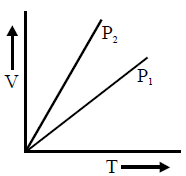
For V versus T curves at constant pressures P1 and P2 for an ideal gas shown in fig. :

1. P1 > P2
2. P1 < P2
3. P1 = P2
4. P1 ≥ P2
View Answer

To analyze the \( V \) versus \( T \) curves for an ideal gas at constant pressures \( P_1 \) and \( P_2 \):

According to Charles's Law:

\[
\frac{V}{T} = \frac{nR}{P}
\]

This implies:

1. At constant pressure, the volume \( V \) is directly proportional to the temperature \( T \), resulting in a straight line.

2. For a given temperature, the volume \( V \) will be greater at a lower pressure \( P \), because \( V \propto \frac{1}{P} \) for a fixed amount of gas.

In the graph:
- The line with a steeper slope corresponds to a lower pressure (since a lower \( P \) results in a larger \( V \) for the same \( T \)).

Since \( P_2 \) has a steeper slope than \( P_1 \), we conclude that:

\[
P_1 > P_2
\]

Therefore, the correct answer is \( P_1 > P_2 \).

Question 8: easy

The temperature of a gas contained in a closed vessel increases by 2°C, when the pressure is increased by 2%. The initial temperature of the gas is :

1. 200 K
2. 100 K
3. 200 °C
4. 100 °C
View Answer

Given:

- The increase in temperature \(\Delta T = 2^\circ \text{C} = 2 \text{ K}\)
- The increase in pressure \(\frac{\Delta P}{P} = 2\% = 0.02\)

Using the relation for a gas at constant volume, \(\frac{\Delta P}{P} = \frac{\Delta T}{T}\):

\[
0.02 = \frac{2}{T}
\]

Solving for \(T\):

\[
T = \frac{2}{0.02} = 100 \text{ K}
\]

Answer: \(T = 100 \, \text{K}\)

Question 9: easy

An ideal gas has a volume of 3V at 2 atmosphere pressure. Keeping the temperature constant, its pressure is doubled. The volume of the gas will be :

1. 6V
2. 3V
3. 1.5V
4. 1V
View Answer

Since the temperature is constant, we can use Boyle's Law, which states that \( P_1 V_1 = P_2 V_2 \).

Given:
- Initial pressure, \( P_1 = 2 \) atm
- Initial volume, \( V_1 = 3V \)
- Final pressure, \( P_2 = 2 \times P_1 = 4 \) atm

Using Boyle's Law:

\[
P_1 V_1 = P_2 V_2
\]
\[
2 \times 3V = 4 \times V_2
\]
\[
6V = 4V_2
\]
\[
V_2 = \frac{6V}{4} = 1.5V
\]

So, the final volume \( V_2 \) is \( 1.5V \).

Question 10: easy

At a given volume and temperature, the pressure of a gas :

1. varies inversely as its mass
2. varies inversely as the square of its mass
3. varies directly as its mass
4. is independent of its mass
View Answer

At constant volume and temperature, the ideal gas law is:

\[
PV = nRT
\]

Since \( n = \frac{\text{mass}}{\text{molar mass}} \), we can rewrite the equation as:

\[
P \propto \frac{\text{mass}}{M}
\]

Thus, for a given volume and temperature, the pressure \( P \) varies directly with the mass of the gas.