Thermodynamics - NEET Physics Questions
Question 1: moderate

‘A’ is a closed vessel of volume V and contains O2 at pressure P and temperature T. ‘B’ is another closed vessel of same volume and it contains H2 at same temperature and 2P pressure. Ratio of masses of O2 and H2 in vessel ‘A’ and ‘B’ is :

1. 2 : 1
2. 4 : 1
3. 8 : 1
4. 1 : 8
View Answer

Using the ideal gas law \( PV = nRT \), we find the moles \( n \) in each vessel:

1. For vessel \( A \) with \( O_2 \):
\[
n_{\text{O}_2} = \frac{PV}{RT}
\]

2. For vessel \( B \) with \( H_2 \) at \( 2P \):
\[
n_{\text{H}_2} = \frac{2PV}{RT} = 2 \times \frac{PV}{RT}
\]

Now, the mass \( m = n \times \text{molar mass} \):

- Mass of \( O_2 \) in \( A = n_{\text{O}_2} \times 32 = \frac{PV}{RT} \times 32 \)
- Mass of \( H_2 \) in \( B = n_{\text{H}_2} \times 2 = 2 \times \frac{PV}{RT} \times 2 \)

So, the mass ratio is:
\[
\frac{\text{mass of } O_2}{\text{mass of } H_2} = \frac{\frac{PV}{RT} \times 32}{2 \times \frac{PV}{RT} \times 2} = \frac{32}{4} = 8:1
\]
Question 2: moderate

One mole of an ideal gas undergoes a process \( P=\frac{_{P_{0}}}{1+\left( \frac{V_{0}}{V} \right)^{2}} \) , Here P0 and V0 are constants. Change in temperature of the gas when volume is changed from V = V0 to V = 2V0 is :

1. \[ \frac{-2P_{0}V_{0}}{5R}\]
2. \[ \frac{11P_{0}V_{0}}{10R}\]
3. \[ \frac{-5P_{0}V_{0}}{4R}\]
4. \[ P_{0}V_{0}\]
View Answer

For one mole of an ideal gas, we use the ideal gas law:

\[
PV = RT
\]

Given \( P = \frac{P_0}{1 + \left( \frac{V_0}{V} \right)^2} \), find \( T \) at \( V = V_0 \) and \( V = 2V_0 \).

1. When \( V = V_0 \):
\[
P = \frac{P_0}{1 + \left( \frac{V_0}{V_0} \right)^2} = \frac{P_0}{1 + 1} = \frac{P_0}{2}
\]
\[
T_1 = \frac{PV}{R} = \frac{\frac{P_0}{2} \cdot V_0}{R} = \frac{P_0 V_0}{2R}
\]

2. When \( V = 2V_0 \):
\[
P = \frac{P_0}{1 + \left( \frac{V_0}{2V_0} \right)^2} = \frac{P_0}{1 + \frac{1}{4}} = \frac{P_0}{\frac{5}{4}} = \frac{4P_0}{5}
\]
\[
T_2 = \frac{PV}{R} = \frac{\frac{4P_0}{5} \cdot 2V_0}{R} = \frac{8P_0 V_0}{5R}
\]

3. Change in temperature:
\[
\Delta T = T_2 - T_1 = \frac{8P_0 V_0}{5R} - \frac{P_0 V_0}{2R} = \frac{11P_0 V_0}{10R}
\]

Question 3: moderate

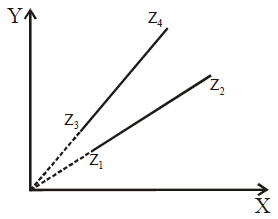
In the diagram as shown, find parameters representing x and y axis and also parameter z, if z1 = z2, z3 = z4 and z2 > z3 :

1. Volume, Pressure and temperature
2. Temperature, volume and pressure
3. Temperature, pressure and volume.
4. Both (2) and (3)
View Answer
Question 4: moderate

An ideal gas contained in a cylinder undergoes a thermodynamic process during which pressure relates to volume as \( P=\frac{A}{1+\left( \frac{B}{V} \right)^{2}}\), where A and B are constants. As the volume of the gas is changed from V = B to V = 2B, its change of temperature can be expressed as :

1. 6AB/5R
2. AB/2
3. -3AB/5R
4. 11AB/10R
View Answer

Given:

\[
P = \frac{A}{1 + \left( \frac{B}{V} \right)^2}
\]

Using the ideal gas equation, \( PV = nRT \), for initial and final states, we can express the temperature change.

 Step 1: Initial State (at \( V = B \))
\[
P_1 = \frac{A}{1 + \left( \frac{B}{B} \right)^2} = \frac{A}{2}
\]
\[
T_1 = \frac{P_1 V}{R} = \frac{\left(\frac{A}{2}\right) B}{R} = \frac{AB}{2R}
\]

Step 2: Final State (at \( V = 2B \))
\[
P_2 = \frac{A}{1 + \left( \frac{B}{2B} \right)^2} = \frac{A}{1 + \frac{1}{4}} = \frac{A}{\frac{5}{4}} = \frac{4A}{5}
\]
\[
T_2 = \frac{P_2 V}{R} = \frac{\left(\frac{4A}{5}\right) (2B)}{R} = \frac{8AB}{5R}
\]

 Step 3: Temperature Change
\[
\Delta T = T_2 - T_1 = \frac{8AB}{5R} - \frac{AB}{2R} = \frac{16AB - 5AB}{10R} = \frac{11AB}{10R}
\]

Answer: \(\frac{11AB}{10R}\)

Question 5: moderate

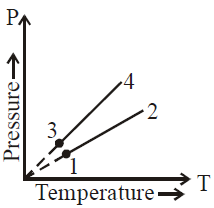
Pressure versus temperature graph of an ideal gas of equal number of moles (μ) of different volumes are plotted as shown in figure. Choose the correct alternative :

1. V1 = V2, V3 = V4 and V2 > V3
2. V1 = V2, V3 = V4 and V2 < V3
3. V1 = V2 = V3 = V4
4. V4 > V3 > V2 > V1
View Answer

For an ideal gas, at constant volume, the pressure \( P \) is directly proportional to the temperature \( T \) (Gay-Lussac's Law):

\[
P \propto T
\]

In the graph, each line represents a pressure-temperature relationship at different volumes. A steeper slope indicates a smaller volume (since \( P = \frac{nRT}{V} \) and a higher \( V \) gives a less steep line).

From the figure:
1. Lines \( 1 \) and \( 2 \) have the same slope, indicating \( V_1 = V_2 \).
2. Lines \( 3 \) and \( 4 \) also have the same slope, indicating \( V_3 = V_4 \).
3. The slope of lines \( 3 \) and \( 4 \) is steeper than that of lines \( 1 \) and \( 2 \), meaning \( V_2 > V_3 \).

Thus, the correct answer is \( V_1 = V_2 \), \( V_3 = V_4 \), and \( V_2 > V_3 \).

Question 6: moderate

A given volume of air at 17°C exerts a pressure of 870 mm of mercury. The temperature at which the pressure becomes 1800 mm of Hg is :

1. 300 K
2. 400 K
3. 500 K
4. 600 K
View Answer

To solve this, we can use Gay-Lussac's Law, which states:

\[
\frac{P_1}{T_1} = \frac{P_2}{T_2}
\]

Given:
- Initial pressure \( P_1 = 870 \, \text{mm Hg} \),
- Final pressure \( P_2 = 1800 \, \text{mm Hg} \),
- Initial temperature \( T_1 = 17^\circ \text{C} = 17 + 273 = 290 \, \text{K} \).

Rearrange to find \( T_2 \):

\[
T_2 = \frac{P_2 \times T_1}{P_1}
\]

Substitute the values:

\[
T_2 = \frac{1800 \times 290}{870}
\]

Calculating this:

\[
T_2 = 600 \, \text{K}
\]

So, the temperature at which the pressure becomes 1800 mm of Hg is  600 K.

Question 7: moderate

Which of the following methods will enable the volume of an ideal gas to be made four times ?
(Consider absolute temperature)

1. Quarter the pressure at constant temperature
2. Quarter the temperature at constant pressure
3. Half the temperature, double the pressure
4. Double the temperature, double the pressure
View Answer

To make the volume of an ideal gas four times its initial volume, we can use Boyle's Law, which states:

\[
P \propto \frac{1}{V} \quad \text{(at constant temperature)}
\]

If the initial pressure is \( P \) and the initial volume is \( V \), we want the final volume \( V_{\text{final}} = 4V \).

According to Boyle's Law:

\[
P_{\text{final}} \times V_{\text{final}} = P \times V
\]

Substituting \( V_{\text{final}} = 4V \):

\[
P_{\text{final}} \times 4V = P \times V
\]

\[
P_{\text{final}} = \frac{P}{4}
\]

So, to make the volume four times, we quarter the pressure at constant temperature.

Question 8: moderate

Find number of molecules of a gas at P = 1.4 × 10⁷ N/m², T = 227°C and V = 2 × 10–³ m³ :

1. \[ 10\times 10^{24}\]
2. \[ 4.06\times 10^{24}\]
3. \[ 14\times 10^{30}\]
4. \[ 30\times 10^{20}\]
View Answer

To find the number of molecules \( N \) of a gas, we can use the ideal gas law in terms of the number of molecules:

\[
PV = NkT
\]

where:
- \( P = 1.4 \times 10^7 \, \text{N/m}^2 \)
- \( V = 2 \times 10^{-3} \, \text{m}^3 \)
- \( T = 227^\circ \text{C} = 227 + 273 = 500 \, \text{K} \)
- \( k = 1.38 \times 10^{-23} \, \text{J/K} \) (Boltzmann constant)

Rearrange to solve for \( N \):

\[
N = \frac{PV}{kT}
\]

Substitute the values:

\[
N = \frac{(1.4 \times 10^7) \times (2 \times 10^{-3})}{(1.38 \times 10^{-23}) \times 500}
\]

Calculating this:

\[
N \approx 4.06 \times 10^{24}
\]

So, the number of molecules is \( 4.06 \times 10^{24} \).

Question 9: moderate

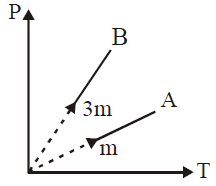
Two different masses m and 3m of an ideal gas are heated separately in a vessel of constant volume, the pressure P and absolute temperature T, graphs for these two cases are shown in the figure as A and B. The ratio of slopes of curves B to A is :

1. 3 : 1
2. 1 : 3
3. 9 : 1
4. 1 : 9
View Answer

To find the ratio of the slopes of curves \( B \) to \( A \) for gases with masses \( m \) and \( 3m \) at constant volume:

1. For an ideal gas at constant volume, \( P = \frac{nRT}{V} \).
2. Since \( n = \frac{\text{mass}}{\text{molar mass}} \), the pressure \( P \propto \frac{\text{mass} \cdot T}{M} \).
3. So, slope \( \propto \frac{\text{mass}}{M} \) for each gas.

For gas \( A \) with mass \( m \), let the slope be \( S \propto \frac{m}{M} \).
For gas \( B \) with mass \( 3m \), slope \( S_B \propto \frac{3m}{M} \).

Thus, the ratio of slopes \( \frac{S_B}{S_A} = \frac{3m/M}{m/M} = 3:1 \).

Question 10: moderate

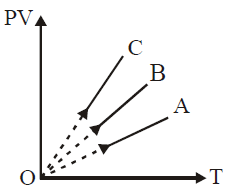
PV versus T graph of equal masses of H2, He and O2 is shown in fig. Choose the correct alternative :

1. C corresponds to H2 , B to He and A to O2
2. A corresponds to He, B to H2 and C to O2
3. A corresponds to He, B to O2 and C to H2
4. A corresponds to O2, B to H2 and C to He
View Answer

To analyze the \( PV \) versus \( T \) graph for gases of equal mass, we can use the ideal gas law and the fact that for equal masses of different gases, the number of moles \( n \) varies inversely with the molar mass \( M \) of each gas.

1. **Ideal Gas Law**:
\[
PV = nRT
\]
For a given temperature \( T \), \( PV \propto n \). Thus, \( PV \) will be larger for gases with more moles (i.e., smaller molar mass).

2. **Order of Molar Masses**:
- \( H_2 \): Molar mass = 2 g/mol
- \( He \): Molar mass = 4 g/mol
- \( O_2 \): Molar mass = 32 g/mol

Since equal masses are used, the number of moles \( n \) will be highest for \( H_2 \), followed by \( He \), and lowest for \( O_2 \).

3. **Conclusion**:
- Line with the highest \( PV \) value corresponds to the gas with the highest number of moles, i.e., \( H_2 \) (line **C**).
- The middle line corresponds to \( He \) (line **B**).
- The line with the lowest \( PV \) value corresponds to \( O_2 \) (line **A**).

Thus, **C corresponds to \( H_2 \)**, **B to \( He \)**, and **A to \( O_2 \)**.