Thermodynamics - NEET Physics Questions
Question 11: easy

A vessel has 6 g of hydrogen at pressure P and temperature 500 K. Their is a small hole in it so that hydogen leaks out. How much hydrogen leaks out if the final pressure is P/2 and temperature falls to 300 K ?

1. 2 g
2. 3 g
3. 4 g
4. 1 g
View Answer

To solve this, we can use the ideal gas law in terms of the number of moles \( n \):

\[
PV = nRT
\]

Let:
- Initial moles of hydrogen be \( n_1 \),
- Final moles of hydrogen be \( n_2 \).

Given data:
- Initial pressure \( P \),
- Final pressure \( P/2 \),
- Initial temperature \( T_1 = 500 \, \text{K} \),
- Final temperature \( T_2 = 300 \, \text{K} \),
- Mass of hydrogen initially = 6 g.

Since \( n = \frac{PV}{RT} \), we can write the initial and final moles as:

\[
n_1 = \frac{PV}{RT_1} \quad \text{and} \quad n_2 = \frac{(P/2)V}{R \cdot 300}
\]

Taking the ratio \( \frac{n_2}{n_1} \):

\[
\frac{n_2}{n_1} = \frac{(P/2) \cdot V / (R \cdot 300)}{P \cdot V / (R \cdot 500)} = \frac{1}{2} \times \frac{500}{300} = \frac{5}{12}
\]

Since initial moles \( n_1 = \frac{6}{2} = 3 \) moles (using molar mass of H₂ = 2 g/mol), then final moles \( n_2 = \frac{5}{12} \times 3 = 2.5 \) moles.

Thus, moles leaked out = \( 3 - 2.5 = 0.5 \) moles, corresponding to \( 0.5 \times 2 = 1 \) gram of hydrogen.

So, 1 g of hydrogen leaks out.
Question 12: easy

The pressure and temperature of two different gases is P and T having the volume V for each. They are mixed keeping the same volume and temperature, the pressure of the mixture will be :

1. P/2
2. P
3. 2P
4. 4P
View Answer

Since the gases are mixed at constant volume \( V \) and temperature \( T \), we can apply the ideal gas law for each gas:

For each gas, we have:
\[
P = \frac{nRT}{V}
\]

Since both gases have the same pressure \( P \), volume \( V \), and temperature \( T \), they contribute equally to the total pressure when mixed.

After mixing, the total pressure of the mixture is the sum of the partial pressures of each gas:
\[
P_{\text{total}} = P + P = 2P
\]

Thus, the pressure of the mixture is 2P.

Question 13: easy

The volume of a gas will be double of what it is at 0°C (pressure remaining constant) at :

1. 1092 K
2. 273 K
3. 546°C
4. 273°C
View Answer

To solve this, we use the relationship from Charles's Law, which states that for a gas at constant pressure:

\[
\frac{V_1}{T_1} = \frac{V_2}{T_2}
\]

where:
- \( V_1 \) is the initial volume at temperature \( T_1 \),
- \( V_2 \) is the final volume at temperature \( T_2 \).

Given:
- Initial temperature \( T_1 = 0^\circ \text{C} = 273 \, \text{K} \),
- \( V_2 = 2V_1 \) (double the initial volume).

Now, substituting into Charles's Law:

\[
\frac{V_1}{273} = \frac{2V_1}{T_2}
\]

Solving for \( T_2 \):

\[
T_2 = 2 \times 273 = 546 \, \text{K}
\]

Converting \( T_2 \) back to Celsius:

\[
T_2 = 546 - 273 = 273^\circ \text{C}
\]

So, the required temperature is 273°C.

Question 14: easy

During an experiment, an ideal gas is found to obey an additional law VP² = constant. The gas is initially at a temperature T and volume V. When it expands to a volume 2V, its temperature will be :

1. 2√2 T
2. 2T
3. √2 T
4. T
View Answer

Given that the gas obeys the law \( VP^2 = \text{constant} \).

1. Initially:
\[
VP^2 = k
\]

2. When the volume changes from \( V \) to \( 2V \):
\[
(2V)P'^2 = k
\]
where \( P' \) is the new pressure.

Since \( VP^2 = (2V)P'^2 \), we can relate the pressures as:
\[
P'^2 = \frac{P^2}{2}
\]
\[
P' = \frac{P}{\sqrt{2}}
\]

3. Use the ideal gas law initially and finally:
\[
PV = nRT
\]
\[
P' \cdot 2V = nRT'
\]

Substitute \( P' = \frac{P}{\sqrt{2}} \):
\[
\frac{P}{\sqrt{2}} \cdot 2V = nRT'
\]

4. Simplify:
\[
\sqrt{2} PV = nRT'
\]

Since \( PV = nRT \):
\[
\sqrt{2} \cdot nRT = nRT'
\]
\[
T' = \sqrt{2} T
\]

So, the new temperature is \( \sqrt{2} T \).

Question 15: easy

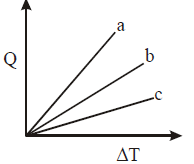
Figure shows the variation in temperature (ΔT) with the amount of heat supplied (Q) in an isobaric process corresponding to a monoatomic (M), diatomic (D) and a polyatomic (P) gas. The initial state of all the gases are the same and the scales for the two axes coincide. Ignoring vibrational degrees of freedom, the lines a, b and c respectively correspond to :

1. M, D and P
2. D, M and P
3. P, D and M
4. P, M and D
View Answer

To determine which line corresponds to each type of gas (monoatomic, diatomic, polyatomic), we can use the fact that the specific heat at constant pressure \( C_p \) varies with the degrees of freedom of each gas. Since \( Q = n C_p \Delta T \), for a given \( Q \), the slope of the \( Q \)-\( \Delta T \) line is inversely proportional to \( C_p \).

1. Monoatomic gas (M): \( C_p = \frac{5}{2} R \).
2. Diatomic gas (D): \( C_p = \frac{7}{2} R \).
3. Polyatomic gas (P): \( C_p \) is higher than both monoatomic and diatomic due to additional rotational degrees of freedom.

Since the slope is inversely related to \( C_p \):
- Line with the lowest slope (shallowest) corresponds to the monoatomic gas (M).
- Line with a medium slope corresponds to the diatomic gas (D).
- Line with the steepest slope corresponds to the polyatomic gas (P).

Thus, lines  a, b, and c correspond to  P, D, and M, respectively.

Question 16: easy

The following sets of values for Cv and Cp of a gas have been reported by different students. The units are cal/mole-K. Which of these sets is most reliable ?

1. Cv = 3, Cp = 5
2. Cv = 3, Cp = 6
3. Cv = 3, Cp = 2
4. Cv = 3, Cp = 4.2
View Answer

For an ideal gas, the relationship between \( C_p \) and \( C_v \) is:

\[
C_p - C_v = R
\]

where \( R \approx 2 \, \text{cal/mole-K} \).

Check each option:

1. If \( C_v = 3 \) and \( C_p = 5 \):
\[
C_p - C_v = 5 - 3 = 2 = R
\]
This matches the expected result.

2. Other sets will not satisfy \( C_p - C_v = 2 \) as accurately.

Thus, \( C_v = 3 \) and \( C_p = 5 \) is the most reliable set.