Thermodynamics - NEET Physics Questions
Question 1: difficult

A closed vessel A having volume V contains N2 gas at pressure P and temperature T. Another closed vessel B having the same volume V contains. He at the same pressure P but temperature 2T. The ratio of masses of N2 and He in the vessels A and B is :

1. 1 : 2
2. 3 : 2
3. 5 : 2
4. 14 :1
View Answer

To find the ratio of the masses of \( \text{N}_2 \) and \( \text{He} \) in vessels \( A \) and \( B \), we use the ideal gas law:

\[
PV = \frac{m}{M} RT
\]

where:
- \( m \) is the mass of the gas,
- \( M \) is the molar mass,
- \( P, V, R, T \) are pressure, volume, gas constant, and temperature, respectively.

For vessel \( A \) (containing \( \text{N}_2 \)):
\[
m_{\text{N}_2} = \frac{PVM_{\text{N}_2}}{RT}
\]

For vessel \( B \) (containing \( \text{He} \) at temperature \( 2T \)):
\[
m_{\text{He}} = \frac{PV M_{\text{He}}}{R \cdot 2T} = \frac{PVM_{\text{He}}}{2RT}
\]

Now, the ratio of the masses \( \frac{m_{\text{N}_2}}{m_{\text{He}}} \) is:

\[
\frac{m_{\text{N}_2}}{m_{\text{He}}} = \frac{\frac{PVM_{\text{N}_2}}{RT}}{\frac{PVM_{\text{He}}}{2RT}} = \frac{M_{\text{N}_2}}{M_{\text{He}}} \times 2
\]

Since \( M_{\text{N}_2} = 28 \) and \( M_{\text{He}} = 4 \):

\[
\frac{m_{\text{N}_2}}{m_{\text{He}}} = \frac{28}{4} \times 2 = 14
\]

Thus, the ratio of masses of \( \text{N}_2 \) to \( \text{He} \) is  14:1.
Question 2: difficult

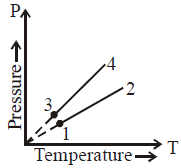
Pressure versus temperature graph of an ideal gas of equal number of moles (μ) of different volumes are plotted as shown in figure. Choose the correct alternative :

1. V1 = V2, V3 = V4 and V2 > V3
2. V1 = V2, V3 = V4 and V2 < V3
3. V1 = V2 = V3 = V4
4. V4 > V3 > V2 > V1
View Answer

Thank you for the clarification. Given the correct answer, let's interpret the graph accordingly.

In this pressure (\( P \)) vs. temperature (\( T \)) graph:

1. **Parallel Lines**: When two lines have the same slope, it implies they have the same volume. This is because the slope in a \( P \)-\( T \) graph (for constant \( V \)) is given by \( \frac{nR}{V} \).

- Since lines **1** and **2** are parallel, we have \( V_1 = V_2 \).
- Similarly, lines **3** and **4** are parallel, so \( V_3 = V_4 \).

2. **Comparing Slopes**: The line with a steeper slope corresponds to a smaller volume, and the line with a shallower slope corresponds to a larger volume.

- Since lines 1 and 2 have a shallower slope compared to lines 3 and 4, we conclude that \( V_1 = V_2 > V_3 = V_4 \).

Final Answer:
- \( V_1 = V_2 \), \( V_3 = V_4 \), and \( V_2 > V_3 \).