A beam of light propagating in medium A with index of refraction n (A) passes across an interface into medium B with index of refraction n(B). The angle of incidence is greater than the angle of refraction ; v(A) and v(B) denote the speed of light in A and B. Then which of the following is true :
The refractive index of a prism for a monochromatic wave is √2 and its refracting angle is 60°. For minimum deviation, the angle of incidence will be :
A prism (μ = 1.5) has refracting angle of 30°. The deviation of a monochromatic ray incident normally on its one surface will be : –
(sin 48° 36′ = 0.75)
For two positions of a lens, the images are obtained on a fixed screen. If the size of object is 2 cm and the size of diminished image is 0.5cm, the size of the other image will be :
Light rays from a source are incident on a glass prism of index of refraction μ and angle of prism α. At near normal incidence, the angle of deviation of the emerging rays is
The angle of minimum deviation for a prism is 40° and the angle of the prism is 60°. The angle of incidence in the position will be
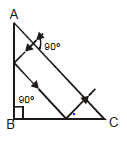
A ray falls on a prism ABC (AB = BC) and travels as shown in figure. The minimum refractive index of the prism material should be

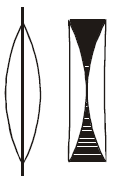
A thin equiconvex glass lens of focal length 10 cm is cut and separated and a material of refractive index 3 is filled between them. What is the focal length of the combination ?
\[\left( \mu_{glass}=1.5\right)\]

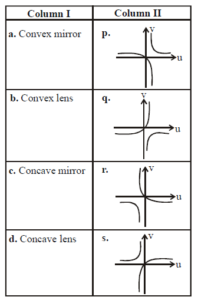
Match the correct u-v graph with optical system using Cartesian sign conventions :

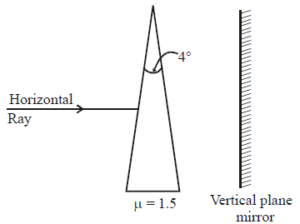
For the situations shown in the figure, determine the angle by which the mirror should be rotated, so that the light ray will retrace its path after refraction through the prism and reflection from the mirror ?