A small coin is resting on the bottom of a beaker filled with liquid. A ray of light from the coin travels upto the surface of the liquid and moves along its surface. How fast is the light travelling in the liquid ?
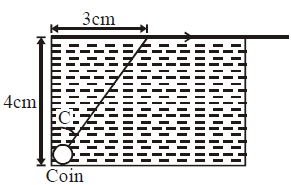
A small coin is resting on the bottom of a beaker filled with liquid. A ray of light from the coin travels upto the surface of the liquid and moves along its surface. How fast is the light travelling in the liquid ?
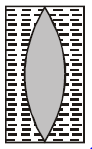
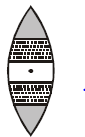
A convex lens is made up of three different materials as shown in the figure. For a point object placed on its axis, the number of images formed are :

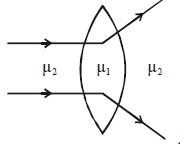
A convex lens made up of a material of refractive index μ1 is immersed in a medium of refractive index μ2 as shown in the figure. The relation between μ1 and μ2 is :

As shown in figure, a convergent lens is placed inside a cell filled with liquid. The lens has focal length +20 cm when in air, and its material has refractive index 1.50. If the liguid has refractive index 1.60, the focal length of the system is :

Two convex lens each of focal length 20 cm are separated by 125 cm. An object of height 0.5 cm placed at distance 25 cm left side from the first lens then, find height of the final image.
The angle of a prism is ‘A’. One of its refracting surfaces is silvered. Light rays falling at an angle of incidence 2A on the first surface returns back through the same path after suffering reflection at the silvered surface. The refractive index μ, of the prism is :
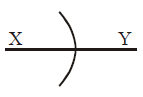
A concave spherical surface of radius of curvature 10 cm separates two medium X & Y of refractive index 4/3 & 3/2 respectively. If the object is placed along principal axis in medium X then :

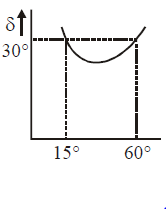
Figure shows graph of deviation d versus angle of incidence for a light ray striking a prism. Angle of prism is :

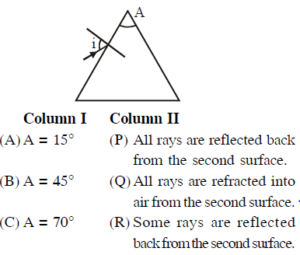
For a prism of refracting angle A and refractive index 2. Assume rays are incident at all angles of incidence 0° ≤ i ≤ 90°. Ignore partial reflection.

Two thin prisms of flint glass, with refracting angles of 6° and 8° respectively, possess dispersive powers in the ratio :