A thin Prism P1 with angle 4° and made from glass of refractive index 1.54 is combined with another thin Prism P2 made from glass of refractive index 1.72 to produce dispersion without deviation. The angle of Prism P2 is
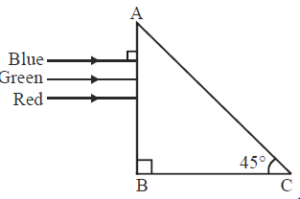
A beam of light consisting of red, green and blue colours incident on a right angled prism. The refractive index of the material of the prism for the above red, green and blue wavelengths are 1.39, 1.44 and 1.47, respectively.

The prism will :-
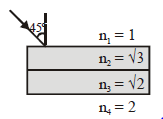
In the figure shown the angle made by the light ray with the normal in the medium of refractive index √2 is :

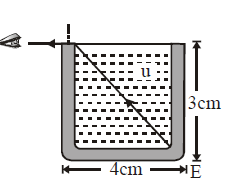
When the rectangular metal tank is filled to the top with an unknown liquid, as observer with eyes level with the top of the tank can just see the corner E; a ray that refracts towards the observer at the top surface of the liquid is shown. The refractive index of the liquid will be nearly :

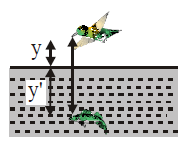
A fish rising vertically up towards the surface of water with speed 3 ms–1 and a bird diving vertically down towards it with speed 9 ms–¹. The velocity of bird with respect to fish and velocity of fish with respect to bird will be :

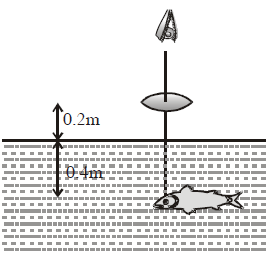
A small fish 0.4m below the surface of a lake , is viewed through a simple converging lens of focal length 3m. The lens is kept at 0.2 m above the water surface such that fish lies on the optical axis of the lens. The image of the fish seen by observer will be at \[v\]

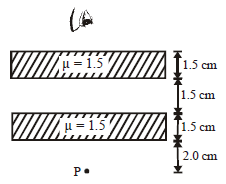
The image of point P when viewed from top of the slabs will be :

If in a plano-convex lens, the radius of curvature of the convex surface is 10 cm and the focal length of the lens is 30 cm, then the refractive index of the material of lens will be
Two convex lens of focal length 20 cm and 25 cm are placed in contact with each other, then power of this combination is
A convex lens of focal length 50 cm forms a real image of size three times of size of object then position of object will be :