A long straight wire along the z-axis carries a current I in the negative z-direction. The magnetic
vector field \[\overrightarrow{B}\] at a point having coordinates (x, y) in the z = 0 plane is :
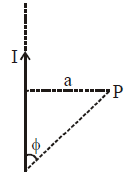
A semi-infinite straight conductor carries a current I P is a point at perpendicular distance a
from the conductor as shown. The field at P due to the conductor is :

A point charge q is in motion with velocity \[\overrightarrow{v}] relative to an inertial axis ‘A’. The instantaneous location of q with respect to a fixed observation point P is \[\overrightarrow{r}\] as shown. \[\overrightarrow{B}\]
the magnetic field at point P is given by :

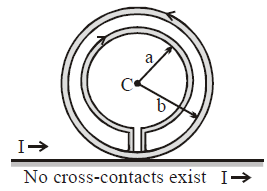
An otherwise infinite, straight wire has two concentric loops of radii a and b carrying equal
currents in opposite directions as shown. The magnetic field at the common centre is zero for

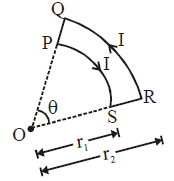
A wire loop is formed by joining two sections of radii r1 and r2 subtending an angle θ at O. The magnetic field at O is B0.

A long solenoid has 200 turns per cm and carries a current i. The magnetic field at its centre is 6.28 × 10–² weber/m². Another long solenoid has 100 turns per cm and it carries a current i/3. The value of the magnetic field at its centre is
To solve this problem, we use the formula for the magnetic field inside a long solenoid:
where:
is the magnetic field at the center of the solenoid,
is the permeability of free space,
is the number of turns per unit length (in meters),
is the current in the solenoid.
Step 1: Magnetic Field for the First Solenoid
The first solenoid has:
,
,
.
Using the formula for
, substitute
to find
:
Simplify:
Substitute
:
Step 2: Magnetic Field for the Second Solenoid
The second solenoid has:
,
.
Using the formula for
:
Substitute the values:
Simplify:
Substitute
:
Final Answer:
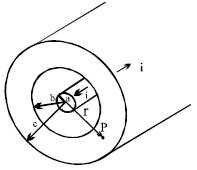
A coaxial cable having radius “a” of inner wire and inner and outer radii “b” and “c” respectively
of the outer shell carries equal and opposite currents of magnitude i on the inner and outer
conductors as shown. What is the magnitude of the magnetic induction at point P of the cable at
a distance r (b < r < c) from the axis?

To calculate the magnetic field
at a point
within the outer shell of a coaxial cable (
), carrying equal and opposite currents
on the inner and outer conductors, we use Ampère's law and superposition principles.
1. Current Distribution in the Outer Shell
The outer shell carries current
, distributed uniformly across the cross-sectional area of the shell between radii
and
.
The current density
in the shell is:
The current enclosed within a radius
(
) in the outer shell is the current
contributed by the region from
to
:
Substituting
:
2. Net Enclosed Current at Radius
At any point
within the shell (
), the net current enclosed by a loop of radius
is:
The inner wire contributes
, and the shell contributes
:
Simplify:
Factorize:
3. Magnetic Field at Radius
Using Ampère's law, the magnetic field
at radius
is:
Substitute
:
Solve for
:
Final Answer:
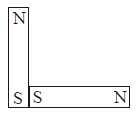
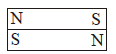
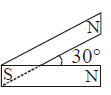
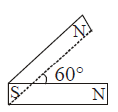
Following figures show the arrangement of bar magnets in different configuration. Each
magnet has magnetic dipole moment \[\overrightarrow{m}\] . Which configuration has highest net magnetic dipole moment?
Two long conductors, separated by a distance d carry currents I1 and I2 in the same direction. They exert a force F on each other. Now the current in one of them is increased to two times and its direction is reversed. The distance is also increased to 3d. The new value of the force between them is
An electric field E and a magnetic field B applied on a proton which moves with velocity v, it goes undeflected through the region if :