A proton, deutron and α-particle are accelerated by same potential, enters in uniform
magnetic field perpendicularly. Ratio of radii of circular path respectively :
An electron \left(mass = 9.1\times 10^{-31}kg; Charge=-1.6\times 10^{-19}C \right) experiences no deflection if subjected to an electric field of \[3.2\times 10^{5} V/m\] and a magnetic field of 2.0 × 10-³ Wb/m² . Both the fields are normal to the path of electron and to each other . If the electric field is removed, then the electron will revolve in an orbit of radius:
A particle having charge of 1 C, mass 1 kg and speed 1 m/s enters a uniform magnetic field, having magnetic induction of 1 T, at an angle θ = 30° between velocity vector and magnetic induction. The pitch of its helical path is (in meters)
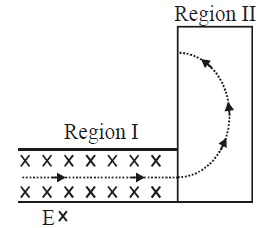
An electron moves in the plane of the page through two regions of space along the
dotted-line trajectory shown in the figure. There is a uniform electric field in Region-I directed
into the plane of the page (as shown). There is no electric field in Region-II. What is a
necessary direction of the magnetic field in regions I and II ? Ignore gravitational forces.

A long wire carrying a current of 2 A is laid along the x axis (current flows along positive
x direction) and another wire carrying current of 4 A is laid along y axis(current flows along
positive y direction). The points at which magnetic field is zero are:
A wire carrying current I has the shape as shown in adjoining figure. Linear parts of the wire are
very long and parallel to X-axis while semicircular portion of radius R is lying in Y-Z plane. Magnetic field at point O is :

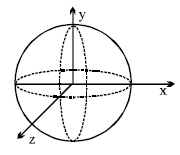
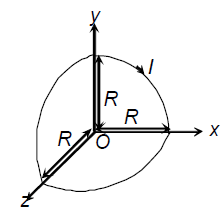
Three rings, each having equal radius R, are placed mutually perpendicular to each other
and each having its centre at the origin of coordinate system. If current I is flowing thriugh
each ring then the magnitude of the magnetic field at the common centre is

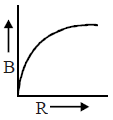
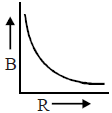
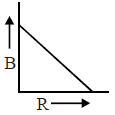
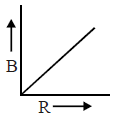
A charge Q is uniformly distributed over the surface of non-conducting disc of radius R. The
disc rotates about an axis perpendicular to its plane and passing through its centre with an
angular velocity ω. As a result of this rotation a magnetic field of induction B is obtained at
the centre of the disc. If we keep both the amount of charge placed on the disc and its
angular velocity to be constant and vary the radius of the disc then the variation of the
magnetic induction at the centre of the disc will be represented by the figure
In the given figure the magnitude of magnetic field at O is (all three wires are quarter circular arc)

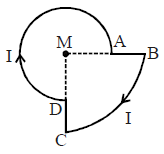
A current I is flowing through the loop. The direction of the current and the shape of the loop are as shown in the figure. The magnetic field at the centre of the loop is (MA = R, MB = 2R, angle DMA = 90°)