Magnetic Effects of Current - NEET Physics Questions
← All Chapters

Magnetic Effects of Current

Question 1: easy

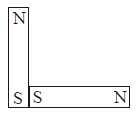
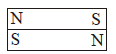
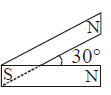
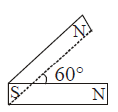
Following figures show the arrangement of bar magnets in different configuration. Each
magnet has magnetic dipole moment \[\overrightarrow{m}\] . Which configuration has highest net magnetic dipole moment?

1.
2.
3.
4.
View Answer
Question 2: easy

A proton, deutron and α-particle are accelerated by same potential, enters in uniform
magnetic field perpendicularly. Ratio of radii of circular path respectively :

1. 1: √2 : √2
2. 2 : 2 : 1
3. 1 : 2 : 1
4. 1 : 1 : 1
View Answer
Question 3: easy

If a long hollow copper pipe carries a direct current, the magnetic field associated with the current will be :

1. only inside the pipe
2. only outside the pipe
3. both inside and outside the pipe
4. neither inside nor outside the pipe
View Answer

Inside the pipe current enclosed will be zero so magnetic field will also be zero. Outside the pipe there will be net Magnetic field

Question 4: easy

In a co-axial straight cable, the central conductor and the outer conductor have equal currents in opposite directions. The magnetic induction is zero :

1. inside the inner conductor
2. inside the outer conductor
3. in between the two conductors
4. outside the outer conductors
View Answer

As outside the conductor net current enclosed is zero. using ampere circuital law Magnetic field is also zero.

Question 5: easy

A solenoid consists of 100 turns of wire and has a length of 10.0cm. The magnetic field inside the solenoid when it carries a current of 0.500 A will be :

1. \[6.28\times 10^{-4} T\]
2. \[6.28\times 10^{-5} T\]
3. \[3.14\times 10^{-4} T\]
4. none of these
View Answer

\[ B= \mu_{0}ni \] where n is number of turns per unit length

n= 100/0.1=1000

i=0.5

substituting we get \[ B = 6.28\times 10^{-4} T\]

Question 6: easy

Two particles X and Y having equal charges, after being accelerated through the same potential
difference, enter a region of uniform magnetic field and describe circular paths of radii R1 and
R2 respectively. The ratio of masses of X and Y is :

1. \[\left( R_{1}/R_{2} \right)^{1/2}\]
2. \[\left( R_{2}/R_{1} \right)\]
3. \[\left( R_{1}/R_{2} \right)^{2}\]
4. \[\left( R_{1}/R_{2} \right)\]
View Answer
Question 7: easy

A beam of electrons is projected horizontally to the right. A straight conductor carrying a current is supported parallel to the electron beam and above it. If the current in the conductor is from left to right, what will be the effect on the electron beam ?

1. The electron beam will be pulled upwards
2. The electron beam will be pulled downwards
3. The electron beam will be retarded
4. The electron beam will be speeded up towards the right
View Answer
Question 8: easy

A uniform electric field and a uniform magnetic field are produced, pointed in the same direction. An electron is projected with its velocity pointed in the same direction :

1. the electron will turn to its right
2. the electron will turn to its left
3. the electron velocity will increase in magnitude
4. the electron velocity will decrease in magnitude
View Answer
Question 9: easy

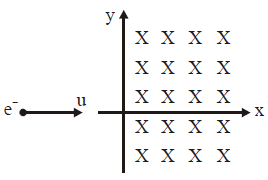
An electron moving with a speed u along the positive x-axis at y = 0 enters in a region of
uniform magnetic field \[\overrightarrow{B}=-B_{0}\hat{k}\] which exists to
the right of y-axis. The electron exits from the region after some time with speed v at coordinate
y, then :

1. v > u, y < 0
2. v = u, y > 0
3. v > u, y > 0
4. v = u, y < 0
View Answer
Question 10: easy

A length of wire carries a steady current. It is bent first to form a circular plane coil of one turn. The same length is now bent more sharply to give a double loop of smaller radius. The magnetic field at the centre caused by the same current is :

1. a quarter of its first value
2. unaltered
3. four times of its first value
4. half of its first value
View Answer