Magnetic Field Due to Straight Current Carrying Wire - NEET Physics Questions
← Back to Magnetic Effects of Current

Magnetic Field Due to Straight Current Carrying Wire

Question 1: difficult

A long straight wire along the z-axis carries a current I in the negative z-direction. The magnetic
vector field \[\overrightarrow{B}\]Β at a point having coordinates (x, y) in the z = 0 plane is :
1. \[\frac{\mu_{0}I}{2\pi}\left( \frac{y\hat{i}-x\hat{j}}{x^{2}+y^{2}} \right)\]
2. \[\frac{\mu_{0}I}{2\pi}\left( \frac{x\hat{i}+y\hat{j}}{x^{2}+y^{2}} \right)\]
3. \[\frac{\mu_{0}I}{2\pi}\left( \frac{x\hat{j}-y\hat{i}}{x^{2}+y^{2}} \right)\]
4. \[\frac{\mu_{0}I}{2\pi}\left( \frac{x\hat{i}-y\hat{j}}{x^{2}+y^{2}} \right)\]
View Answer
Question 2: moderate

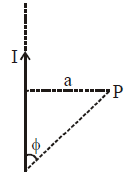
A semi-infinite straight conductor carries a current I P is a point at perpendicular distance a
from the conductor as shown. The field at P due to the conductor is :

1. \[B=\frac{\mu_{0}I}{4\pi a}(1+sin\phi):outwards\]
2. \[B=\frac{\mu_{0}I}{4\pi a}(1+cos\phi):outwards\]
3. \[B=\frac{\mu_{0}I}{4\pi a}(1+sin\phi):inwards\]
4. \[B=\frac{\mu_{0}I}{4\pi a}(1+cos\phi):inwards\]
View Answer
Question 3: moderate

A point charge q is in motion with velocity \[\overrightarrow{v}] relative to an inertial axis ‘A’. The instantaneous location of q with respect to a fixed observation point P is \[\overrightarrow{r}\] as shown. \[\overrightarrow{B}\]
the magnetic field at point P is given by :

1. \[\overrightarrow{B}=\frac{\mu_{0}q}{4\pi}\frac{(\overrightarrow{r}\times \overrightarrow{v})}{r^{3}}\]
2. \[\overrightarrow{B}=\frac{\mu_{0}q}{2\pi}\frac{(\overrightarrow{v}\times \overrightarrow{r})}{r^{3}}\]
3. \[\overrightarrow{B}=\frac{\mu_{0}q}{4\pi}\frac{(\overrightarrow{v}\times \overrightarrow{r})}{r^{3}}\]
4. Zero
View Answer
Question 4: difficult

A long wire carrying a current of 2 A is laid along the x axis (current flows along positive
x direction) and another wire carrying current of 4 A is laid along y axis(current flows along
positive y direction). The points at which magnetic field is zero are:

1. (2, 1, 0)
2. (1, 2, 0)
3. (6, 3, 1)
4. (–2, 4, 0)
View Answer
Question 5: moderate

A wire carrying current I has the shape as shown in adjoining figure. Linear parts of the wire are
very long and parallel to X-axis while semicircular portion of radius R is lying in Y-Z plane. Magnetic field at point O is :

1. \[\overrightarrow{B}=-\frac{\mu_{0}}{4\pi}\frac{I}{R}\left( \pi \hat{i}-2\hat{k} \right)\]
2. \[\overrightarrow{B}=-\frac{\mu_{0}}{4\pi}\frac{I}{R}\left( \pi \hat{i}+2\hat{k} \right)\]
3. \[\overrightarrow{B}=\frac{\mu_{0}}{4\pi}\frac{I}{R}\left( \pi \hat{i}-2\hat{k} \right)\]
4. \[\overrightarrow{B}=\frac{\mu_{0}}{4\pi}\frac{I}{R}\left( \pi \hat{i}+2\hat{k} \right)\]
View Answer
Question 6: difficult

A cube made of wires of equal length is connected to a battery as shown in the figure. The magnetic field at the centre of the cube is :

1. \[\frac{12\mu_{0}I}{\sqrt{2}\pi L}\]
2. \[\frac{6\mu_{0}I}{\sqrt{2}\pi L}\]
3. \[\frac{6\mu_{0}I}{\pi L}\]
4. zero
View Answer
Question 7: difficult

Adjoining figure shows a rectangular loop of conductor carrying a current i. The length and breadth of the loop are respectively a and b. The magnetic field at the centre of loop is :

1. \[\frac{\mu_{0}i\left( a+b \right)}{2\pi \sqrt{a^{2}+b^{2}}}\]
2. \[\frac{\mu_{0}iab}{2\pi \sqrt{a^{2}+b^{2}}}\]
3. \[\frac{\mu_{0}i\left( a+b \right)}{\pi \sqrt{a^{2}+b^{2}}}\]
4. \[\frac{2\mu_{0}i\sqrt{a^{2}+b^{2}}}{\pi ab}\]
View Answer
Question 8: difficult

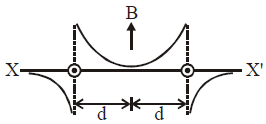
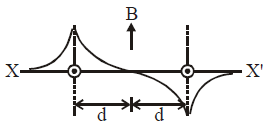
Two long parallel wires are at a distance 2d apart. The carry steady equal current flowing out of the plane of the paper as shown. The variation of the magnetic field along the line XX’ is given by :

1.
2.
3.
4.
View Answer
Question 9: difficult

Two identical wires A and B have the same length l and carry the same current I. Wire A is bent into a circle of radius R and wire B is bent to form a square of side a. If B1 and B2 are the values of magnetic induction at the centre of the circle and the centre of the square, respectively. then the ratio B1/B2 is :

1. (π² / 8)
2. (π² / 8√2)
3. (π² / 16)
4. (π² / 16√2)
View Answer
Question 10: moderate

A long straight, hollow, conductor (tube) carrying a current has two sections A and C of unequal cross sections joined by a conical section B. 1, 2 and 3 are points on a line parallel to the axis of the conductor. The magnetic fields at 1, 2 and 3 have magnitudes B1, B2 and B3. Then :

1. B1 = B2 = B3
2. B1 = B2 β‰  B3
3. B1 < B2 < B3
4. B2 cannot be found unless the dimensions of the section B are known
View Answer