Ampere's Circuital Law - NEET Physics Questions
Question 1: moderate

A long solenoid has 200 turns per cm and carries a current i. The magnetic field at its centre is 6.28 × 10–² weber/m². Another long solenoid has 100 turns per cm and it carries a current i/3. The value of the magnetic field at its centre is

1. \[1.05\times 10^{-2} weber/m^{2}\]
2. \[1.05\times 10^{-5} weber/m^{2}\]
3. \[1.05\times 10^{-3} weber/m^{2}\]
4. \[1.05\times 10^{-4} weber/m^{2}\]
View Answer

To solve this problem, we use the formula for the magnetic field inside a long solenoid:


B=μ0ni,B = \mu_0 n i,


where:


  • BB
     

    is the magnetic field at the center of the solenoid,


  • μ0=4π×107T\cdotpm/A\mu_0 = 4\pi \times 10^{-7} \, \text{T·m/A}
     

    is the permeability of free space,


  • nn
     

    is the number of turns per unit length (in meters),


  • ii
     

    is the current in the solenoid.


Step 1: Magnetic Field for the First Solenoid

The first solenoid has:


  • n1=200turns per cm=200×100=20000turns per metern_1 = 200 \, \text{turns per cm} = 200 \times 100 = 20000 \, \text{turns per meter}
     

    ,


  • i1=ii_1 = i
     

    ,


  • B1=6.28×10²weber/m2B_1 = 6.28 \times 10^{-2} \, \text{weber/m}^2
     

    .

Using the formula for

BB

, substitute

B1B_1

to find

ii

:


B1=μ0n1i,B_1 = \mu_0 n_1 i,


6.28×102=(4π×107)20000i.6.28 \times 10^{-2} = (4\pi \times 10^{-7}) \cdot 20000 \cdot i.


Simplify:


i=6.28×1024π×10720000.i = \frac{6.28 \times 10^{-2}}{4\pi \times 10^{-7} \cdot 20000}.


Substitute

4π12.574\pi \approx 12.57

:


i=6.28×10212.57×10720000=6.28×1022.514×102.i = \frac{6.28 \times 10^{-2}}{12.57 \times 10^{-7} \cdot 20000} = \frac{6.28 \times 10^{-2}}{2.514 \times 10^{-2}}.


i=2.5A.i = 2.5 \, \text{A}.


Step 2: Magnetic Field for the Second Solenoid

The second solenoid has:


  • n2=100turns per cm=100×100=10000turns per metern_2 = 100 \, \text{turns per cm} = 100 \times 100 = 10000 \, \text{turns per meter}
     

    ,


  • i2=i3=2.53=0.833Ai_2 = \frac{i}{3} = \frac{2.5}{3} = 0.833 \, \text{A}
     

    .

Using the formula for

BB

:


B2=μ0n2i2,B_2 = \mu_0 n_2 i_2,


Substitute the values:


B2=(4π×107)100000.833.B_2 = (4\pi \times 10^{-7}) \cdot 10000 \cdot 0.833.


Simplify:


B2=4π×1078330.B_2 = 4\pi \times 10^{-7} \cdot 8330.


Substitute

4π12.574\pi \approx 12.57

:


B2=12.57×1078330=1.048×102.B_2 = 12.57 \times 10^{-7} \cdot 8330 = 1.048 \times 10^{-2}.


Final Answer:


B2=1.05×10²weber/m2\boxed{B_2 = 1.05 \times 10^{-2} \, \text{weber/m}^2}


Question 2: difficult

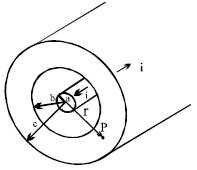
A coaxial cable having radius “a” of inner wire and inner and outer radii “b” and “c” respectively
of the outer shell carries equal and opposite currents of magnitude i on the inner and outer
conductors as shown. What is the magnitude of the magnetic induction at point P of the cable at
a distance r (b < r < c) from the axis?

1. Zero
2. \[\frac{\mu_{0}ir}{2\pi a^{2}}\]
3. \[\frac{\mu_{0}i}{2\pi r}\]
4. \[\frac{\mu_{0}i}{2\pi r}\frac{c^{2}-r^{2}}{c^{2}-b^{2}}\]
View Answer

To calculate the magnetic field

BB

at a point

PP

within the outer shell of a coaxial cable (

b<r<cb < r < c

), carrying equal and opposite currents

ii

on the inner and outer conductors, we use Ampère's law and superposition principles.


1. Current Distribution in the Outer Shell

The outer shell carries current

i-i

, distributed uniformly across the cross-sectional area of the shell between radii

bb

and

cc

.

The current density

JJ

in the shell is:


J=iπ(c2b2).J = \frac{-i}{\pi (c^2 - b^2)}.


The current enclosed within a radius

rr

(

b<r<cb < r < c

) in the outer shell is the current

i-i

contributed by the region from

bb

to

rr

:


Ienc,shell=Jarea of shell portion=Jπ(r2b2).I_{\text{enc,shell}} = J \cdot \text{area of shell portion} = J \cdot \pi (r^2 - b^2).


Substituting

JJ

:


Ienc,shell=iπ(c2b2)π(r2b2)=i(r2b2)c2b2.I_{\text{enc,shell}} = \frac{-i}{\pi (c^2 - b^2)} \cdot \pi (r^2 - b^2) = \frac{-i (r^2 - b^2)}{c^2 - b^2}.


2. Net Enclosed Current at Radius rr


At any point

PP

within the shell (

b<r<cb < r < c

), the net current enclosed by a loop of radius

rr

is:


Ienc=current from the inner wire+current from the outer shell.I_{\text{enc}} = \text{current from the inner wire} + \text{current from the outer shell}.


The inner wire contributes

+i+i

, and the shell contributes

Ienc,shellI_{\text{enc,shell}}

:


Ienc=i+i(r2b2)c2b2.I_{\text{enc}} = i + \frac{-i (r^2 - b^2)}{c^2 - b^2}.


Simplify:


Ienc=i(1r2b2c2b2).I_{\text{enc}} = i \left(1 - \frac{r^2 - b^2}{c^2 - b^2}\right).


Factorize:


Ienc=ic2r2c2b2.I_{\text{enc}} = i \cdot \frac{c^2 - r^2}{c^2 - b^2}.


3. Magnetic Field at Radius rr


Using Ampère's law, the magnetic field

BB

at radius

rr

is:


B2πr=μ0Ienc.B \cdot 2\pi r = \mu_0 I_{\text{enc}}.


Substitute

IencI_{\text{enc}}

:


B2πr=μ0ic2r2c2b2.B \cdot 2\pi r = \mu_0 \cdot i \cdot \frac{c^2 - r^2}{c^2 - b^2}.


Solve for

BB

:


B=μ0i2πrc2r2c2b2.B = \frac{\mu_0 i}{2\pi r} \cdot \frac{c^2 - r^2}{c^2 - b^2}.


Final Answer:


B=μ0i2πrc2r2c2b2\boxed{B = \frac{\mu_0 i}{2\pi r} \cdot \frac{c^2 - r^2}{c^2 - b^2}}


Question 3: easy

If a long hollow copper pipe carries a direct current, the magnetic field associated with the current will be :

1. only inside the pipe
2. only outside the pipe
3. both inside and outside the pipe
4. neither inside nor outside the pipe
View Answer

Inside the pipe current enclosed will be zero so magnetic field will also be zero. Outside the pipe there will be net Magnetic field

Question 4: easy

In a co-axial straight cable, the central conductor and the outer conductor have equal currents in opposite directions. The magnetic induction is zero :

1. inside the inner conductor
2. inside the outer conductor
3. in between the two conductors
4. outside the outer conductors
View Answer

As outside the conductor net current enclosed is zero. using ampere circuital law Magnetic field is also zero.

Question 5: easy

A solenoid consists of 100 turns of wire and has a length of 10.0cm. The magnetic field inside the solenoid when it carries a current of 0.500 A will be :

1. \[6.28\times 10^{-4} T\]
2. \[6.28\times 10^{-5} T\]
3. \[3.14\times 10^{-4} T\]
4. none of these
View Answer

\[ B= \mu_{0}ni \] where n is number of turns per unit length

n= 100/0.1=1000

i=0.5

substituting we get \[ B = 6.28\times 10^{-4} T\]

Question 6: moderate

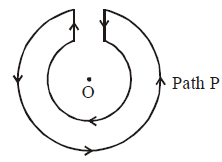
In the adjacent figure is shown a closed path P. A long straight conductor carrying a current I passes through O and perpendicular to the plane of the paper. Then which of the following holds good ?


1. \[\int_{P}^{}\overrightarrow{B}.\overrightarrow{dl}=0\]
2. \[\int_{P}^{}\overrightarrow{B}.\overrightarrow{dl}=\mu_{0}I\]
3. \[\int_{P}^{}\overrightarrow{B}.\overrightarrow{dl}>\mu_{0}I\]
4. None of these
View Answer

As Current enclosed is zero.  \[\int_{P}^{}\overrightarrow{B}.\overrightarrow{dl}=0\]

Question 7: moderate

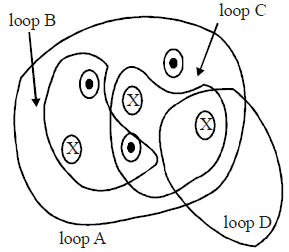
Consider six wires coming into or out of the page, all with the same current. Rank the line integral of the magnetic field (from most positive to most negative) taken counter-clockwise around each

loop shown.

1. B > C > D > A
2. B > C = D > A
3. B > A > C = D  
4. C > B = D > A
View Answer

Current enclosed in A = 3i -3i =0

Current enclosed in B = 2i-i=i

Current enclosed in C = - 2i + i= - i

Current enclosed in D= -i

so Correct order of integral of B.dl is B > A > C = D

Question 8: moderate

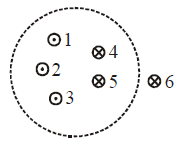
Six wires of current I1 = 1A, I2 = 2A, I3 = 3A, I4 = 1A, I5 = 4A, I6 = 5A cut the page perpendicular at points 1,2,3,4,5 and 6. The value of time integral of \(\overrightarrow{B}\) around the dotted closed path \(\left( i.e, \oint_{}^{}\overrightarrow{B} \overrightarrow{dl} \right)\)  is :

1. zero
2. \[\mu_{0} wb m^{-1}\]
3. \[2\mu_{0} wb m^{-1}\]
4. \[4\mu_{0} wb m^{-1}\]
View Answer

current enclosed is (1+2+3-1-4)= 1A

using ampere circuital law we get the answer.

Question 9: difficult

A hallow cylindrical wire carries current I, having inner & outer radius R & 2R respectively. Magnetic field at a point which is 5R/4 distance away from the wire :

1. \[\frac{5\mu_{0}I}{18\pi R}\]
2. \[\frac{\mu_{0}I}{36\pi R}\]
3. \[\frac{5\mu_{0}I}{36\pi R}\]
4. \[\frac{3}{40}\frac{\mu_{0}I}{\pi R}\]
View Answer

To solve for the magnetic field at a distance of

5R4\frac{5R}{4}

from the axis of a hollow cylindrical wire carrying current

II

, with inner radius

RR

and outer radius

2R2R

, we use Ampère's Law. The key steps are:

1. Magnetic Field Inside a Hollow Cylinder

For

R<r<2RR < r < 2R

(points within the shell of the cylinder):

  • Current density
    JJ
     

    is uniform, given by: 

    J=Iπ((2R)2R2)=I3πR2.J = \frac{I}{\pi \left((2R)^2 - R^2\right)} = \frac{I}{3\pi R^2}. 

  • The current enclosed within a radius
    rr
     

    (where R<r<2RR < r < 2R 

    ) is: 

    Ienc=Jarea enclosed=Jπ(r2R2).I_{\text{enc}} = J \cdot \text{area enclosed} = J \cdot \pi (r^2 - R^2).Substituting

    JJ:


    Ienc=I3πR2π(r2R2)=I3R2(r2R2).I_{\text{enc}} = \frac{I}{3\pi R^2} \cdot \pi (r^2 - R^2) = \frac{I}{3R^2}(r^2 - R^2). 

  • Using Ampère's Law: 

    B2πr=μ0Ienc,B \cdot 2\pi r = \mu_0 I_{\text{enc}}, 

    B=μ02πrI3R2(r2R2).B = \frac{\mu_0}{2\pi r} \cdot \frac{I}{3R^2}(r^2 - R^2). 

2. Magnetic Field at r=5R4r = \frac{5R}{4}


Since

5R4\frac{5R}{4}

lies within the shell (

R<r<2RR < r < 2R

), substitute

r=5R4r = \frac{5R}{4}

into the above equation:


B=μ02π5R4I3R2((5R4)2R2).B = \frac{\mu_0}{2\pi \cdot \frac{5R}{4}} \cdot \frac{I}{3R^2}\left(\left(\frac{5R}{4}\right)^2 - R^2\right).


Simplify:


  • r2=(5R4)2=25R216r^2 = \left(\frac{5R}{4}\right)^2 = \frac{25R^2}{16}
     

    ,


  • r2R2=25R216R2=25R21616R216=9R216r^2 - R^2 = \frac{25R^2}{16} - R^2 = \frac{25R^2}{16} - \frac{16R^2}{16} = \frac{9R^2}{16}
     

    .

Thus:


B=μ02π5R4I3R29R216.B = \frac{\mu_0}{2\pi \cdot \frac{5R}{4}} \cdot \frac{I}{3R^2} \cdot \frac{9R^2}{16}.


Simplify further:


B=μ02π45R9I48=μ0I2π36240R.B = \frac{\mu_0}{2\pi} \cdot \frac{4}{5R} \cdot \frac{9I}{48} = \frac{\mu_0 I}{2\pi} \cdot \frac{36}{240R}.


Final simplification:


B=340μ0IπR.B = \frac{3}{40} \frac{\mu_0 I}{\pi R}.


Final Answer:


B=340μ0IπR\boxed{B = \frac{3}{40} \frac{\mu_0 I}{\pi R}}


Question 10: easy

For the hollow thin cylindrical current carrying straight pipe which statement is correct:

1. Magnetic field inside the pipe is not zero.
2. Magnetic field outside the pipe is zero.
3. Electric field outside the pipe is zero.
4. Electric field on the surface of pipe is zero.
View Answer

Inside the hollow pipe, the magnetic field is zero according to Ampere's law. Since a current-carrying pipe is electrically neutral, the electric field outside the pipe is zero.