A rectangular loop carrying a current i1, is situated near a long straight wire carrying a steady current i2. The wire is parallel to one of the sides of the loop and is in the plane of the loop as shown in the figure. Then the current loop will :
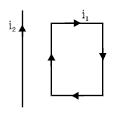
1. move away from the wire
2. move towards the wire.
3. remain stationary.
4. rotate about an axis parallel to the wire.
View Answer
A long straight wire carries an electric current \(4\text{ A}\). The magnetic induction at a perpendicular distance \(2\text{ m}\) from the wire is
1. \(2 \times 10^{-7}\text{ T}\)
2. \(4 \times 10^{-7}\text{ T}\)
3. \(2 \times 10^{-8}\text{ T}\)
4. \(4 \times 10^{-8}\text{ T}\)
View Answer
The magnetic field near a long straight wire is given by \(B = \frac{\mu_0 I}{2\pi r}\). Substituting \(I = 4\text{ A}\) and \(r = 2\text{ m}\) with \(\mu_0 = 4\pi \times 10^{-7}\text{ T m/A}\) gives \(B = \frac{4\pi \times 10^{-7} \times 4}{4\pi} = 4 \times 10^{-7}\text{ T}\).
A circular coil of radius \(R\) having current \(I\) is placed in a uniform magnetic field \(B\). If the angle between the area vector of the coil and the magnetic field is \(60^circ\), then the torque on the coil will be:
1. \[\frac{\pi R^2 I B}{2}\]
2. \[\frac{\sqrt{3}\pi R^2 I B}{2}\]
3. \(\pi R^2 I B\)
4. Zero
View Answer
The torque is given by \(\tau = MBsin\theta\), where \(M = I A = I(\pi R^2)\) and \(\theta = 60^\circ\). Thus, \(tau = I(\pi R^2)Bsin 60^\circ = \frac{\sqrt{3}\pi R^2 I B}{2}\).
A long solenoid having number of turns per unit length 200 carries a current of \(2.5 \text{ A}\), the magnetic field at the end of the solenoid is
1. \(6.28 \times 10^{-4} \text{ T}\)
2. \(3.14 \times 10^{-4} \text{ T}\)
3. \(6.28 \times 10^{-5} \text{ T}\)
4. \(3.14 \times 10^{-5} \text{ T}\)
View Answer
The magnetic field at the end of a long solenoid is \(B_{\text{end}} = \frac{1}{2} \mu_0 n I\). Substituting the given values: \(B_{\text{end}} = \frac{1}{2} (4\pi \times 10^{-7}) (200) (2.5) = 3.14 \times 10^{-4} \text{ T}\).
Assertion (A): Parallel current in wires attracts to each other due to magnetic force.
Reason (R): Two electron beams moving parallel to each other repels to each other due to electric force.
1. (1) Both (A) & (R) are true and the (R) is the correct explanation of the (A)
2. (2) Both (A) & (R) are true but the (R) is not the correct explanation of the (A)
3. (3) (A) is true but (R) is false
4. (4) Both (A) and (R) are false
View Answer
Wires with parallel currents attract due to magnetic force, so (A) is true. Two parallel electron beams experience electric repulsion due to like charges, so (R) is true. However, the magnetic force (A) and electric force (R) are distinct phenomena. Thus, (R) does not explain (A).
Assertion (A): Force on a current carrying wire of length \(dvec{l}\) placed in magnetic field \(vec{B}\) is given by \(d\vec{F} = Id\vec{l} \times \vec{B}\).
Reason (R): Net force on a current carrying loop in a non-uniform magnetic field must be non-zero.
1. (1) Both (A) & (R) are true and the (R) is the correct explanation of the (A)
2. (2) Both (A) & (R) are true but the (R) is not the correct explanation of the (A)
3. (3) (A) is true but (R) is false
4. (4) Both (A) and (R) are false
View Answer
The Lorentz force law states \(d\vec{F} = I(d\vec{l} \times \vec{B})\), so (A) is true. For a loop in a uniform field, net force is zero; in a non-uniform field, it is generally non-zero, so (R) is true. However, (R) is a consequence of the force law, not an explanation of the force law itself.