Question 21:
easy
The ratio of tension T1 and T2 is (strings are massless)
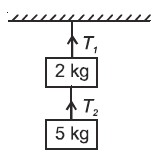
The ratio of tension T1 and T2 is (strings are massless)
A man of mass m is standing on a board and pulling the board of mass m up with force F by the pulley system as shown. Normal reaction between man and board is
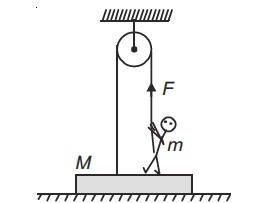
As the person is in equilibrium net force acting on it should be zero,
so, mg = N + F
⇒ N = mg - F
In the arrangement shown, the normal reaction between the block A and ground is:
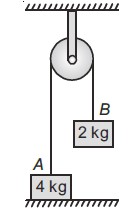
Weight of block = N.
Weight of block = N.
Tension in the string = Weight of = 20 N.
Normal reaction on , Weight of – Tension = N.
The value of frictional force on block in the given diagram is (Take g = 10 m/s²)
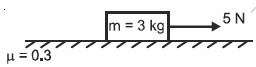
Maximum friction force acting on the object will be uN= 0.3 * 30 = 9 N
But applied force is 5N so friction force acting on the object will be 5N
In translatory equilibrium
In translational equilibrium the net force acting on the object is zero. so the object moves with constant velocity.
The minimum value of coefficient of friction (μ) such that block of mass ‘5 kg’ remains at rest is
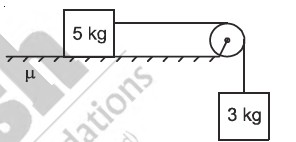
Given
kg,
kg, and
m/s²:
N
Solving,
.
Sand is poured on a conveyor belt at the rate of 2 kg/s. If belt is moving horizontally with velocity 4 m/s, then additional force required by engine to keep the belt moving with same constant velocity
The force required to keep the conveyor belt moving at a constant velocity is given by the rate of change of momentum.
Momentum of sand per second:
Given kg/s and m/s,
Thus, the additional force required is 8 N.
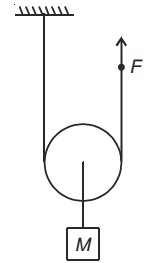
The force F needed to keep the block at equilibrium in given figure is (pulley and string are massless)
A block of mass m is in contact with the cart. The coefficient of static friction between the block and the cart is ü. The acceleration a of the cart that prevent the block from falling will be
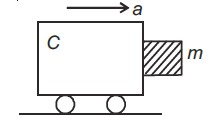
The condition to prevent the block from falling is that the friction force must be at least equal to the weight of the block:
Since static friction is given by and the normal force is due to pseudo force , we get:
Dividing both sides by :
Thus, the required acceleration of the cart is .
A truck is stationary and has a bob suspended by a light string, in a frame attached to the truck. The truck suddenly moves to the right with an acceleration of a. The pendulum will tilt
When the truck accelerates to the right with , a pseudo force acts to the left on the bob in the truck's frame. The bob reaches equilibrium where the tension components balance forces:
Thus, the pendulum tilts to the left at an angle with the vertical.