Laws of Motion - NEET Physics Questions
← All Chapters

Laws of Motion

Question 11: easy

Generally it is said “Normal reaction always acts perpendicular to the surface of contact” :

1. The statement is always correct
2. The statement is some times correct
3. The statement is correct
4. I can not comment, the way you have designed the question made me speech less.
View Answer

Normal reaction force is always normal ( Perpendicular ) to the surface.  
Question 12: easy

If a fly collides with the wind shield of a fast moving bus which experiences an impact force with a larger magnitude :

1. The fly
2. The bus
3. The same force is experienced by both
4. No force is experienced
View Answer

From Newton's third law of motion both bus and fly will experience equal force in opposite direction.

Question 13: easy

If action force is gravitational force, then reaction force :

1. May be electromagnetic force
2. May be electric force
3. May be spring force
4. Must be gravitational force
View Answer

Action and Reaction forces are of same nature.

Question 14: easy

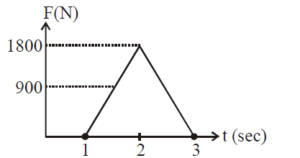
Figure shows an estimated force-time graph for a base ball struck by a bat from this curve determine impulse delivered to the ball.

1. 1800 kg-m/sec
2. 900 kg-m/sec
3. 2700 kg-m/sec
4. None of these
View Answer

Area bounded by force time graph with time axis represents impulse. Area of triangle in the figure is ⇒Impulse = ½×2 ×1800 = 1800 kg m/sec

Question 15: easy

In the motion picture ‘It happened one night’ (columbia pictures, 1934), Clark ceable in
standing inside a stationary bus in front of the claudetle colbert, who is seated, the bus suddenly starts moving forward and clark fall into claudetters lap which of following explains this phenomena best :

1. Newton's first law (Inertia of rest)
2. Newton's second law
3. Newton's third law
4. None of these
View Answer

Due to inertia of rest clark want to remain at rest. 

Question 16: easy

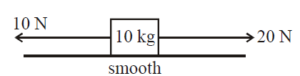
Acceleration of the block is

1. 1 m/sec²
2. 2 m/sec²
3. 3 m/sec²
4. 4 m/sec²
View Answer

Net force acting on the object is 10 N.

so, acceleration a = F/m = 10 N/10 kg= 1 m/s²

Question 17: easy

A force F = (3ˆi + 4ˆj +12kˆ ) N produces an acceleration of 1 m/sec² in a body, find the mass of the body :

1. 10 kg
2. 13 kg
3. 1 kg
4. 12 kg
View Answer

Given force is F = (3ˆi + 4ˆj +12kˆ ) N , magnitude of force is

⇒F²= (3²+4²+12²) so, F = 13 N

From Newton's second law of motion F= m.a

⇒ 13 N = m.1 so, m=13 kg

Question 18: easy

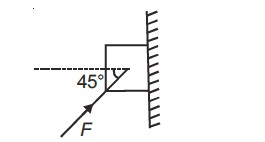
Block A of mass 4 kg is to be kept at rest against a smooth vertical wall by applying a force F as shown in figure. The force required is (g = 10 m/s²)

equilibrium based question in laws of motion neet physics

1. 40√2 N
2. 20√2 N
3. 10√2 N
4. 15√2 N
View Answer

equilibrium based question in laws of motion neet physics

For Equilibrium, F cos ( 45°) = 40

so, F = 40√2 N

Question 19: easy

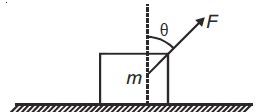
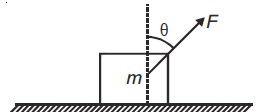
In the given arrangement, the normal force applied by block on the ground is


laws of motion neet physics questions

1. mg
2. mg – Fcosθ
3. mg + Fcosθ
4. Fcosθ
View Answer

For Equilibrium in vertical direction

F cos θ + N = mg

or N = mg - F cosθ

Question 20: easy

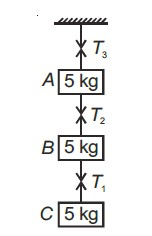
The value of \( \frac{T_{3}}{T_{1}} \) is

\[ \]


1. 1
2. 2
3. 3
4. 3/2
View Answer

As the arrangement is in equilibrium T3= 150 N and T1 = 50 N

so T3/T1=3