Laws of Motion - NEET Physics Questions
← All Chapters

Laws of Motion

Question 11: easy

A body of weight  W1 is suspended from the ceiling of a room through a chain of weight W2. The ceiling pulls the chain by a force

1. W1
2. W2
3. (W1+W2)/2
4. W1+W2
View Answer

Total weight of chain + block system is W1 +W2.
Question 12: easy

When a constant force is applied to a body, it moves with uniform

1. acceleration
2. velocity
3. speed
4. momentum
View Answer

From Newton's second law of motion, F= m.a

if force is constant acceleration remains constant.

Question 13: easy

A particle is moving with a constant speed along a straight line path. A force is not required to

1. increase its speed
2. decrease its momentum
3. change the direction
4. keep it moving with uniform velocity
View Answer

As the particle moves with constant speed in straight line its velocity is constant i.e accleration is zero. From Newton's second law of motion

F=m.a

Force required to keep moving with uniform velocity is zero.

Question 14: difficult

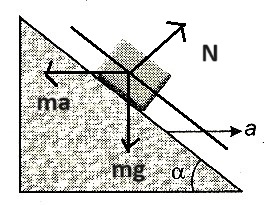
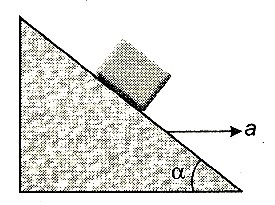
A block is kept on the frictionless inclined surface with angle of inclination . The incline is given an acceleration a to keep the block stationary w.r.t incline plane. Then a is equal to

1. g/tan α
2. g cosec α
3. g
4. g tan α
View Answer

Taking incline plane as frame of reference,  Pseudo force ma act towards right.

component of Pseudo force up the incline is m.a.cos α which is balanced by m.g.sin α. so,

m.a.cos α = m.g.sin α

⇒a= g tan α

Question 15: moderate

A fireman wants to slide down a rope. The rope can bear a tension of (3/4)th of the weight of the man. With what minimum acceleration should the fireman slide down:

1. g/3
2. g/6
3. g/4
4. g/2
View Answer

According to the question, T=3mg/4

Using equations of motion, i.e. Fnet = m.a

⇒mg-T =ma

⇒mg-3mg/4= ma

a =g/4

Question 16: moderate

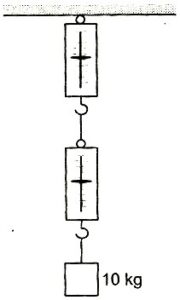
A block of mass 10 kg is suspended through two light spring balances as shown in figure


1. Both the scales will read 10 kg
2. Both the scales will read 5 kg
3. The upper scale will read 10 kg and the lower zero
4. The readings may be anything but their sum will be 10 kg.  
View Answer

Always remember that spring balance measure Tension in the string in form of kg-wt. As tension in the string is 10 kg-wt.

Reading of Both the scales will read 10 kg

Question 17: moderate

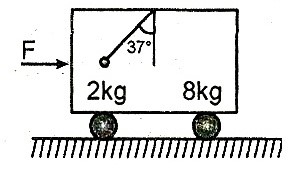
A trolley of mass 8 kg is standing on a frictionless surface inside which an object of mass 2 kg is suspended. A constant force F starts acting on the trolley as a result of which the string stood at an angle of 370 from the vertical (bob at rest relative to trolley) Then:

1. acceleration of the trolley is 40/3 m/sec.sec
2. force applied is 60 N
3. force applied is 75 N
4. force applied is 25 N
View Answer

Using concept of Pseudo force

a= g tanθ

⇒ a = g tan 37 = 10 ×3/4= 7.5 m/s^2

Using Equation of motion

⇒Fnet = 10×2.5 = 25 N

Question 18: moderate

Consider a car moving on a straight road with a speed of 10 ms-1. The distance at which car can be stopped is: [μ=0.5] 


1. 800 m
2. 10 m
3. 100 m
4. 400 m
View Answer

Friction force action on the object is f=μ.N= μ.mg

Retardation of the block is  a=μ.g = 0.5× 10 =5

Using equation of motion. Stopping distance = u^2/2a=(10 × 10)/( 2* 5)=10 m

Question 19: difficult

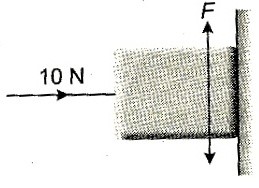
A horizontal force of 10 N is necessary to just hold a block stationary against a wall. The coefficient of friction between the block and the wall is 0.2. The weight of the block is

1. 20 N
2. 50 N
3. 100 N
4. 2 N
View Answer

Maximum Friction force action on an object is μN.

Here μ=0.2 and Normal reaction force will be equal to applied force i.e 10 N.,

So, friction force is 0.2*10 = 2N

Question 20: moderate

A marble block of mass 2 kg lying on ice when given a velocity of 6 ms-1 is stopped by friction in 10 s. Then the coefficient of friction is

1. 0.02
2. 0.03
3. 0.06
4. 0.01
View Answer

Using equation of motion

v= u + at

⇒ 0= 6 + a ×10

⇒ a= -0.6 m/sec^2

Maximum Friction force is μN = μ mg so, a= μ.g

⇒ -0.6 = - μ. 10

⇒μ = 0.06