Laws of Motion - NEET Physics Questions
← All Chapters

Laws of Motion

Question 51: moderate

A small block slides without friction down an inclined plane starting from rest. Let Sn be the distance travelled from time t = n – 1 to t = n. Then Sn/Sn+1 is :

1. 2n-1/2n
2. 2n+1/2n-1
3. 2n-1/2n+1
4. 2n/2n+1
View Answer

Sn = u + a/2(2n-1) = a/2(2n-1)

Sn+1 = u + a/2(2(n+1)-1) = a/2(2n+1)

Sn / Sn+1 = (2n-1)/(2n+1)
Question 52: easy

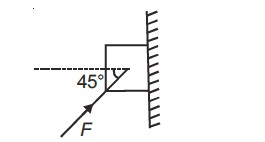
Block A of mass 4 kg is to be kept at rest against a smooth vertical wall by applying a force F as shown in figure. The force required is (g = 10 m/s²)

equilibrium based question in laws of motion neet physics

1. 40√2 N
2. 20√2 N
3. 10√2 N
4. 15√2 N
View Answer

equilibrium based question in laws of motion neet physics

For Equilibrium, F cos ( 45°) = 40

so, F = 40√2 N

Question 53: easy

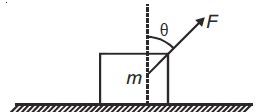
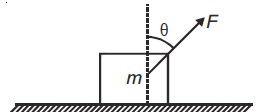
In the given arrangement, the normal force applied by block on the ground is


laws of motion neet physics questions

1. mg
2. mg – Fcosθ
3. mg + Fcosθ
4. Fcosθ
View Answer

For Equilibrium in vertical direction

F cos θ + N = mg

or N = mg - F cosθ

Question 54: easy

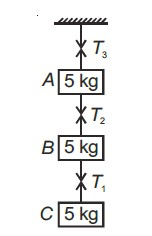
The value of \( \frac{T_{3}}{T_{1}} \) is

\[ \]


1. 1
2. 2
3. 3
4. 3/2
View Answer

As the arrangement is in equilibrium T3= 150 N and T1 = 50 N

so T3/T1=3

Question 55: easy

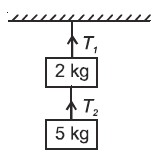
The ratio of tension T1 and T2 is (strings are massless)

1. 7 : 2
2. 7 : 5
3. 5 : 2
4. 2 : 7
View Answer

For Equilibrium Condition,


T1 = 70 N and T2 = 50 N so, T1: T2 = 7 : 5neet equilibrium question

Question 56: easy

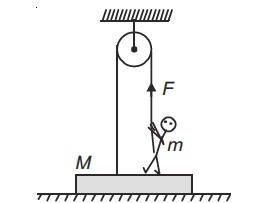
A man of mass m is standing on a board and pulling the board of mass m up with force F by the pulley system as shown. Normal reaction between man and board is


neet question for equilibrium NLM

1. mg – F
2. mg + F
3. (m + M) g + F
4. (m – M)g – F
View Answer

As the person is in equilibrium net force acting on it should be zero,

so, mg = N + F

⇒ N = mg - F

Question 57:

A uniform chain of mass m and length l is lying on a horizontal table with one third of its length hanging over the edge of the table. If the chain is in limiting equilibrium what is the coefficient of friction for the contact between the table and chain?

1. 1/3
2. 2/3
3. 3/4
4. 1/2
View Answer

The hanging part of the chain has weight

Wh=m3gW_h = \frac{m}{3} g

, and the part on the table has normal force

N=2m3gN = \frac{2m}{3} g

. In limiting equilibrium, friction

Ff=μNF_f = \mu N

balances

WhW_h

, so


μ×2m3g=m3g\mu \times \frac{2m}{3} g = \frac{m}{3} g


Solving,

μ=12\mu = \frac{1}{2}

.

Question 58: easy

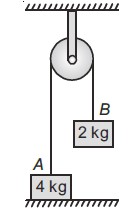
In the arrangement shown, the normal reaction between the block A and ground is:


1. 10 N
2. 20 N
3. 30 N
4. 40 N
View Answer

Weight of block AA = 4×10=404 \times 10 = 40 N.

Weight of block BB = 2×10=202 \times 10 = 20 N.

Tension in the string TT = Weight of BB = 20 N.

Normal reaction on AA, N=N = Weight of AA – Tension TT = 4020=2040 - 20 = 20 N.

Question 59: moderate

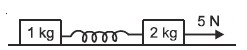
Two blocks of masses 1 kg and 2 kg are connected with massless spring as shown. If the acceleration of 1 kg block is 1 m/s² towards right then the acceleration of 2 kg block is: 

NLM Question NEET Physics

1. 2 m/s²
2. 1 m/s²
3. 3 m/s²
4. 5 m/s²
View Answer

Spring force acting on 1 kg block is F = m.a = 1 N

NLM Question NEET Physics

Same spring force will act on 2 kg block in opposite direction. Thus net force acting on 2 kg block is 5N - 1 N = 4N

Acceleration of the block will be 4 N/2 kg = 2 m/s²

Question 60: easy

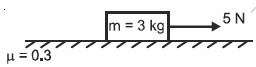
The value of frictional force on block in the given diagram is (Take g = 10 m/s²)

1. 4 N
2. 5 N
3. 6 N
4. 9 N
View Answer

Maximum friction force acting on the object will be uN= 0.3 * 30 = 9 N

But applied force is 5N so friction force acting on the object will be 5N