Question 41:
easy
If action force is gravitational force, then reaction force :
Action and Reaction forces are of same nature.
If action force is gravitational force, then reaction force :
Action and Reaction forces are of same nature.
Figure shows an estimated force-time graph for a base ball struck by a bat from this curve determine impulse delivered to the ball.
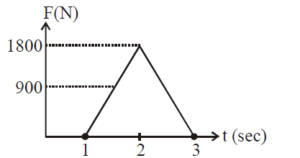
Area bounded by force time graph with time axis represents impulse. Area of triangle in the figure is ⇒Impulse = ½×2 ×1800 = 1800 kg m/sec
In the motion picture ‘It happened one night’ (columbia pictures, 1934), Clark ceable in
standing inside a stationary bus in front of the claudetle colbert, who is seated, the bus suddenly starts moving forward and clark fall into claudetters lap which of following explains this phenomena best :
Due to inertia of rest clark want to remain at rest.
Acceleration of the block is
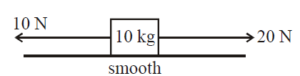
Net force acting on the object is 10 N.
so, acceleration a = F/m = 10 N/10 kg= 1 m/s²
Acceleration of the block is :
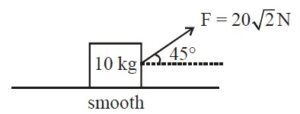
Horizontal component of force is F cosθ = 20√2 cos 45° = 20√2 × 1/√2 = 20 N.
So, Horizontal acceleration = 20N / 10kg = 2m/s²
A hammer of man 1 kg moving with a speed of 6 m/sec strikes a wall and comes to rest in 0.1 sec find average retarding force that stops the hammer :
According to Newtons second law of motion, Force is time rate of change in momentum.
So, F = change in momentum / time
F= m (vf-vi)/t= 1 kg (0-6)/0.1= -60 N
A force F = (3ˆi + 4ˆj +12kˆ ) N produces an acceleration of 1 m/sec² in a body, find the mass of the body :
Given force is F = (3ˆi + 4ˆj +12kˆ ) N , magnitude of force is
⇒F²= (3²+4²+12²) so, F = 13 N
From Newton's second law of motion F= m.a
⇒ 13 N = m.1 so, m=13 kg
A 5 kg block is resting on a frictionless plane, it is struck by a Jet, releasing water at the rate of 4 kg/sec emerging with a speed of 5 m/sec. Calculate the initial acceleration of block :
Force acting on the object is F = v.(dm/dt)= 5×4 = 20 N
so Acceleration is a= F/m = 20/5 = 4 m/s²
A body of mass 1 kg is acted upon by two perpendicular forces of 8 N and 6 N, find the magnitude of acceleration :
Resultant force on the object will be F= (8² + 6²)½= 10 N
So, acceleration is a = F/m = 10/1 = 10 m/s²
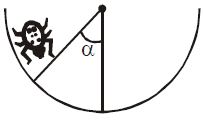
An insect crawls up a hemispherical surface very slowly (see the figure). The coefficient of friction between the insect and the surface is 1/3. If the line joining the centre of the hemispherical surface to the insect makes an angle a with the vertical, the maximum possible value of α is given by :