Laws of Motion - NEET Physics Questions
← All Chapters

Laws of Motion

Question 21: moderate

Consider the following two statements:

(A) Linear momentum of a system of particles is zero

(B) Kinetic energy of a system of particles is zero

Then: 

1. A does not imply B and B does not imply A
2. A implies B but B does not imply A
3. A does not imply B but B implies A
4. A implies B and B implies A
View Answer

When kinetic energy of the system is zero, speed of objects will be zero so momentum will always be zero.

Whereas momentum being a vector quantity may be zero when directions of velocities cancel each other. so speed and kinetic energy may of may not be zero when momentum is zero
Question 22: easy

A passenger in the bus finds that his suit-case suddenly starts sliding backwards. This means that the bus is :

1. Turning left
2. Turning right
3. Accelerating
4. Retarding
View Answer

This is due to inertia of motion. 

Question 23: easy

The linear momentum of a particle is given by P = a + bt², where t is time and a & b are constants. The force acting on the body is directly proportional to :

1.
2. t
3.
4.
View Answer

Given momentum of the object is P = a + bt²;

Force is defined as rate of change of momentum F= dP/dt= 2bt. so Force is proportional to t.

Question 24: easy

A body of mass 1 kg moving on a smooth horizontal surface with velocity 5m/s is to be brought to rest in 5 sec. How much force need to be applied :

1. 25N
2. 10N
3. 5N
4. 1N
View Answer

Force is defined as rate of change of momentum ie. F= dP/dt= change in momentum / time

Here Force = (mv-mu)/t= m(v-u)/t= 1 kg (0- 5)/ 5 = 1 N

Question 25: easy

The momentum of a particle is P = 2cos tˆi + 2sin t ˆj. What is the angle between the force F acting on the particle and the momentum P ?

1. 45°
2. 90°
3. 135°
4. 180°
View Answer

Momentum of object is given as, P = 2cos tˆi + 2sin t ˆj , 

From Newtons Second law, F = dP/dt = -2 sin t î + 2 cos t ˆj.

Taking Dot product of P and F we get = -4 sint . cos t + 4 sint .cost =0 .

So, force and momentum are perpendicular to each other.

Question 26: moderate

Two forces of 6N and 8N act on a body of mass 7 kg. The value of acceleration produced can not be more than :

1. 2m/s²
2. 4 m/s²
3. 6 m/s²
4. 8 m/s²
View Answer

Maximum resultant force will act on the object when 6N and 8 N forces will be acting in same direction. F max= 14 N.

Maximum Acceleration= Maximum Force/ mass= 14 N/ 7 kg = 2m/s²

Question 27: easy

Passengers standing in a bus are thrown outwards when the bus takes a sudden turn. This happens because of :

1. Outwards pull on them
2. Inertia
3. Change in momentum
4. Change in acceleration
View Answer

Due to inertia of direction person inside the bus has a tendency to move in a straight line. In case of sudden turn body ties to maintain its linear motion.

Question 28: easy

A body moving with uniform velocity is stopped in 0.25 sec by applying a force of 200 N. What is the impulse :

1. 5 N-s
2. 25 N-s
3. 50 N-s
4. 100 N-s
View Answer

Impulse is change in momentum so, J = F.dt = 200 × 0.25 =50 N-s

Question 29: moderate

A rocket of mass 6000 kg is set for vertical firing. If the exhaust speed be 1 km/s how much gas must be ejected to give the rocket an upward acceleration of 20 m/s² (neglect gravity) :-

1. 45 kg/sec
2. 90 kg/sec
3. 120 kg/sec
4. 12 × 10 ^4 kg/sec
View Answer

According to Newtons second law of motion

F= v. dm/dt

so, acceleration = v. (dm/dt)/m

⇒ 20 m/s² = 1000 ×(dm/dt)/6000

⇒dm/dt = 120 kg/sec

Question 30: moderate

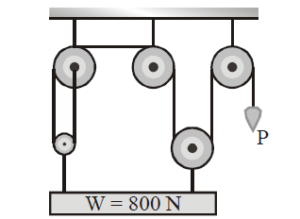
For the arrangement of pulleys shown in figure the effort (P) required to raise the given load (W) is

1. 200 N
2. 250 N
3. 800 N
4. 1000 N
View Answer

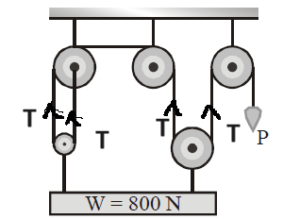
Net Force acting on the block in upward direction is 4T which will balance weight of the object. So, 

⇒ 4T= 800 N 

⇒T = 200 N