Electrostatics - NEET Physics Questions
← All Chapters

Electrostatics

Question 81: difficult

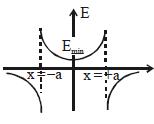
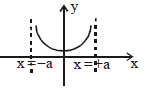
As shown in the figure a positive charge +q is placed at x = –a and negative charge –q is placed at x = + a. Then choose the curve which shows variation of E along the x-axis :
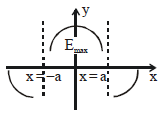
1.
2.
3.
4. none of these
View Answer

The figure represents the electric field (E) along the \(x\)-axis due to a dipole consisting of a positive charge (\(+q\)) at \(x = -a\) and a negative charge (\(-q\)) at \(x = +a\).

The electric field due to such a dipole varies as follows:

1. Near \(x = -a\): The field is dominated by the positive charge, so it points away from \(x = -a\).
2. Near \(x = +a\): The field is dominated by the negative charge, so it points toward \(x = +a\).
3. Between \(x = -a\) and \(x = +a\): The contributions from both charges partially cancel out, leading to a local minimum in the field magnitude.
4. Far from the charges (\(|x| \gg a\)): The field behaves approximately as a dipole field, decreasing as \(1/x^3\).

The attached graph correctly shows these features:
- A local minimum in \(E\) between \(x = -a\) and \(x = +a\), at the midpoint where the dipole effect is weakest.
- The field magnitude diverges near \(x = -a\) and \(x = +a\) due to the proximity to the charges.
- Symmetry around the origin is preserved, as the system is symmetric about \(x = 0\).
Question 82: moderate

A charge Q is placed at the mouth of a conical flask. The flux of the electric field through the flask is

1. \[ \frac{Q}{3\varepsilon_{0}}\]
2. \[ \frac{Q}{\varepsilon_{0}}\]
3. \[ \frac{Q}{2\varepsilon_{0}}\]
4. \[ \frac{2Q}{\varepsilon_{0}}\]
View Answer

The total flux due to a charge \(Q\) is given by Gauss's law:

\[
\Phi_{\text{total}} = \frac{Q}{\varepsilon_0}.
\]

Since the charge \(Q\) is placed at the mouth of the conical flask, the flux through the flask corresponds to half the total flux (because the charge is symmetrically distributed above and below the mouth):

\[
\Phi_{\text{flask}} = \frac{1}{2} \cdot \Phi_{\text{total}} = \frac{1}{2} \cdot \frac{Q}{\varepsilon_0}.
\]

Thus, the flux through the conical flask is:

\[
\Phi = \frac{Q}{2\varepsilon_0}.
\]

Question 83: moderate

In a certain region of surface there exists a uniform electric field of \( 2\times 10^{3}\hat{k} \) V/m. A rectangular coil of dimensions 10 cm × 20 cm is placed in x-y plane. The electric flux through the coil is 

1. zero
2. 4 × 10–³ V-m
3. 40 V-m
4. \[ 4\times 10^{5} V-m\]
View Answer

The electric flux is given by:

\[
\Phi = \vec{E} \cdot \vec{A} = E A \cos\theta,
\]

where:
- \(E = 2 \times 10^3 \, \text{V/m}\),
- \(A = \text{area of the coil} = 10 \, \text{cm} \times 20 \, \text{cm} = 0.1 \, \text{m} \times 0.2 \, \text{m} = 0.02 \, \text{m}^2\),
- \(\theta = 0^\circ\) (field is perpendicular to the coil, as the coil is in the \(xy\)-plane and the field is along \(\hat{k}\)).

Substitute values:
\[
\Phi = (2 \times 10^3) \cdot (0.02) \cdot \cos(0^\circ),
\]
\[
\Phi = 40 \, \text{V·m}.
\]

Thus, the electric flux is:

\[
40 \, \text{V·m}
\]

Question 84: difficult

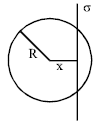
An infinite, uniformly charged sheet with surface charge density σ cuts through a spherical Gaussian surface of radius R at a distance x from its center, as shown in the figure. The electric flux Φ through the Gaussian surface is :

1. \[ \frac{\pi R^{2}\sigma}{\varepsilon_{0}}\]
2. \[ \frac{2\pi \left( R^{2}-x^{2} \right)\sigma}{\varepsilon_{0}}\]
3. \[ \frac{\pi \left( R-x \right)^{2}\sigma}{\varepsilon_{0}}\]
4. \[ \frac{\pi \left( R^{2}-x^{2} \right)\sigma}{\varepsilon_{0}}\]
View Answer

The electric flux \(\Phi\) through the Gaussian surface can be found using Gauss's law:

\[
\Phi = \frac{q_{\text{enc}}}{\epsilon_0}
\]

Here, \(q_{\text{enc}}\) is the charge enclosed by the spherical Gaussian surface.

Since the infinite sheet has a uniform surface charge density \(\sigma\), the charge enclosed is the product of \(\sigma\) and the area of the sheet that lies inside the sphere. The area of the sheet within the sphere is the area of the circle formed by the intersection, which has a radius \(r\) determined by the geometry of the sphere and the plane.

1. The radius of the intersection circle is \(r = \sqrt{R^2 - x^2}\).
2. The area of this circle is \(A = \pi r^2 = \pi (R^2 - x^2)\).

Thus, the enclosed charge is:

\[
q_{\text{enc}} = \sigma A = \sigma \pi (R^2 - x^2).
\]

Substituting this into Gauss's law:

\[
\Phi = \frac{\sigma \pi (R^2 - x^2)}{\epsilon_0}.
\]

So, the electric flux through the Gaussian surface is:

\[
\Phi = \frac{\sigma \pi (R^2 - x^2)}{\epsilon_0}.
\]

Question 85: moderate

The length of each side of a cubical closed surface is l. If charge q is situated on one of the vertices of the cube, then find the flux passing through shaded face of the cube.

1. \[ \frac{q}{6\varepsilon_{0}}\]
2. \[ \frac{q}{8\varepsilon_{0}}\]
3. \[ \frac{q}{24\varepsilon_{0}}\]
4. \[ \frac{q}{\varepsilon_{0}}\]
View Answer

To find the flux through the shaded face of the cube, we use symmetry:

1. The total flux through a closed surface is given by Gauss's law:
\[
\Phi_{\text{total}} = \frac{q}{\varepsilon_0}.
\]

2. The charge \(q\) is at one vertex of the cube. It is shared equally among 8 cubes because the vertex belongs to 8 adjacent cubes. Hence, the charge effectively enclosed in one cube is:
\[
q_{\text{enclosed}} = \frac{q}{8}.
\]

3. The flux through the entire surface of one cube is:
\[
\Phi_{\text{cube}} = \frac{q_{\text{enclosed}}}{\varepsilon_0} = \frac{q}{8\varepsilon_0}.
\]

4. A cube has 6 faces, and due to symmetry, the flux through each face is the same. Therefore, the flux through one face is:
\[
\Phi_{\text{one face}} = \frac{\Phi_{\text{cube}}}{6} = \frac{q}{48\varepsilon_0}.
\]

5. The shaded face is shared by 2 adjacent cubes, so it will receive twice the flux compared to one face:
\[
\Phi_{\text{shaded face}} = 2 \times \frac{q}{48\varepsilon_0} = \frac{q}{24\varepsilon_0}.
\]

Thus, the flux through the shaded face is:

\[
\Phi = \frac{q}{24\varepsilon_0}.
\]

Question 86: difficult

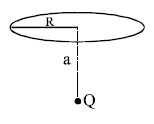
A point charge Q is located on the axis of a disc of radius R at a distance a from the plane of the disc. If one fourth (1/4th) of the flux from the charge passes through the disc, then find the relation between a & R.


1. a = R/2
2. \[ a =\frac{R}{\sqrt{3}}\]
3. a = R
4. \[ a =\frac{R}{\sqrt{2}}\]
View Answer

To solve the problem using the formula:

\[
\Phi = \frac{Q}{2\varepsilon_0} \left(1 - \cos\theta\right),
\]

where \(\theta\) is the half-angle subtended by the disc at the charge, follow these steps:

1. The flux through the disc is given to be one-fourth of the total flux:
\[
\Phi = \frac{1}{4} \cdot \frac{Q}{\varepsilon_0}.
\]

Substituting this into the formula:
\[
\frac{1}{4} \cdot \frac{Q}{\varepsilon_0} = \frac{Q}{2\varepsilon_0} \left(1 - \cos\theta\right).
\]

2. Simplify:
\[
\frac{1}{4} = \frac{1}{2} \left(1 - \cos\theta\right).
\]

3. Multiply through by 2:
\[
\frac{1}{2} = 1 - \cos\theta.
\]

4. Solve for \(\cos\theta\):
\[
\cos\theta = 1 - \frac{1}{2} = \frac{1}{2}.
\]

5. Using the geometry, \(\cos\theta = \frac{a}{\sqrt{a^2 + R^2}}\). Substituting:
\[
\frac{a}{\sqrt{a^2 + R^2}} = \frac{1}{2}.
\]

6. Square both sides:
\[
\frac{a^2}{a^2 + R^2} = \frac{1}{4}.
\]

7. Rearrange:
\[
4a^2 = a^2 + R^2.
\]

\[
3a^2 = R^2.
\]

8. Solve for \(a\):
\[
a = \frac{R}{\sqrt{3}}.
\]

Thus, the relation is:

\[
a = \frac{R}{\sqrt{3}}.
\]

Question 87: difficult

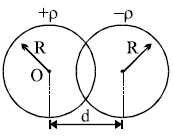
There are two non-conducting spheres having uniform volume charge densities ρ and –ρ . Both spheres have equal radius R. The spheres are
now laid down such that they overlaps as shown in the figure. The electric field \(\overrightarrow{E}\) in the overlap region is

1. non uniform
2. zero
3. \[ \frac{\rho}{3\epsilon_{0}}\overrightarrow{d}\]
4. \[ \frac{\rho}{3\epsilon_{0}}\overrightarrow{r}\]
View Answer

To calculate the electric field in the overlap region, we use the principle of superposition of electric fields. Let's analyze:

Step 1: Electric field due to one sphere
For a uniformly charged non-conducting sphere, the electric field inside the sphere at a distance \(\vec{r}\) from the center is:

\[
\vec{E}_{\text{sphere}} = \frac{\rho}{3\epsilon_0} \vec{r}
\]

Here:
- \(\rho\) is the charge density of the sphere,
- \(\epsilon_0\) is the permittivity of free space,
- \(\vec{r}\) is the position vector from the center of the sphere.

Step 2: Contribution of both spheres in the overlap region
- For the positively charged sphere (\(+\rho\)), the electric field at any point in the overlap region is directed **away** from its center, proportional to \(\vec{r}_1\) (distance from its center).
- For the negatively charged sphere (\(-\rho\)), the electric field at any point in the overlap region is directed **toward** its center, proportional to \(\vec{r}_2\) (distance from its center).

Thus, the net electric field is the vector sum:

\[
\vec{E}_{\text{net}} = \frac{\rho}{3\epsilon_0} \vec{r}_1 + \frac{-\rho}{3\epsilon_0} \vec{r}_2
\]

Step 3: Relation between \(\vec{r}_1\), \(\vec{r}_2\), and \(\vec{d}\)
In the overlap region, \(\vec{r}_1 - \vec{r}_2 = \vec{d}\), where \(\vec{d}\) is the displacement vector between the centers of the two spheres.

Substitute this into the expression for \(\vec{E}_{\text{net}}\):

\[
\vec{E}_{\text{net}} = \frac{\rho}{3\epsilon_0} (\vec{r}_1 - \vec{r}_2) = \frac{\rho}{3\epsilon_0} \vec{d}
\]

Final Answer:

The electric field in the overlap region is:

\[
{\frac{\rho}{3\epsilon_0} \vec{d}}
\]

Question 88: moderate

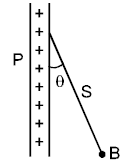
A charged ball B hangs from a silk thread S which makes an angle θ with a large charged conducting sheet P, as shown in the figure. The surface charge density ρ of the sheet is proportional to :


1. cos θ
2. cot θ
3. sin θ
4. tan θ
View Answer

To solve for the proportionality of the surface charge density \(\sigma\) with \(\tan\theta\), we analyze the forces acting on the charged ball \(B\):

Step 1: Forces acting on the ball
1. Gravitational force (\(F_g\)): Acts vertically downward, magnitude \(F_g = mg\), where \(m\) is the mass of the ball.
2. Electric force (\(F_e\)): Acts horizontally, due to the electric field produced by the charged conducting sheet.
3. Tension (\(T\)): Acts along the silk thread, balancing the net forces in both horizontal and vertical directions.

The electric field near a charged conducting sheet with surface charge density \(\sigma\) is:

\[
E = \frac{\sigma}{2\epsilon_0}
\]

The electric force on the ball is:

\[
F_e = qE = q \cdot \frac{\sigma}{2\epsilon_0}
\]

Step 2: Force balance
At equilibrium:
- In the vertical direction: \(T \cos\theta = mg\)
- In the horizontal direction: \(T \sin\theta = F_e = q \cdot \frac{\sigma}{2\epsilon_0}\)

Taking the ratio of the horizontal and vertical components:

\[
\tan\theta = \frac{T \sin\theta}{T \cos\theta} = \frac{F_e}{F_g} = \frac{q \cdot \frac{\sigma}{2\epsilon_0}}{mg}
\]

\[
\tan\theta \propto \sigma
\]

Final Answer:
The surface charge density \(\sigma\) of the sheet is proportional to:

\[
{\tan\theta}
\]

Question 89: easy

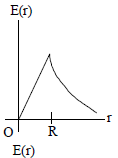
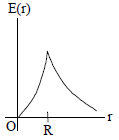
A thin spherical shell of radius R has charge Q spread uniformly over its surface. Which of the following graphs most closely represents the electric field E (r) produced by the shell in the range 0 ≤ r < ∞, where r is the distance from the centre of the shell?

1.
2.
3.
4.
View Answer

The graph in the uploaded image is correct. Here's the explanation with equations:

For a spherical shell of radius \( R \) with charge \( Q \), the electric field \( E(r) \) is given by:

1. Inside the shell (\( 0 \leq r < R \)):
By Gauss's law, the electric field inside a spherical shell is zero:
\[
E(r) = 0, \quad \text{for } r < R
\]

2. On or outside the shell (\( r \geq R \)):
The shell behaves like a point charge located at its center. The electric field at a distance \( r \) is:
\[
E(r) = \frac{1}{4 \pi \epsilon_0} \cdot \frac{Q}{r^2}, \quad \text{for } r \geq R
\]

Graph Representation:
- For \( r < R \), \( E(r) = 0 \), so the graph is flat (on the \( x \)-axis).
- For \( r \geq R \), \( E(r) \propto \frac{1}{r^2} \), so the graph decreases as \( r \) increases, starting from a maximum value at \( r = R \).

Question 90: moderate

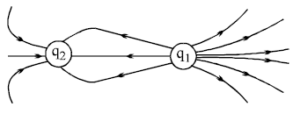
For the figure shown, what is the ratio of the charges q2/q1, where the figure shown has a representation of the field lines in the space near the charges

1. –3/2
2. –2/3
3. 2/3
4. 3/2
View Answer

Number of Electric Field line is proportional to amount of charge. so,

\[ \frac{Q_{2}}{Q_{1}}=\frac{-6}{9}=\frac{-2}{3} \]