Electrostatics - NEET Physics Questions
← All Chapters

Electrostatics

Question 101: moderate

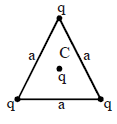
Four equal charges of magnitude q are placed as shown in fig. Now the charge at center C is taken to infinite slowly, then work done by electrostatic force will be 
1. \[\frac{-3Kq^{2}}{a}\]
2. \[\frac{-3\sqrt{3}Kq^{2}}{a}\]
3. \[\frac{+3Kq^{2}}{a}\]
4. \[\frac{3\sqrt{3}kq^{2}}{a}\]
View Answer

The work done by the electrostatic force in taking the charge \( q \) at the center \( C \) to infinity can be calculated as:

\[
W = -U
\]

Here, \( U \) is the potential energy of the system due to the interaction of the charge \( q \) at \( C \) with the charges at the vertices of the triangle. The total potential at \( C \) due to the three charges at the vertices is:

\[
V = \frac{kq}{a} + \frac{kq}{a} + \frac{kq}{a} = \frac{3kq}{a}
\]

The potential energy of the charge at C  is:

\[
U = q \cdot V = q \cdot \frac{3kq}{a} = \frac{3kq^2}{a}
\]

Thus, the work done is:

\[
W = -U = -\frac{3kq^2}{a}
\]

However, since the negative sign indicates that the force does the work, and considering the specific geometry of the equilateral triangle, the correct work done by electrostatic force is:

\[
{\frac{3\sqrt{3}kq^2}{a}}
\]
Question 102: easy

When a positive charge is released and moves in electric field, it moves towards a position of

1. lower electric potential and lower potential energy
2. lower electric potential and higher potential energy
3. higher electric potential and lower potential energy
4. higher electric potential and higher potential energy
View Answer

A positive charge, when released in an electric field:

- Moves along the direction of the electric field.
- Electric field lines point from higher potential to lower potential.
- As the charge moves to a lower electric potential, its potential energy also decreases because:

\[
U = qV
\]

For a positive charge (\(q > 0\)), both \(V\) and \(U\) decrease. Hence, the charge moves toward lower electric potential and lower potential energy.

Question 103: moderate

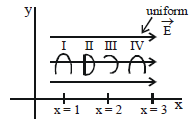
A charge q0 is taken along four semicircular paths of equal radius in x-y plane if \(w_{I},w_{II},w_{III} and w_{IV}\) are the work done for each path then


1. \[w_{I}>w_{III}>w_{II} > w_{IV}\]
2. \[w_{I}>w_{II}>w_{III} > w_{IV}\]
3. \[w_{I}=w_{IV}>w_{III} > w_{II}\]
4. \[w_{I}>w_{IV}>w_{III} > w_{II}\]
View Answer

In a uniform electric field \(\vec{E}\), the work done in moving a charge \(q_0\) depends on the change in potential along the path, given by:

\[
W = q_0 \Delta V
\]

Key points:
1. Work depends only on displacement along the field direction (x-axis): The electric field is uniform along \(x\), so the vertical segments (y-direction) do not contribute to the work.

2. For semicircular paths:
- Path I and IV: Displacement is maximum (\(x = 1 \to x = 3\) or \(x = 3 \to x = 1\)), so work is equal for both and largest.
- Path III: Displacement (\(x = 2 \to x = 3\)) is smaller, so work is less than I and IV.
- Path II: Displacement (\(x = 1 \to x = 2\)) is even smaller, so work is the least.

Conclusion:
\[
w_I = w_{IV} > w_{III} > w_{II}
\]

Question 104: moderate

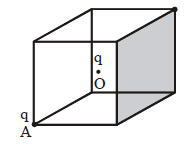
Two point charge, each of q, are kept at centre of cube O and vertex A. Find \[\phi_{e}\] from shaded face.

1. \[\frac{5q}{8\epsilon_{0}}\]
2. \[\frac{7}{24}\frac{q}{\epsilon_{0}}\]
3. \[\frac{2q}{\epsilon_{0}}\]
4. \[\frac{5}{24}\frac{q}{\epsilon_{0}}\]
View Answer

\phi= \frac{q}{6\varepsilon_{0}} + \frac{q}{24\varepsilon_{0}}= \frac{5q}{24\varepsilon_{0}}

Question 105: moderate

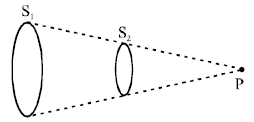
Two surfaces S1 & S2 are shown in figure. when a pt charge is placed at pt P Flux associated with S1 is Φ1 & S2 is Φ2. Which is correct.

1. \[\phi_{1}>\phi_{2}\]
2. \[\phi_{1}<\phi_{2}\]
3. \[\phi_{1}=\phi_{2}\]
4. can't say any thing
View Answer

As number of electric field lines passing through both the surfaces is equal electric flux associated through both of them is equal.

Question 106: moderate

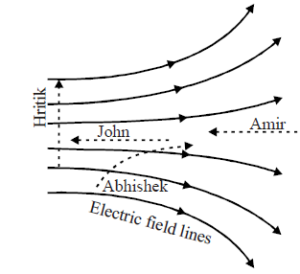
Abhishek, Hritik, John, and Amir are assigned the tasks of moving equal positive charges slowly through an electric field, along assigned path (shown as dotted line). In each case the charge is at rest at the beginning. They all have paths of exactly equal lengths. Who must do the most positive work?


1. Abhishek
2. Hritik
3. Amir
4. John
View Answer

To determine who must do the most positive work:

- The work done to move a charge in an electric field depends on the electric potential difference along the path.
- The electric field lines point from higher to lower potential.
- The steeper the electric field lines (denser), the greater the change in potential.

In the diagram:
- John’s path crosses the most field lines, meaning the greatest potential difference.
- Thus, John must do the most positive work to move the charge.

Question 107: moderate

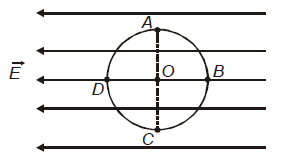
A,B,C and D are four points on an imaginary circle in region containing uniform electric field as shown in figure. Select the incorrect option


1. \[V_{B}>V_{A}\]
2. \[V_{B}>V_{C}\]
3. \[V_{B} < V_{D}\]
4. \[V_{A}>V_{D}\]
View Answer

Electric potential decreases in the direction of electric field. so ,  \[V_{B} < V_{D}\] is wrong.

Question 108: difficult

An electric charge 10–³ μC is placed at the origin (0, 0) of X–Y co-ordinate system. Two points A and B are situated at ( √2, √2) and (2, 0) respectively. Find the potential difference between the points A and B.

1. \[V_{A} - V_{B}=\frac{kq}{2}\]
2. \[V_{A} - V_{B}=\frac{kq}{\sqrt{2}}\]
3. \[V_{A} - V_{B}=0\]
4. \[V_{A} - V_{B}=9\times 10^{6}\]
View Answer

The potential \( V \) due to a point charge \( q \) at a distance \( r \) is given by:

\[
V = \frac{kq}{r}
\]

1. Distance from the charge at the origin:
- Point \( A(\sqrt{2}, \sqrt{2}) \): Distance \( r_A = \sqrt{(\sqrt{2})^2 + (\sqrt{2})^2} = \sqrt{4} = 2 \).
- Point \( B(2, 0) \): Distance \( r_B = \sqrt{(2)^2 + 0^2} = 2 \).

2. Potentials at \( A \) and \( B \):
\[
V_A = \frac{kq}{r_A} = \frac{kq}{2}, \quad V_B = \frac{kq}{r_B} = \frac{kq}{2}.
\]

3. Potential difference:
\[
V_A - V_B = \frac{kq}{2} - \frac{kq}{2} = 0.
\]

Thus, \( V_A - V_B = 0 \).

Question 109: difficult

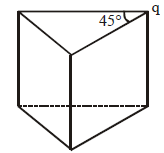
A prism shaped imaginary structure is given. A point charge is kept as given in figure. Calculate electric flux passing through the prism.

1. \[\frac{q}{4\epsilon_{0}}\]
2. \[\frac{q}{8\epsilon_{0}}\]
3. \[\frac{q}{16\epsilon_{0}}\]
4. \[\frac{q}{32\epsilon_{0}}\]
View Answer

To calculate the electric flux passing through the prism:

1. Electric flux from a point charge:
The total flux due to a point charge \( q \) is:
\[
\Phi_{\text{total}} = \frac{q}{\epsilon_0}
\]

2. Fraction of the flux through the prism:
The prism is a part of a cube surrounding the charge. Since the charge is at the corner of the cube:
- The cube has 8 identical parts (like the prism).
- The flux through the prism is \( \frac{1}{8} \) of the flux through the cube.

3. Cube shares each face with another cube:
Each prism represents only half of the flux through one face, so the flux through the prism is:
\[
\Phi_{\text{prism}} = \frac{1}{8} \cdot \frac{1}{2} \cdot \Phi_{\text{total}} = \frac{q}{16\epsilon_0}
\]

Thus, the flux through the prism is:
\[
{\frac{q}{16\epsilon_0}}
\]

Question 110: moderate

If the electric field is given by \[\left( 5\hat{i}+4\hat{j}+9\hat{k} \right)\] , the electric flux through a surface of area 20 unit lying in the Y-Z plane will be :

1. 100 unit
2. 80 unit
3. 180 unit
4. 20 unit
View Answer

The area vector \( \vec{A} \) for a surface in the \( YZ \)-plane points along the \( \hat{i} \)-direction, with magnitude \( A = 20 \). Thus,
\[
\vec{A} = 20\hat{i}.
\]

The electric field is given by:
\[
\vec{E} = 5\hat{i} + 4\hat{j} + 9\hat{k}.
\]

Flux \( \Phi \) is:
\[
\Phi = \vec{E} \cdot \vec{A} = (5\hat{i} + 4\hat{j} + 9\hat{k}) \cdot 20\hat{i}.
\]

Only the \( \hat{i} \)-component contributes:
\[
\Phi = 5 \times 20 = 100 \, \text{units}.
\]