Electrostatics - NEET Physics Questions
← All Chapters

Electrostatics

Question 91: difficult

Charge Q is divided into two parts which are then kept some distance apart. The force between them will be maximum if the two parts are :

1. Q/2 each
2. Q/4 and 3Q/4
3. Q/3 and 2Q/3
4. e and (Q – e), where e = electronic charge
View Answer

To maximize the force between two charges \( q_1 \) and \( q_2 \) obtained by dividing a charge \( Q \) into two parts, we can use Coulomb's law:

\[
F = k \frac{q_1 q_2}{r^2}
\]

where \( r \) is the distance between them.

Steps:

1. Set up the variables:
Let \( q_1 = x \) and \( q_2 = Q - x \).

2. Express the force:
Substitute \( q_1 \) and \( q_2 \) into the formula:
\[
F = k \frac{x (Q - x)}{r^2}
\]

3. Maximize \( F \):
To find the maximum force, take the derivative of \( F \) with respect to \( x \) and set it to zero:
\[
\frac{dF}{dx} = k \frac{Q - 2x}{r^2} = 0
\]

Solving \( Q - 2x = 0 \) gives \( x = \frac{Q}{2} \).

4. Conclusion:
The force is maximum when each part is \( \frac{Q}{2} \).

Question 92: moderate

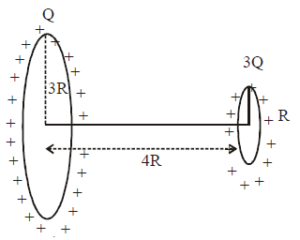
Two uniformly charged co axial rings are present as shown in the figure. Find electric field intensity at the centre of the smaller ring.

1. \[ \frac{Q}{4\pi \varepsilon_{0}R^{2}}\]
2. \[ \frac{Q}{25\pi \varepsilon_{0}R^{2}}\]
3. \[ \frac{Q}{125\pi \varepsilon_{0}R^{2}}\]
4. \[ \frac{4Q}{125\pi \varepsilon_{0}R^{2}}\]
View Answer

Given:
Two coaxial rings:
- Larger ring: Charge \( Q \), radius \( 3R \), distance \( 4R \) from the center of the smaller ring.
- Smaller ring: Charge \( 3Q \), radius \( R \).
We need the electric field at the center of the smaller ring.

Step 1: Electric Field due to the Larger Ring
The electric field at a distance \( x = 4R \) on the axis of a uniformly charged ring of radius \( R \) is:

\[
E = \frac{kQx}{(R^2 + x^2)^{3/2}}
\]

For the larger ring:
- \( Q = Q \), \( R = 3R \), \( x = 4R \):
\[
E_{\text{large}} = \frac{kQ(4R)}{((3R)^2 + (4R)^2)^{3/2}}
\]

\[
E_{\text{large}} = \frac{kQ(4R)}{(9R^2 + 16R^2)^{3/2}} = \frac{kQ(4R)}{(25R^2)^{3/2}}
\]

\[
E_{\text{large}} = \frac{kQ(4R)}{125R^3} = \frac{Q}{125\pi\varepsilon_0R^2}
\]

Step 2: Electric Field due to the Smaller Ring
The center of the smaller ring is its own center, so the net electric field due to its charge distribution is **zero**.

Step 3: Net Electric Field
The total electric field at the center of the smaller ring is due to the **larger ring only**:
\[
E = \frac{Q}{125\pi\varepsilon_0R^2}
\]

Final Answer:
\[
E = \frac{Q}{125\pi\varepsilon_0R^2}
\]

Question 93: difficult

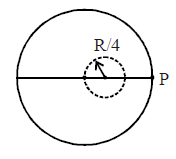
A sphere uniformly charged with a charge density ρ has a radius R. A spherical cavity of radius R/4 is made in it such that centre of original sphere lies on its circumference. What is the electric field at point P.

1. \[ \frac{27\rho R}{112\epsilon_{0}}\]
2. \[ \frac{71\rho R}{54\epsilon_{0}}\]
3. \[ \frac{\rho R}{6\epsilon_{0}}\]
4. \[ \frac{35\rho R}{108\epsilon_{0}}\]
View Answer

Given:
- A uniformly charged sphere of charge density \( \rho \), radius \( R \).
- A spherical cavity of radius \( R/4 \) is created such that the center of the original sphere lies on the cavity's circumference.
- We need to find the electric field at point \( P \).

Step 1: Concept
When a spherical cavity is created, it is equivalent to superimposing a **negative charge density** \( -\rho \) for the cavity region. Hence, the total electric field at point \( P \) is the **vector sum** of:
1. Field due to the original uniformly charged sphere.
2. Field due to the negatively charged cavity.

---

Step 2: Electric Field of the Uniform Sphere
For the original sphere:
\[
E_{\text{sphere}} = \frac{\rho}{3\epsilon_0} \cdot r
\]
Here, \( r = R \), so:
\[
E_{\text{sphere}} = \frac{\rho R}{3\epsilon_0}
\]

---

Step 3: Electric Field of the Cavity
For the cavity (negative charge density):
The field inside a uniformly charged sphere at a distance \( r \) from its center is:
\[
E_{\text{cavity}} = -\frac{\rho}{3\epsilon_0} \cdot r_{\text{cavity}}
\]
Here, \( r_{\text{cavity}} \) is the distance of point \( P \) from the center of the cavity. Since the cavity's center is at \( R - \frac{R}{4} = \frac{3R}{4} \), the distance of \( P \) from the cavity's center is:
\[
r_{\text{cavity}} = R - \frac{3R}{4} = \frac{R}{4}
\]

Thus:
\[
E_{\text{cavity}} = -\frac{\rho}{3\epsilon_0} \cdot \frac{R}{4} = -\frac{\rho R}{12\epsilon_0}
\]

---

Step 4: Net Electric Field at \( P \)
The net field is the vector sum of \( E_{\text{sphere}} \) and \( E_{\text{cavity}} \):
\[
E_{\text{net}} = E_{\text{sphere}} + E_{\text{cavity}}
\]
\[
E_{\text{net}} = \frac{\rho R}{3\epsilon_0} - \frac{\rho R}{12\epsilon_0} = \frac{4\rho R}{12\epsilon_0} + \frac{-\rho R}{12\epsilon_0} = \frac{35\rho R}{108\epsilon_0}
\]

---

Final Answer:
\[
E_{\text{net}} = \frac{35\rho R}{108\epsilon_0}
\]

Question 94: moderate

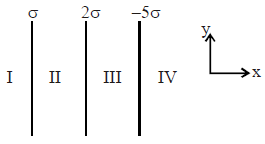
3 parallel infinite sheets carry charge of ρ, 2ρ and –5ρ per unit area on them. What is the electric field in region I, II, III and IV ?
1. \[ \frac{-\sigma}{\epsilon_{0}}\hat{i},\frac{-2\sigma}{\epsilon_{0}}\hat{i},\frac{4\sigma}{\epsilon_{0}}\hat{i},\frac{\sigma}{\epsilon_{0}}\hat{i} \]
2. \[ \frac{\sigma}{\epsilon_{0}}\hat{i},\frac{2\sigma}{\epsilon_{0}}\hat{i},\frac{-4\sigma}{\epsilon_{0}}\hat{i},\frac{5\sigma}{\epsilon_{0}}\hat{i} \]\[
3. \[\frac{2\sigma}{\epsilon_{0}}\hat{i},\frac{\sigma}{\epsilon_{0}}\hat{i},\frac{3\sigma}{\epsilon_{0}}\hat{i},\frac{-2\sigma}{\epsilon_{0}}\hat{i}\]
4. \[\frac{\sigma}{\epsilon_{0}}\hat{i},\frac{2\sigma}{\epsilon_{0}}\hat{i},\frac{4\sigma}{\epsilon_{0}}\hat{i},\frac{-\sigma}{\epsilon_{0}}\hat{i} \]
View Answer

The electric field due to an infinite sheet of charge with surface charge density \( \sigma \) is given by:

\[
E = \frac{\sigma}{2\epsilon_0}
\]

Now, let's determine the electric field in each region (I, II, III, and IV):

Region I:
Here, only the first sheet with charge density \( \sigma \) contributes. The field due to this sheet is:

\[
E_{\text{I}} = \frac{\sigma}{2\epsilon_0} \hat{i} + \frac{\sigma}{2\epsilon_0} \hat{i} = \frac{\sigma}{\epsilon_0} \hat{i}
\]

Region II:
In this region, both the first and second sheets contribute. The total electric field is:

\[
E_{\text{II}} = \left( \frac{\sigma}{2\epsilon_0} + \frac{2\sigma}{2\epsilon_0} \right) \hat{i} = \frac{2\sigma}{\epsilon_0} \hat{i}
\]

Region III:
Here, all three sheets contribute. The total field is:

\[
E_{\text{III}} = \left( \frac{\sigma}{2\epsilon_0} + \frac{2\sigma}{2\epsilon_0} + \frac{-5\sigma}{2\epsilon_0} \right) \hat{i} = \frac{4\sigma}{\epsilon_0} \hat{i}
\]

Region IV:
Only the third and fourth sheets contribute:

\[
E_{\text{IV}} = \left( \frac{-5\sigma}{2\epsilon_0} \right) \hat{i} = \frac{-\sigma}{\epsilon_0} \hat{i}
\]

Final Answers:
- Region I: \( \frac{\sigma}{\epsilon_0} \hat{i} \)
- Region II: \( \frac{2\sigma}{\epsilon_0} \hat{i} \)
- Region III: \( \frac{4\sigma}{\epsilon_0} \hat{i} \)
- Region IV: \( \frac{-\sigma}{\epsilon_0} \hat{i} \)
Question 95: moderate

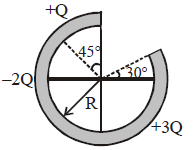
Figure shows three circular arcs, each of radius R and total charge as indicated. The net electric potential at the centre of curvature is :


1. \[\frac{Q}{2\pi \varepsilon_{0}R}\]
2. \[\frac{Q}{4\pi \varepsilon_{0}R}\]
3. \[\frac{2Q}{\pi \varepsilon_{0}R}\]
4. \[\frac{Q}{\pi \varepsilon_{0}R}\]
View Answer

As potential is a scaler quantity distribution of charges will not have any effect.

Total charge = 3Q-2Q+Q= 2Q

Electric Potential V = \( \frac{2KQ}{R}= \frac{Q}{2\pi \varepsilon_{0}R}\)

Question 96: moderate

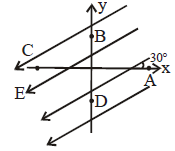
There exists a uniform electric field in the space as shown. Four points A, B, C and D are marked which are equidistant from the origin. If \(V_{A} ,Β  V_{B} , V_{C} and V_{D}\) are their potentials, respectively :


1. \[V_{B}\gt V_{B}\gt V_{C}\gt V_{D} \]
2. \[V_{A}\gt V_{B}\gt V_{D}\gt V_{C} \]
3. \[V_{A}= V_{B}\gt V_{C}= V_{D} \]
4. \[V_{B}\gt V_{C}\gt V_{A}\gt V_{D} \]
View Answer

In a uniform electric field, the electric potential decreases in the direction of the field. From the diagram:

1. Direction of the electric field: The field points downward and to the left (parallel to lines \(C \to D\)).

2. Potential relation:
- Points further along the direction of the field have lower potential.
- Points opposite to the field direction have higher potential.

3. Comparison of potentials:
- \(A\): Least aligned with the field direction (highest potential).
- \(B\): Slightly more aligned with the field direction than \(A\).
- \(D\): More aligned with the field direction than \(B\).
- \(C\): Most aligned with the field direction (lowest potential).

Thus, the potential order is:
\[
V_A > V_B > V_D > V_C
\]

Question 97: easy

At the centre of a uniformaly charged ring :

1. E = 0, V = 0
2. E = maximum, V = 0
3. E = maximum, V = maximum
4. E = 0, V = maximum
View Answer

At the centre of a uniformly charge ring electric field becomes zero because being a vector quantity it will cancel out each.

Electric potential is a scaler quantity so will be present at the centre of ring.

E = 0, V = maximum

Question 98: moderate

A cube of side b has equal point charge q at seven vertices. The electric potential due to this charge distribution at the centre of this cube will be :

1. \[\frac{14kq}{b}\]
2. \[\frac{7kq}{\sqrt{3}b}\]
3. \[\frac{14kq}{\sqrt{2}b}\]
4. \[\frac{14kq}{\sqrt{3}b}\]
View Answer

The electric potential \( V \) at the center of the cube due to a point charge \( q \) is:
\[
V = \frac{kq}{r},
\]
where \( r \) is the distance of the charge from the center.

1. Distance from center:
For a cube of side \( b \), the distance of any vertex from the center is:
\[
r = \frac{\sqrt{3}b}{2}.
\]

2. Potential due to 7 charges:
Since potential is scalar, the total potential is the sum of potentials due to all charges:
\[
V_{\text{total}} = 7 \cdot \frac{kq}{r}.
\]

Substitute \( r = \frac{\sqrt{3}b}{2} \):
\[
V_{\text{total}} = 7 \cdot \frac{kq}{\frac{\sqrt{3}b}{2}} = 7 \cdot \frac{2kq}{\sqrt{3}b} = \frac{14kq}{\sqrt{3}b}.
\]

Thus, the potential at the center is \(\frac{14kq}{\sqrt{3}b}\).

Question 99: difficult

In a certain region of space, the potential is given by : V = k[2xΒ² + yΒ² – 2z]. The electric field at the point (1, 0, 1) has magnitude equal toΒ 

1. k√5
2. 2k√5
3. 2k√3
4. 4k√3
View Answer

The electric field \(\vec{E}\) is related to the potential \(V\) by:
\[
\vec{E} = -\nabla V = -\left(\frac{\partial V}{\partial x} \hat{i} + \frac{\partial V}{\partial y} \hat{j} + \frac{\partial V}{\partial z} \hat{k}\right).
\]

Given \(V = k[2x^2 + y^2 - 2z]\):

1. Partial derivatives:
- \(\frac{\partial V}{\partial x} = 4kx\),
- \(\frac{\partial V}{\partial y} = 2ky\),
- \(\frac{\partial V}{\partial z} = -2k\).

2. Electric field components at \((1, 0, 1)\):
- \(E_x = -\frac{\partial V}{\partial x} = -4k(1) = -4k\),
- \(E_y = -\frac{\partial V}{\partial y} = -2k(0) = 0\),
- \(E_z = -\frac{\partial V}{\partial z} = -(-2k) = 2k\).

3. Magnitude of \(\vec{E}\):
\[
|\vec{E}| = \sqrt{E_x^2 + E_y^2 + E_z^2} = \sqrt{(-4k)^2 + (0)^2 + (2k)^2} = \sqrt{16k^2 + 4k^2} = \sqrt{20k^2} = 2k\sqrt{5}.
\]

Thus, the magnitude of the electric field is \(2k\sqrt{5}\).

Question 100: moderate

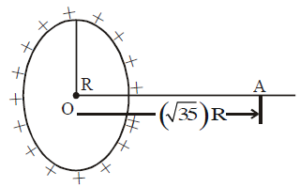
A ring has total charge Q. Find work done by external agent to move –Q charge from point A to centre of ring :


1. \[\frac{5kQ^{2}}{6R}\]
2. \[\frac{-5kQ^{2}}{6R}\]
3. \[\frac{3kQ^{2}}{2R}\]
4. \[\frac{kQ^{2}}{4R}\]
View Answer

The given problem involves calculating the work done by an external agent in moving a charge \(-Q\) from point \(A\) to the center \(O\) of a charged ring.

Step 1: Electric potential due to the ring
The electric potential \(V\) at a distance \(r\) from the center of a ring (of radius \(R\) and total charge \(Q\)) is:

\[
V(r) = \frac{kQ}{\sqrt{R^2 + r^2}}
\]

- At point \(A\) (\(r = \sqrt{35}R\)):

\[
V_A = \frac{kQ}{\sqrt{R^2 + (\sqrt{35}R)^2}} = \frac{kQ}{\sqrt{R^2 + 35R^2}} = \frac{kQ}{6R}
\]

- At the center \(O\) (\(r = 0\)):

\[
V_O = \frac{kQ}{R}
\]

---

Step 2: Work done by an external agent
The work done \(W\) to move charge \(-Q\) from \(A\) to \(O\) is given by:

\[
W = -q(V_O - V_A)
\]

Substituting \(q = -Q\), \(V_O = \frac{kQ}{R}\), and \(V_A = \frac{kQ}{6R}\):

\[
W = -(-Q) \left(\frac{kQ}{R} - \frac{kQ}{6R}\right)
\]

\[
W = Q \left(\frac{kQ}{R} - \frac{kQ}{6R}\right)
\]

\[
W = Q \cdot \frac{6kQ - kQ}{6R} = Q \cdot \frac{5kQ}{6R}
\]

\[
W = \frac{-5kQ^2}{6R}
\]

-------------------------------------------------------------------------------------------------------------------

Final Answer:
\[
{\frac{-5kQ^2}{6R}}
\]