A point charge of 100 μC is placed at 3\hat{i}+4\hat{j} m. Find the electric field intensity due to this charge at a point located at 9\hat{i}+12\hat{j} m :
Five point charges, each of value +q, are placed on five vertices of a regular hexagon of side L. The magnitude of the force on a point charge of value –q coulomb placed at the center of the hexagon is
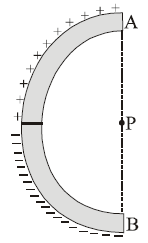
A thin glass rod is bent into a semicircle of radius r. A charge +Q is uniformly
distributed along the upper half, and a charge –Q is uniformly distributed along the lower half, as shown in Fig. The electric field E at P, the center of the semicircle, is :

Using the direct formula for the electric field due to a uniformly charged arc:
\[
E = \frac{2k\lambda \sin(\theta/2)}{r}
\]
Step 1: Identify Parameters
- \(\lambda\): Linear charge density.
- \(k = \frac{1}{4 \pi \varepsilon_0}\): Coulomb's constant.
- \(r\): Radius of the semicircle.
- \(\theta = \pi\): Angle subtended by the semicircle at the center.
Step 2: Substitute \(\lambda\)
The total charge on the semicircle is \(+Q\) or \(-Q\), and the arc length is \(\pi r\). Therefore:
\[
\lambda = \frac{Q}{\pi r}
\]
Step 3: Substitute into the Formula
\[
E = \frac{2k \lambda \sin(\pi/2)}{r}
\]
Here, \(\sin(\pi/2) = 1\). Substituting \(\lambda = \frac{Q}{\pi r}\):
\[
E = \frac{2k \left(\frac{Q}{\pi r}\right)}{r}
\]
Step 4: Simplify
\[
E = \frac{2k Q}{\pi r^2}
\]
Since \(k = \frac{1}{4 \pi \varepsilon_0}\), substitute \(k\):
\[
E = \frac{2}{4 \pi \varepsilon_0} \cdot \frac{Q}{\pi r^2}
\]
\[
E = \frac{Q}{\pi^2 \varepsilon_0 r^2}
\]
Final Answer:
The electric field at the center is:
\[
{\frac{Q}{\pi^2 \varepsilon_0 r^2}}
\]
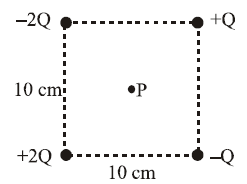
Four electrical charges are arranged on the corners of a 10 cm square as shown. What would be the direction of the resulting electric field at the center point P?

Explanation:
To determine the direction of the electric field at the center \(P\), we consider the contributions of the electric fields due to each charge:
1. Electric Field Due to Each Charge:
- The electric field at point \(P\) due to a charge at a corner of the square points away from the charge if it is positive, and toward the charge if it is negative.
2. Symmetry of the Problem:
- Opposite charges on diagonally opposite corners will partially cancel their contributions due to symmetry in their horizontal (\(x\)) or vertical (\(y\)) components.
- However, due to the **asymmetry in the magnitudes of the charges**, there will be a net resultant field.
3. Analyzing the Contributions:
- The charge \(-2Q\) (top left) will produce a stronger electric field toward itself compared to \(+Q\) (top right).
- Similarly, the charge \(+2Q\) (bottom left) will produce a stronger field away from itself compared to \(-Q\) (bottom right).
- The vertical components of the fields due to the charges \(-2Q\) and \(+2Q\) add **upward**.
- The horizontal components of the fields due to opposite charges (\(-2Q\) and \(+2Q\), and \(+Q\) and \(-Q\)) cancel each other.
4. Result:
- The net electric field at point \(P\) is directed upward, dominated by the vertical components due to the unequal magnitudes of the charges.
Hence, the correct answer is upward.
The maximum electric field at a point on the axis of a uniformly charged ring is E0. At how many points on the axis will the magnitude of the electric field be E0/2.
To understand why the magnitude of the electric field is \(E_0/2\) at four points on the axis of a uniformly charged ring, let's analyze this with the help of the electric field graph versus distance.
Key Concepts:
1. Electric Field on the Axis of a Uniformly Charged Ring:
The electric field at a distance \(x\) from the center of the ring along its axis is given by:
\[
E = \frac{k Q x}{(x^2 + R^2)^{3/2}}
\]
where:
- \(k\) is Coulomb's constant,
- \(Q\) is the total charge on the ring,
- \(R\) is the radius of the ring,
- \(x\) is the distance from the center along the axis.
2. Behavior of \(E\) as a Function of \(x\):
- At \(x = 0\): The electric field is \(0\) due to symmetry (no net field at the center).
- As \(x\) increases: \(E\) first increases, reaches a **maximum value** (\(E_0\)) at some distance \(x = x_{\text{max}}\), and then decreases asymptotically to \(0\) as \(x \to \infty\).
3. Points Where \(E = E_0/2\):
The equation \(E = \frac{E_0}{2}\) will have **two solutions** on either side of the point where \(E\) is maximum (\(x = \pm x_{\text{max}}\)):
- Two points closer to the ring's center (on both sides of \(x = 0\)).
- Two points farther from the center (on both sides of \(x = 0\)).
Thus, there are a total of four points where \(E = \frac{E_0}{2}\).
-------------------------------------------------------------------------------------------------------------------
Graphical Explanation:
1. The graph of \(E\) versus \(x\) is symmetric about \(x = 0\) and resembles a bell-shaped curve.
2. \(E\) starts at \(0\) at \(x = 0\), increases to a peak value of \(E_0\) at \(x_{\text{max}}\), and then decreases symmetrically as \(x\) moves away from \(x_{\text{max}}\) on both sides.
3. To find the points where \(E = \frac{E_0}{2}\), draw a horizontal line at \(E = \frac{E_0}{2}\). This line will intersect the \(E\)-vs-\(x\) curve at **four points**:
- Two on the rising part of the curve (closer to \(x = 0\)),
- Two on the falling part of the curve (farther from \(x = 0\)).
Conclusion:
The electric field is \(E_0/2\) at four points on the axis of the ring—two on each side of the ring's center. These correspond to the solutions of the equation \(E = \frac{k Q x}{(x^2 + R^2)^{3/2}} = \frac{E_0}{2}\).
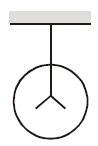
An electroscope is given a positive charge, causing its foil leaves to separate. When an object is brought near the top plate of the electrosope, the foils
separate even further. We conclude :

The behavior of the electroscope can be explained as follows:
- The electroscope is already positively charged, causing its foil leaves to separate due to the like charges repelling each other.
- When the object is brought near the top plate and the foils separate even further, it indicates that more positive charge is being induced on the leaves. This happens when the object is also positively charged, as it repels positive charges towards the leaves, increasing the repulsion.
Thus, we conclude that the object is positively charged.
Mark correct option :
The statement "Like charged bodies may attract each other" is correct in certain situations due to charge redistribution. Here's the explanation:
- When two like-charged bodies are brought close to each other, the distribution of charges on their surfaces may become non-uniform. This happens due to polarization effects caused by the electric fields of each body.
- If the bodies are not perfectly conducting or have uneven shapes, the induced charge distributions may result in regions of opposite charge between the bodies, leading to localized attraction despite the overall like charges.
Thus, under specific conditions, like-charged bodies can exhibit attraction.
The force between 2 charges 0.06 cm apart is 5 N. Then the force when they are brought 0.01 cm closer will be :
The force between two charges varies inversely with the square of the distance between them, according to Coulomb's law:
\[
F \propto \frac{1}{r^2}
\]
Solution Steps:
1. Initial and Final Distances:
- Initial distance \( r_1 = 0.06 \, \text{cm} \)
- Final distance \( r_2 = 0.06 - 0.01 = 0.05 \, \text{cm} \)
2. Force Ratio:
\[
\frac{F_2}{F_1} = \frac{r_1^2}{r_2^2}
\]
3. Substitute Values:
\[
\frac{F_2}{5} = \frac{(0.06)^2}{(0.05)^2}
\]
\[
F_2 = 5 \cdot \frac{0.0036}{0.0025} = 5 \cdot 1.44 = 7.2 \, \text{N}
\]
Conclusion:
The new force \( F_2 \) is \( 7.2 \, \text{N} \).
If a body has a charge of /(10^{-12}\) coulomb :
To determine the deficiency of electrons for a body with a charge of
, follow these steps:
- Charge of a single electron: The charge of one electron is
.
- Number of electrons (deficiency): The total number of electrons causing the charge is given by:
- Interpretation: Since the body is positively charged, it has a deficiency of
electrons.
Two metallic spheres of same mass are given equal and opposite charges; then :
The mass of the negatively charged sphere increases because:
- When a sphere becomes negatively charged, it gains extra electrons. Since electrons have mass (
), the addition of electrons increases the mass of the negatively charged sphere.
- Conversely, the positively charged sphere loses electrons, resulting in a slight decrease in its mass.
Thus, the mass of the negatively charged sphere increases due to the addition of electrons.