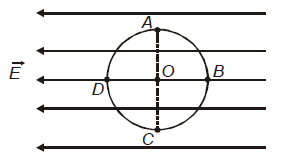
A,B,C and D are four points on an imaginary circle in region containing uniform electric field as shown in figure. Select the incorrect option

Electric potential decreases in the direction of electric field. so , \[V_{B} < V_{D}\] is wrong.
A,B,C and D are four points on an imaginary circle in region containing uniform electric field as shown in figure. Select the incorrect option

Electric potential decreases in the direction of electric field. so , \[V_{B} < V_{D}\] is wrong.
If the electric field is given by \[\left( 5\hat{i}+4\hat{j}+9\hat{k} \right)\] , the electric flux through a surface of area 20 unit lying in the Y-Z plane will be :
The area vector \( \vec{A} \) for a surface in the \( YZ \)-plane points along the \( \hat{i} \)-direction, with magnitude \( A = 20 \). Thus,
\[
\vec{A} = 20\hat{i}.
\]
The electric field is given by:
\[
\vec{E} = 5\hat{i} + 4\hat{j} + 9\hat{k}.
\]
Flux \( \Phi \) is:
\[
\Phi = \vec{E} \cdot \vec{A} = (5\hat{i} + 4\hat{j} + 9\hat{k}) \cdot 20\hat{i}.
\]
Only the \( \hat{i} \)-component contributes:
\[
\Phi = 5 \times 20 = 100 \, \text{units}.
\]
Which of the following is sufficient condition for finding the electric flux Φ through a closed surface?
Specifying the total charge inside the surface is a sufficient condition for finding the electric flux \( \Phi \) through a closed surface.
According to Gauss's law:
\[
\Phi = \frac{q_{\text{enclosed}}}{\varepsilon_0}
\]
The flux depends only on the enclosed charge \( q_{\text{enclosed}} \), regardless of the surface's shape or the charge distribution.
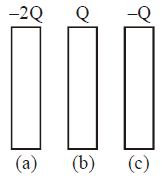
Three identical conducting plates are shown in figure. Findout the charge on the right face of the plate b.

Yes, direct formulas can simplify the solution for problems like this involving conducting plates. Here's how:
Formula for charge redistribution in conductors:
For three parallel conducting plates with charges \( Q_1, Q_2, Q_3 \):
1. The charge on the inner faces is:
\[
Q_{\text{inner}} = \frac{Q_1 - Q_3}{2}
\]
2. The charge on the outer faces remains equal to the net charge on the respective plates:
- Outer left face: \( Q_1 \)
- Outer right face: \( Q_3 \)
---
Applying the formula:
- Given charges:
\[
Q_1 = -2Q, \, Q_2 = Q, \, Q_3 = -Q
\]
- Charge on the inner faces of plate \( b \):
\[
Q_{\text{inner}} = \frac{Q_1 - Q_3}{2} = \frac{-2Q - (-Q)}{2} = \frac{-2Q + Q}{2} = \frac{-Q}{2}
\]
- Since the **right face of \( b \)** contributes to the inner faces:
\[
Q_{\text{right face of \( b \)}} = 0
\]
Final Answer:
\[
{Zero (0)}
\]
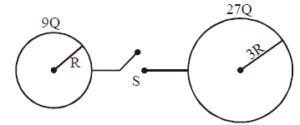
Find final charge on smaller sphere after closing switch :

After closing the switch:
1. Potential equality: \(\frac{Q_1}{R} = \frac{Q_2}{3R} \Rightarrow Q_2 = 3Q_1\).
2. Charge conservation: \(Q_1 + Q_2 = 36Q \Rightarrow Q_1 + 3Q_1 = 36Q \Rightarrow Q_1 = 9Q\).
Final charge on the smaller sphere = 9Q.
Four charges are placed at the circumference of the dial of a clock as shown in figure. If the clock has only hour hand, then the resultant force on a positive charge q0 placed at the centre, points in the direction which shows the time as :

To determine the direction of the resultant force on the positive charge \(q_0\) placed at the center due to the four charges on the clock face, we analyze the forces exerted by each charge.
1. Forces by Opposing Pairs:
- The positive charges at 12 and 3 exert a repulsive force on \(q_0\), while the negative charges at 6 and 9 exert an attractive force on \(q_0\).
- Each pair of opposing charges creates forces with equal magnitudes but different directions.
2. Force Components:
- The force due to the charges at 12 and 6 (along the vertical line) will cancel each other out in the vertical direction, as they are equal and opposite.
- Similarly, the forces due to the charges at 3 and 9 (along the horizontal line) will cancel each other out in the horizontal direction.
3. Resultant Force:
- Since the charges at 12 and 9 are positive and repulsive, they push \(q_0\) away from them.
- The vector sum of these forces results in a net force pointing diagonally between the 6 and 9 positions.
4. Direction:
- The resultant force points toward the 7:30 position, as this is the direction of the net vector resulting from the combination of all four forces.
Thus, the direction of the resultant force on \(q_0\) points to 7:30.
There are two concentric conducting shells. The potential of outer shell is 10 V and that of inner shell is 15 V. If the outer shell is grounded, the potential of inner shell becomes/remains
When the outer shell is grounded, its potential becomes 0. The potential difference between the shells remains the same as before grounding (since grounding doesn't change the relative configuration of charges).
Initial potential difference:
Inner shell - Outer shell = \( 15 \, \text{V} - 10 \, \text{V} = 5 \, \text{V} \).
After grounding, the inner shell’s potential relative to the grounded outer shell becomes \( 0 + 5 \, \text{V} = 5 \, \text{V} \).
Thus, the inner shell’s potential is 5 V.
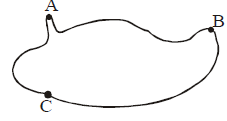
Figure shows a charged conductor of irregular shape. If \ ( \sigma_{A},\sigma_{B} and \sigma_{C}\) are the surface charge densities at A, B and C respectively, then :

Pointed ends have more surface charge density so,
\[\sigma_{A}>\sigma_{B} > \sigma_{C}\]
If an electron moves in the direction of electric field then :
This statement applies when a particle moves against a force field (e.g., an electron moving against an electric field). As it moves, work is done on it, leading to:
- Decrease in kinetic energy: The particle slows down as it loses speed.
- Increase in potential energy: The work done on the particle increases its potential energy.
This satisfies the conservation of energy principle.
If an electron is accelerated from rest through a potential difference V, then its final speed is proportional to :
The kinetic energy gained by the electron is equal to the work done by the electric field:
\[
eV = \frac{1}{2} m v^2
\]
Rearranging for \(v\):
\[
v = \sqrt{\frac{2eV}{m}}
\]
This shows that \(v \propto \sqrt{V}\).