Gauss's Law - NEET Physics Questions
Question 1: easy

A uniform electric field E = 2 × 10³ NC–¹ is acting along the positive x-axis. The flux of this field through a square of 10 cm on a side whose plane is parallel to the yz plane is :


1. \[20NC^{-1}m^{2}\]
2. \[ 30NC^{-1}m^{2}\]
3. \[ 10NC^{-1}m^{2}\]
4. \[ 40NC^{-1}m^{2}\]
View Answer

To calculate the flux \(\Phi_E\) of the electric field \(\vec{E}\) through the square, we use the formula:

\[
\Phi_E = \vec{E} \cdot \vec{A}
\]

Here:
- \(\vec{E} = 2 \times 10^3 \, \text{N/C}\) (along the positive x-axis),
- \(\vec{A}\) is the area vector, perpendicular to the plane of the square.

Since the square lies in the yz-plane, its area vector points along the x-axis (same direction as \(\vec{E}\)), and its magnitude is the area of the square:

\[
\text{Side of square} = 10 \, \text{cm} = 0.1 \, \text{m}, \quad \text{Area} = (0.1)^2 = 0.01 \, \text{m}^2
\]

The flux is:

\[
\Phi_E = |\vec{E}| \cdot |\vec{A}| \cdot \cos\theta
\]

Here, \(\theta = 0^\circ\) (since \(\vec{E}\) is parallel to \(\vec{A}\)):

\[
\Phi_E = (2 \times 10^3) \cdot 0.01 \cdot \cos 0^\circ = 20 \, \text{N·m}^2/\text{C}
\]

Thus, the flux is:

\[
{20 \, \text{N·m}^2/\text{C}}
\]

Question 2: easy

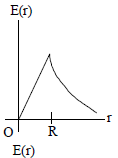
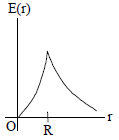
A thin spherical shell of radius R has charge Q spread uniformly over its surface. Which of the following graphs most closely represents the electric field E (r) produced by the shell in the range 0 ≤ r < ∞, where r is the distance from the centre of the shell?

1.
2.
3.
4.
View Answer

The graph in the uploaded image is correct. Here's the explanation with equations:

For a spherical shell of radius \( R \) with charge \( Q \), the electric field \( E(r) \) is given by:

1. Inside the shell (\( 0 \leq r < R \)):
By Gauss's law, the electric field inside a spherical shell is zero:
\[
E(r) = 0, \quad \text{for } r < R
\]

2. On or outside the shell (\( r \geq R \)):
The shell behaves like a point charge located at its center. The electric field at a distance \( r \) is:
\[
E(r) = \frac{1}{4 \pi \epsilon_0} \cdot \frac{Q}{r^2}, \quad \text{for } r \geq R
\]

Graph Representation:
- For \( r < R \), \( E(r) = 0 \), so the graph is flat (on the \( x \)-axis).
- For \( r \geq R \), \( E(r) \propto \frac{1}{r^2} \), so the graph decreases as \( r \) increases, starting from a maximum value at \( r = R \).

Question 3: easy

The mathematical form of Gauss’ law is :

\[\varepsilon_{0}\oint_{}^{}\overrightarrow{E}.d\overrightarrow{S}=q\]
In this reference which of the following is correct?

1. E depends on the charge q which is enclosed within the Gaussian surface only
2. E depends on the charge which is inside and outside the Gaussian surface.
3. E does not depend on the magnitude of charge q
4. All of the above
View Answer

The question states the mathematical form of Gauss's law as:

\[
\varepsilon_{0}\oint \overrightarrow{E} \cdot d\overrightarrow{S} = q
\]

Where:
- \(\varepsilon_0\) is the permittivity of free space,
- \(\overrightarrow{E}\) is the electric field vector,
- \(d\overrightarrow{S}\) is the infinitesimal area vector on the Gaussian surface,
- \(q\) is the total charge enclosed within the Gaussian surface.

Key Points in Gauss's Law:

1. The electric flux through the Gaussian surface (\(\oint \overrightarrow{E} \cdot d\overrightarrow{S}\)) depends only on the charge enclosed (\(q\)) within the surface.

2. The electric field \(\overrightarrow{E}\) at any point on the Gaussian surface depends on all charges in the system—both inside and outside the Gaussian surface.

Why Does \(E\) Depend on Charges Outside the Gaussian Surface?

While Gauss's law calculates flux based only on enclosed charge, the electric field \(\overrightarrow{E}\) at a point on the Gaussian surface is influenced by all charges, regardless of their location (inside or outside the surface). Here's why:

- Charges inside the Gaussian surface: These contribute directly to the net flux as per Gauss's law.
- Charges outside the Gaussian surface: These do not contribute to the net flux (their contributions cancel out overall due to symmetry), but they **still influence the local value of \(\overrightarrow{E}\)**.

Example:

- Imagine a spherical Gaussian surface around a point charge \(q_1\). If another charge \(q_2\) is placed outside the sphere, it doesn't affect the total flux, but it does contribute to the electric field at various points on the sphere.

Thus, the electric field \(\overrightarrow{E}\) depends on all charges in the vicinity, while the total flux (as per Gauss's law) depends solely on the charges enclosed. This is why the correct answer is:

"E depends on the charge which is inside and outside the Gaussian surface."

Question 4: easy

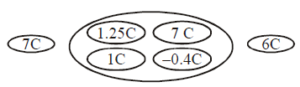
What is the electric flux linked with closed surface?

1. /[10^{11} N-m^{2}/C/]
2. /[10^{12} N-m^{2}/C/]
3. /[10^{10} N-m^{2}/C/]
4. /[8.86\times 10^{13} N-m^{2}/C/]
View Answer
Question 5: easy

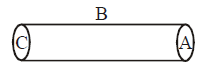
A hollow cylinder has charge q coulomb within it. If Φ is the electric flux in units of V-m associated with the curved surface B, the flux linked with the plane surface A in unit of V-m will be :

1. /[\frac{q}{2\varepsilon_{0}}/]
2. /[\frac{\phi}{3}/]
3. /[\frac{q}{\varepsilon_{0}}-\phi/]
4. /[\frac{1}{2}\left( \frac{q}{\varepsilon_{0}}-\phi \right)/]
View Answer