Gauss's Law - NEET Physics Questions
Question 1: moderate

Two parallel plates of infinite dimensions are uniformly charged. The surface charge density on one is \(\sigma_{A} \)and on the other is \(\sigma_{B}\), field intensity at point C will be

1. Proportional to \[\left( \sigma_{A}-\sigma_{B} \right)\]
2. Proportional to \[\left( \sigma_{A}+\sigma_{B} \right)\]
3. zero
4. \[2\sigma_{A}\]
View Answer

Net Electric Point at Point C will be directed downwards

\[ \overrightarrow{E}=\frac{\sigma_{A}}{2\varepsilon_{0}} + \frac{\sigma_{B}}{2\varepsilon_{0}}\]

Question 2: moderate

Two large thin metal plates are parallel and close to each other. On their inner faces, the plates have surface charge densities of opposite signs and magnitude 27\times 10^{-22}Cm^{-2}. The electric field \overrightarrow{E} in region II in between the plates is :

1. \[ 4.25\times 10^{-8}NC^{-1}\]
2. \[ 6.28\times 10^{-10}NC^{-1}\]
3. \[ 3.05\times 10^{-10}NC^{-1}\]
4. \[ 5.03\times 10^{-10}NC^{-1}\]
View Answer

Electric field at Point II will be due to both the sheets so,

\[\overrightarrow{E}=\frac{\sigma}{2\varepsilon_{0}} + \frac{\sigma}{2\varepsilon_{0}}=\frac{\sigma}{\varepsilon_{0}}\]

Question 3: moderate

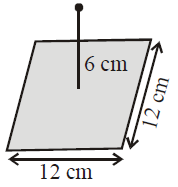
A point charge +20 μC is at a distance 6 cm directly above the centre of a square of side 12 cm as shown is figure. The magnitude of electric flux through the square is :


1. \[ 2.5\times 10^{6}Nm^{2}C^{-1}\]
2. \[ 3.8\times 10^{5}Nm^{2}C^{-1}\]
3. \[ 4.2\times 10^{5}Nm^{2}C^{-1}\]
4. \[ 2.9\times 10^{6}Nm^{2}C^{-1}\]
View Answer

To calculate the electric flux through the square, we use Gauss's law and symmetry principles.

The total flux from a point charge \(q = +20 \, \mu\text{C}\) is:

\[
\Phi_{\text{total}} = \frac{q}{\epsilon_0}
\]

Here:
- \(q = 20 \times 10^{-6} \, \text{C}\),
- \(\epsilon_0 = 8.854 \times 10^{-12} \, \text{C}^2/\text{N·m}^2\).

The square is part of an imaginary cube with the charge at its center. The flux through one face of the cube (the square in question) is:

\[
\Phi_{\text{square}} = \frac{\Phi_{\text{total}}}{6} = \frac{q}{6\epsilon_0}
\]

Substitute the values:

\[
\Phi_{\text{square}} = \frac{20 \times 10^{-6}}{6 \times 8.854 \times 10^{-12}}
\]

Simplify:

\[
\Phi_{\text{square}} = 3.77 \times 10^5 \, \text{N·m}^2/\text{C}
\]

Thus, the flux through the square is approximately:

\[
{3.8 \times 10^5 \, \text{N·m}^2/\text{C}}
\]

Question 4: moderate

The electric field in a region is give n by \[ \overrightarrow{E}=200\hat{i}N/C for x > 0 and -200\hat{i}N/C for x < 0 \]

A closed cylinder of length 2m and cross -section area 10² m² is kept in such away that the axis of cylinder is along X-axis and its centre coincides with origin. The total charge inside the cylinder is
(Take \(e_{0}=8.85\times 10^{-12} C^{2}m^{2}N)\)

1. zero
2. \[ 1.86\times 10^{-5}C\]
3. \[ 1.77\times 10^{-11}C\]
4. \[ 35.4\times 10^{-8}C\]
View Answer

To calculate the total charge inside the cylinder, we use Gauss's law:

\[
\Phi_E = \frac{q_{\text{inside}}}{\epsilon_0}
\]

Here:
- \(\Phi_E\) is the total electric flux through the surface of the cylinder,
- \(q_{\text{inside}}\) is the total charge enclosed by the cylinder,
- \(\epsilon_0 = 8.85 \times 10^{-12} \, \text{C}^2/(\text{N·m}^2)\).

Step 1: Electric flux through the cylinder
The cylinder has two flat faces (at \(x = +1\) m and \(x = -1\) m) and a curved surface. The electric field is parallel to the axis, so the flux through the curved surface is **zero**. Thus, only the two flat faces contribute to the flux.

- For the face at \(x = +1\) m:
\(\Phi_E^+ = E \cdot A = 200 \cdot 10^{-2} = 2 \, \text{N·m}^2/\text{C}\),

- For the face at \(x = -1\) m:
\(\Phi_E^- = E \cdot A = -200 \cdot 10^{-2} = -2 \, \text{N·m}^2/\text{C}\).

The total flux is:

\[
\Phi_E = \Phi_E^+ + \Phi_E^- = 2 - (-2) = 4 \, \text{N·m}^2/\text{C}
\]

Step 2: Total charge inside the cylinder
Using Gauss's law:

\[
q_{\text{inside}} = \Phi_E \cdot \epsilon_0 = 4 \cdot (8.85 \times 10^{-12})
\]

Simplify:

\[
q_{\text{inside}} = 35.4 \times 10^{-8} \, \text{C}
\]

Thus, the total charge inside the cylinder is:

\[
{35.4 \times 10^{-8} \, \text{C}}
\]

Question 5: moderate

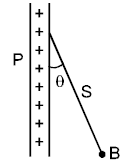
A charged ball B hangs from a silk thread S which makes an angle θ with a large charged conducting sheet P, as shown in the figure. The surface charge density ρ of the sheet is proportional to :


1. cos θ
2. cot θ
3. sin θ
4. tan θ
View Answer

To solve for the proportionality of the surface charge density \(\sigma\) with \(\tan\theta\), we analyze the forces acting on the charged ball \(B\):

Step 1: Forces acting on the ball
1. Gravitational force (\(F_g\)): Acts vertically downward, magnitude \(F_g = mg\), where \(m\) is the mass of the ball.
2. Electric force (\(F_e\)): Acts horizontally, due to the electric field produced by the charged conducting sheet.
3. Tension (\(T\)): Acts along the silk thread, balancing the net forces in both horizontal and vertical directions.

The electric field near a charged conducting sheet with surface charge density \(\sigma\) is:

\[
E = \frac{\sigma}{2\epsilon_0}
\]

The electric force on the ball is:

\[
F_e = qE = q \cdot \frac{\sigma}{2\epsilon_0}
\]

Step 2: Force balance
At equilibrium:
- In the vertical direction: \(T \cos\theta = mg\)
- In the horizontal direction: \(T \sin\theta = F_e = q \cdot \frac{\sigma}{2\epsilon_0}\)

Taking the ratio of the horizontal and vertical components:

\[
\tan\theta = \frac{T \sin\theta}{T \cos\theta} = \frac{F_e}{F_g} = \frac{q \cdot \frac{\sigma}{2\epsilon_0}}{mg}
\]

\[
\tan\theta \propto \sigma
\]

Final Answer:
The surface charge density \(\sigma\) of the sheet is proportional to:

\[
{\tan\theta}
\]

Question 6: moderate

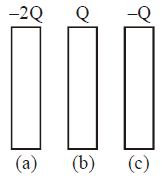
Three identical conducting plates are shown in figure. Findout the charge on the right face of the plate b.

1. -Q
2. Q/2
3. Q
4. Zero
View Answer

Yes, direct formulas can simplify the solution for problems like this involving conducting plates. Here's how:

Formula for charge redistribution in conductors:
For three parallel conducting plates with charges \( Q_1, Q_2, Q_3 \):
1. The charge on the inner faces is:
\[
Q_{\text{inner}} = \frac{Q_1 - Q_3}{2}
\]
2. The charge on the  outer faces remains equal to the net charge on the respective plates:
- Outer left face: \( Q_1 \)
- Outer right face: \( Q_3 \)

---

Applying the formula:
- Given charges:
\[
Q_1 = -2Q, \, Q_2 = Q, \, Q_3 = -Q
\]
- Charge on the inner faces of plate \( b \):
\[
Q_{\text{inner}} = \frac{Q_1 - Q_3}{2} = \frac{-2Q - (-Q)}{2} = \frac{-2Q + Q}{2} = \frac{-Q}{2}
\]

- Since the **right face of \( b \)** contributes to the inner faces:
\[
Q_{\text{right face of \( b \)}} = 0
\]

Final Answer:
\[
{Zero (0)}
\]