There are two non-conducting spheres having uniform volume charge densities ρ and –ρ . Both spheres have equal radius R. The spheres are
now laid down such that they overlaps as shown in the figure. The electric field \(\overrightarrow{E}\) in the overlap region is
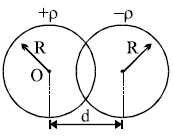
To calculate the electric field in the overlap region, we use the principle of superposition of electric fields. Let's analyze:
Step 1: Electric field due to one sphere
For a uniformly charged non-conducting sphere, the electric field inside the sphere at a distance \(\vec{r}\) from the center is:
\[
\vec{E}_{\text{sphere}} = \frac{\rho}{3\epsilon_0} \vec{r}
\]
Here:
- \(\rho\) is the charge density of the sphere,
- \(\epsilon_0\) is the permittivity of free space,
- \(\vec{r}\) is the position vector from the center of the sphere.
Step 2: Contribution of both spheres in the overlap region
- For the positively charged sphere (\(+\rho\)), the electric field at any point in the overlap region is directed **away** from its center, proportional to \(\vec{r}_1\) (distance from its center).
- For the negatively charged sphere (\(-\rho\)), the electric field at any point in the overlap region is directed **toward** its center, proportional to \(\vec{r}_2\) (distance from its center).
Thus, the net electric field is the vector sum:
\[
\vec{E}_{\text{net}} = \frac{\rho}{3\epsilon_0} \vec{r}_1 + \frac{-\rho}{3\epsilon_0} \vec{r}_2
\]
Step 3: Relation between \(\vec{r}_1\), \(\vec{r}_2\), and \(\vec{d}\)
In the overlap region, \(\vec{r}_1 - \vec{r}_2 = \vec{d}\), where \(\vec{d}\) is the displacement vector between the centers of the two spheres.
Substitute this into the expression for \(\vec{E}_{\text{net}}\):
\[
\vec{E}_{\text{net}} = \frac{\rho}{3\epsilon_0} (\vec{r}_1 - \vec{r}_2) = \frac{\rho}{3\epsilon_0} \vec{d}
\]
Final Answer:
The electric field in the overlap region is:
\[
{\frac{\rho}{3\epsilon_0} \vec{d}}
\]