Question 1:
moderate
As shown in the diagram, two fixed charges, q1 = +1.00 μC and q2 = –4.00 μC, are 0.200 m apart. Where is the total field zero?

As shown in the diagram, two fixed charges, q1 = +1.00 μC and q2 = –4.00 μC, are 0.200 m apart. Where is the total field zero?
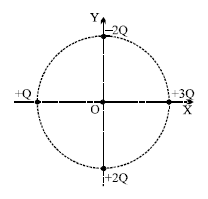
Four charges are placed on the circumference of a circle of radius R, 90° apart as shown in the figure . The electric field strength at the centre of the circle is
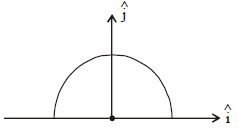
A thin semi-circular ring of radius r has a positive charge q distributed uniformly over it. The net field \overrightarrow{E} at the centre O is :
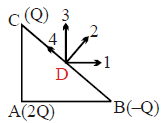
In the figure , ΔABC is in an isosceles triangle with A = 90°. D is the mid point of BC. Three charges 2Q, –Q and Q are placed at A, B, C respectively.
The net electric field at D due to three charges is directed along the numbered arrow :
Find the electric field due to a circular arc of radius R and charge / length λ at the origin. The arc is in xy plane and extends from θ = π/3 to θ = π w .r.t.x-axis .
A point charge of 100 μC is placed at 3\hat{i}+4\hat{j} m. Find the electric field intensity due to this charge at a point located at 9\hat{i}+12\hat{j} m :
Five point charges, each of value +q, are placed on five vertices of a regular hexagon of side L. The magnitude of the force on a point charge of value –q coulomb placed at the center of the hexagon is
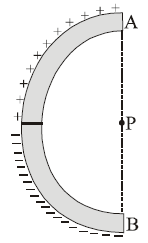
A thin glass rod is bent into a semicircle of radius r. A charge +Q is uniformly
distributed along the upper half, and a charge –Q is uniformly distributed along the lower half, as shown in Fig. The electric field E at P, the center of the semicircle, is :
Using the direct formula for the electric field due to a uniformly charged arc:
\[
E = \frac{2k\lambda \sin(\theta/2)}{r}
\]
Step 1: Identify Parameters
- \(\lambda\): Linear charge density.
- \(k = \frac{1}{4 \pi \varepsilon_0}\): Coulomb's constant.
- \(r\): Radius of the semicircle.
- \(\theta = \pi\): Angle subtended by the semicircle at the center.
Step 2: Substitute \(\lambda\)
The total charge on the semicircle is \(+Q\) or \(-Q\), and the arc length is \(\pi r\). Therefore:
\[
\lambda = \frac{Q}{\pi r}
\]
Step 3: Substitute into the Formula
\[
E = \frac{2k \lambda \sin(\pi/2)}{r}
\]
Here, \(\sin(\pi/2) = 1\). Substituting \(\lambda = \frac{Q}{\pi r}\):
\[
E = \frac{2k \left(\frac{Q}{\pi r}\right)}{r}
\]
Step 4: Simplify
\[
E = \frac{2k Q}{\pi r^2}
\]
Since \(k = \frac{1}{4 \pi \varepsilon_0}\), substitute \(k\):
\[
E = \frac{2}{4 \pi \varepsilon_0} \cdot \frac{Q}{\pi r^2}
\]
\[
E = \frac{Q}{\pi^2 \varepsilon_0 r^2}
\]
Final Answer:
The electric field at the center is:
\[
{\frac{Q}{\pi^2 \varepsilon_0 r^2}}
\]
Four electrical charges are arranged on the corners of a 10 cm square as shown. What would be the direction of the resulting electric field at the center point P?
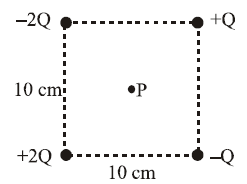
Explanation:
To determine the direction of the electric field at the center \(P\), we consider the contributions of the electric fields due to each charge:
1. Electric Field Due to Each Charge:
- The electric field at point \(P\) due to a charge at a corner of the square points away from the charge if it is positive, and toward the charge if it is negative.
2. Symmetry of the Problem:
- Opposite charges on diagonally opposite corners will partially cancel their contributions due to symmetry in their horizontal (\(x\)) or vertical (\(y\)) components.
- However, due to the **asymmetry in the magnitudes of the charges**, there will be a net resultant field.
3. Analyzing the Contributions:
- The charge \(-2Q\) (top left) will produce a stronger electric field toward itself compared to \(+Q\) (top right).
- Similarly, the charge \(+2Q\) (bottom left) will produce a stronger field away from itself compared to \(-Q\) (bottom right).
- The vertical components of the fields due to the charges \(-2Q\) and \(+2Q\) add **upward**.
- The horizontal components of the fields due to opposite charges (\(-2Q\) and \(+2Q\), and \(+Q\) and \(-Q\)) cancel each other.
4. Result:
- The net electric field at point \(P\) is directed upward, dominated by the vertical components due to the unequal magnitudes of the charges.
Hence, the correct answer is upward.
The maximum electric field at a point on the axis of a uniformly charged ring is E0. At how many points on the axis will the magnitude of the electric field be E0/2.
To understand why the magnitude of the electric field is \(E_0/2\) at four points on the axis of a uniformly charged ring, let's analyze this with the help of the electric field graph versus distance.
Key Concepts:
1. Electric Field on the Axis of a Uniformly Charged Ring:
The electric field at a distance \(x\) from the center of the ring along its axis is given by:
\[
E = \frac{k Q x}{(x^2 + R^2)^{3/2}}
\]
where:
- \(k\) is Coulomb's constant,
- \(Q\) is the total charge on the ring,
- \(R\) is the radius of the ring,
- \(x\) is the distance from the center along the axis.
2. Behavior of \(E\) as a Function of \(x\):
- At \(x = 0\): The electric field is \(0\) due to symmetry (no net field at the center).
- As \(x\) increases: \(E\) first increases, reaches a **maximum value** (\(E_0\)) at some distance \(x = x_{\text{max}}\), and then decreases asymptotically to \(0\) as \(x \to \infty\).
3. Points Where \(E = E_0/2\):
The equation \(E = \frac{E_0}{2}\) will have **two solutions** on either side of the point where \(E\) is maximum (\(x = \pm x_{\text{max}}\)):
- Two points closer to the ring's center (on both sides of \(x = 0\)).
- Two points farther from the center (on both sides of \(x = 0\)).
Thus, there are a total of four points where \(E = \frac{E_0}{2}\).
-------------------------------------------------------------------------------------------------------------------
Graphical Explanation:
1. The graph of \(E\) versus \(x\) is symmetric about \(x = 0\) and resembles a bell-shaped curve.
2. \(E\) starts at \(0\) at \(x = 0\), increases to a peak value of \(E_0\) at \(x_{\text{max}}\), and then decreases symmetrically as \(x\) moves away from \(x_{\text{max}}\) on both sides.
3. To find the points where \(E = \frac{E_0}{2}\), draw a horizontal line at \(E = \frac{E_0}{2}\). This line will intersect the \(E\)-vs-\(x\) curve at **four points**:
- Two on the rising part of the curve (closer to \(x = 0\)),
- Two on the falling part of the curve (farther from \(x = 0\)).
Conclusion:
The electric field is \(E_0/2\) at four points on the axis of the ring—two on each side of the ring's center. These correspond to the solutions of the equation \(E = \frac{k Q x}{(x^2 + R^2)^{3/2}} = \frac{E_0}{2}\).