Electric Field - NEET Physics Questions
Question 11: moderate

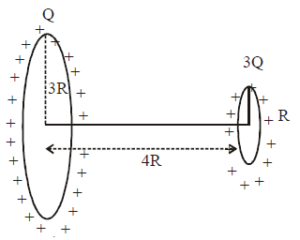
Two uniformly charged co axial rings are present as shown in the figure. Find electric field intensity at the centre of the smaller ring.
1. \[ \frac{Q}{4\pi \varepsilon_{0}R^{2}}\]
2. \[ \frac{Q}{25\pi \varepsilon_{0}R^{2}}\]
3. \[ \frac{Q}{125\pi \varepsilon_{0}R^{2}}\]
4. \[ \frac{4Q}{125\pi \varepsilon_{0}R^{2}}\]
View Answer

Given:
Two coaxial rings:
- Larger ring: Charge \( Q \), radius \( 3R \), distance \( 4R \) from the center of the smaller ring.
- Smaller ring: Charge \( 3Q \), radius \( R \).
We need the electric field at the center of the smaller ring.

Step 1: Electric Field due to the Larger Ring
The electric field at a distance \( x = 4R \) on the axis of a uniformly charged ring of radius \( R \) is:

\[
E = \frac{kQx}{(R^2 + x^2)^{3/2}}
\]

For the larger ring:
- \( Q = Q \), \( R = 3R \), \( x = 4R \):
\[
E_{\text{large}} = \frac{kQ(4R)}{((3R)^2 + (4R)^2)^{3/2}}
\]

\[
E_{\text{large}} = \frac{kQ(4R)}{(9R^2 + 16R^2)^{3/2}} = \frac{kQ(4R)}{(25R^2)^{3/2}}
\]

\[
E_{\text{large}} = \frac{kQ(4R)}{125R^3} = \frac{Q}{125\pi\varepsilon_0R^2}
\]

Step 2: Electric Field due to the Smaller Ring
The center of the smaller ring is its own center, so the net electric field due to its charge distribution is **zero**.

Step 3: Net Electric Field
The total electric field at the center of the smaller ring is due to the **larger ring only**:
\[
E = \frac{Q}{125\pi\varepsilon_0R^2}
\]

Final Answer:
\[
E = \frac{Q}{125\pi\varepsilon_0R^2}
\]
Question 12: moderate

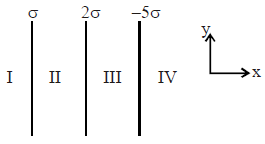
3 parallel infinite sheets carry charge of ρ, 2ρ and –5ρ per unit area on them. What is the electric field in region I, II, III and IV ?

1. \[ \frac{-\sigma}{\epsilon_{0}}\hat{i},\frac{-2\sigma}{\epsilon_{0}}\hat{i},\frac{4\sigma}{\epsilon_{0}}\hat{i},\frac{\sigma}{\epsilon_{0}}\hat{i} \]
2. \[ \frac{\sigma}{\epsilon_{0}}\hat{i},\frac{2\sigma}{\epsilon_{0}}\hat{i},\frac{-4\sigma}{\epsilon_{0}}\hat{i},\frac{5\sigma}{\epsilon_{0}}\hat{i} \]\[
3. \[\frac{2\sigma}{\epsilon_{0}}\hat{i},\frac{\sigma}{\epsilon_{0}}\hat{i},\frac{3\sigma}{\epsilon_{0}}\hat{i},\frac{-2\sigma}{\epsilon_{0}}\hat{i}\]
4. \[\frac{\sigma}{\epsilon_{0}}\hat{i},\frac{2\sigma}{\epsilon_{0}}\hat{i},\frac{4\sigma}{\epsilon_{0}}\hat{i},\frac{-\sigma}{\epsilon_{0}}\hat{i} \]
View Answer

The electric field due to an infinite sheet of charge with surface charge density \( \sigma \) is given by:

\[
E = \frac{\sigma}{2\epsilon_0}
\]

Now, let's determine the electric field in each region (I, II, III, and IV):

Region I:
Here, only the first sheet with charge density \( \sigma \) contributes. The field due to this sheet is:

\[
E_{\text{I}} = \frac{\sigma}{2\epsilon_0} \hat{i} + \frac{\sigma}{2\epsilon_0} \hat{i} = \frac{\sigma}{\epsilon_0} \hat{i}
\]

Region II:
In this region, both the first and second sheets contribute. The total electric field is:

\[
E_{\text{II}} = \left( \frac{\sigma}{2\epsilon_0} + \frac{2\sigma}{2\epsilon_0} \right) \hat{i} = \frac{2\sigma}{\epsilon_0} \hat{i}
\]

Region III:
Here, all three sheets contribute. The total field is:

\[
E_{\text{III}} = \left( \frac{\sigma}{2\epsilon_0} + \frac{2\sigma}{2\epsilon_0} + \frac{-5\sigma}{2\epsilon_0} \right) \hat{i} = \frac{4\sigma}{\epsilon_0} \hat{i}
\]

Region IV:
Only the third and fourth sheets contribute:

\[
E_{\text{IV}} = \left( \frac{-5\sigma}{2\epsilon_0} \right) \hat{i} = \frac{-\sigma}{\epsilon_0} \hat{i}
\]

Final Answers:
- Region I: \( \frac{\sigma}{\epsilon_0} \hat{i} \)
- Region II: \( \frac{2\sigma}{\epsilon_0} \hat{i} \)
- Region III: \( \frac{4\sigma}{\epsilon_0} \hat{i} \)
- Region IV: \( \frac{-\sigma}{\epsilon_0} \hat{i} \)