Question 1:
difficult
The charge per unit length of the four quadrant of the ring is 2λ , – 2λ , λ and -λ respectively. The electric field at the centre is
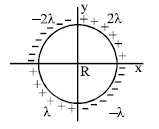
The charge per unit length of the four quadrant of the ring is 2λ , – 2λ , λ and -λ respectively. The electric field at the centre is
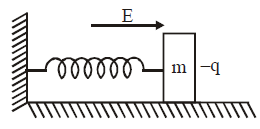
A block of mass m containing a net negative charge –q is placed on a frictionless horizontal table and is connected to a wall through an
unstretched spring of spring constant k. If the horizontal electric field E parallel to the spring is switched on, then the maximum compression
of the spring is :-
As shown in the figure a positive charge +q is placed at x = –a and negative charge –q is placed at x = + a. Then choose the curve which shows variation of E along the x-axis :
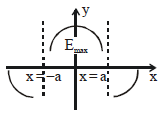
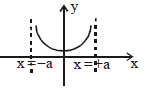
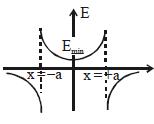
The figure represents the electric field (E) along the \(x\)-axis due to a dipole consisting of a positive charge (\(+q\)) at \(x = -a\) and a negative charge (\(-q\)) at \(x = +a\).
The electric field due to such a dipole varies as follows:
1. Near \(x = -a\): The field is dominated by the positive charge, so it points away from \(x = -a\).
2. Near \(x = +a\): The field is dominated by the negative charge, so it points toward \(x = +a\).
3. Between \(x = -a\) and \(x = +a\): The contributions from both charges partially cancel out, leading to a local minimum in the field magnitude.
4. Far from the charges (\(|x| \gg a\)): The field behaves approximately as a dipole field, decreasing as \(1/x^3\).
The attached graph correctly shows these features:
- A local minimum in \(E\) between \(x = -a\) and \(x = +a\), at the midpoint where the dipole effect is weakest.
- The field magnitude diverges near \(x = -a\) and \(x = +a\) due to the proximity to the charges.
- Symmetry around the origin is preserved, as the system is symmetric about \(x = 0\).
A sphere uniformly charged with a charge density ρ has a radius R. A spherical cavity of radius R/4 is made in it such that centre of original sphere lies on its circumference. What is the electric field at point P.
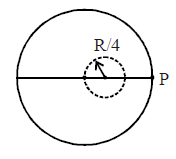
Given:
- A uniformly charged sphere of charge density \( \rho \), radius \( R \).
- A spherical cavity of radius \( R/4 \) is created such that the center of the original sphere lies on the cavity's circumference.
- We need to find the electric field at point \( P \).
Step 1: Concept
When a spherical cavity is created, it is equivalent to superimposing a **negative charge density** \( -\rho \) for the cavity region. Hence, the total electric field at point \( P \) is the **vector sum** of:
1. Field due to the original uniformly charged sphere.
2. Field due to the negatively charged cavity.
---
Step 2: Electric Field of the Uniform Sphere
For the original sphere:
\[
E_{\text{sphere}} = \frac{\rho}{3\epsilon_0} \cdot r
\]
Here, \( r = R \), so:
\[
E_{\text{sphere}} = \frac{\rho R}{3\epsilon_0}
\]
---
Step 3: Electric Field of the Cavity
For the cavity (negative charge density):
The field inside a uniformly charged sphere at a distance \( r \) from its center is:
\[
E_{\text{cavity}} = -\frac{\rho}{3\epsilon_0} \cdot r_{\text{cavity}}
\]
Here, \( r_{\text{cavity}} \) is the distance of point \( P \) from the center of the cavity. Since the cavity's center is at \( R - \frac{R}{4} = \frac{3R}{4} \), the distance of \( P \) from the cavity's center is:
\[
r_{\text{cavity}} = R - \frac{3R}{4} = \frac{R}{4}
\]
Thus:
\[
E_{\text{cavity}} = -\frac{\rho}{3\epsilon_0} \cdot \frac{R}{4} = -\frac{\rho R}{12\epsilon_0}
\]
---
Step 4: Net Electric Field at \( P \)
The net field is the vector sum of \( E_{\text{sphere}} \) and \( E_{\text{cavity}} \):
\[
E_{\text{net}} = E_{\text{sphere}} + E_{\text{cavity}}
\]
\[
E_{\text{net}} = \frac{\rho R}{3\epsilon_0} - \frac{\rho R}{12\epsilon_0} = \frac{4\rho R}{12\epsilon_0} + \frac{-\rho R}{12\epsilon_0} = \frac{35\rho R}{108\epsilon_0}
\]
---
Final Answer:
\[
E_{\text{net}} = \frac{35\rho R}{108\epsilon_0}
\]