Parallel Plate Capacitor - NEET Physics Questions
← Back to Capacitors

Parallel Plate Capacitor

Question 1: difficult

A capacitor of capacitance C is initially charged to a potential difference of V volt. Now it is connected to a battery of 2V Volt with opposite polarity. The ratio of heat generated to the final energy stored in the capacitor will be

1. 1.75
2. 2.25
3. 2.5
4. 1/2
View Answer
Question 2: difficult

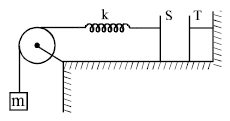
The plates S and T of an uncharged parallel plate capacitor are connected across a battery. The battery is then disconnected and the charged plates are now connected in a system as shown in the figure. The system shown is in equilibrium. All the strings are insulating and massless. The magnitude of charge on one of the capacitor plates is: [Area of plates = A]

1. \[\sqrt{2mgA \epsilon_{0}}\]
2. \[\sqrt\frac{{4mgA \epsilon_{0}}}{k}\]
3. \[\sqrt{mgA \epsilon_{0}}\]
4. \[\sqrt\frac{{2mgA \epsilon_{0}}}{k}\]
View Answer

To solve this, let us analyze the situation and derive the required expression for the charge:


1. Setup of the System

  • The parallel plate capacitor is initially charged, and the battery is disconnected.
  • One plate of the capacitor is connected to a spring, and the other is attached to a mass
    mm
     

    .

  • The capacitor plates attract each other due to the opposite charges, generating an electrostatic force.

2. Equilibrium Condition

In equilibrium, the upward force due to the spring's tension balances the downward gravitational force acting on the mass

mm

:


T=mgT = mg


This tension

TT

is equal to the electrostatic force

FelecF_{\text{elec}}

between the plates of the capacitor:


Felec=Q22ϵ0AF_{\text{elec}} = \frac{Q^2}{2 \epsilon_0 A}


3. Force Balance

At equilibrium:


Felec=mgF_{\text{elec}} = mg


Substitute

Felec=Q22ϵ0AF_{\text{elec}} = \frac{Q^2}{2 \epsilon_0 A}

:


Q22ϵ0A=mg\frac{Q^2}{2 \epsilon_0 A} = mg


4. Solve for QQ


Rearranging for

QQ

:


Q2=2mgϵ0AQ^2 = 2 mg \epsilon_0 A


Taking the square root:


Q=2mgϵ0AQ = \sqrt{2 mg \epsilon_0 A}


Final Answer:

The magnitude of the charge on one of the capacitor plates is:


Q=2mgAϵ0Q = \sqrt{2mgA\epsilon_0}


Question 3: difficult

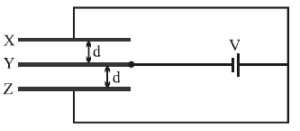
Consider the arrangement of three plates X, Y and Z each of area A and separation d. The energy stored in the system when the plates are fully charged is:

1. \[\frac{\varepsilon_{0}AV^{2}}{2d}\]
2. \[\frac{\varepsilon_{0}AV^{2}}{d}\]
3. \[\frac{2\varepsilon_{0}AV^{2}}{d}\]
4. \[\frac{3\varepsilon_{0}AV^{2}}{2d}\]
View Answer

To solve for the energy stored in the system of three plates (X, Y, Z), let's break the system into simpler components:


1. System Description

  • The arrangement forms two capacitors:
    • Capacitor 1: Between plates X and Y.
    • Capacitor 2: Between plates Y and Z.
  • Each capacitor has the same plate area
    AA
     

    and plate separation dd 

    .

The capacitance of a parallel plate capacitor is given by:


C=ε0AdC = \frac{\varepsilon_0 A}{d}


Thus, the capacitance of each capacitor is:


C1=C2=ε0AdC_1 = C_2 = \frac{\varepsilon_0 A}{d}


2. Effective Capacitance

The two capacitors are in parallel because plate Y is connected to the battery on one side and plate X and Z are on the opposite side. For capacitors in parallel, the effective capacitance is:


Ceq=C1+C2C_{\text{eq}} = C_1 + C_2


Ceq=ε0Ad+ε0Ad=2ε0AdC_{\text{eq}} = \frac{\varepsilon_0 A}{d} + \frac{\varepsilon_0 A}{d} = \frac{2 \varepsilon_0 A}{d}


3. Energy Stored in the System

The energy stored in a capacitor is:


U=12CeqV2U = \frac{1}{2} C_{\text{eq}} V^2


Substitute

Ceq=2ε0AdC_{\text{eq}} = \frac{2 \varepsilon_0 A}{d}

:


U=122ε0AdV2U = \frac{1}{2} \cdot \frac{2 \varepsilon_0 A}{d} \cdot V^2


U=ε0AV2dU = \frac{\varepsilon_0 A V^2}{d}


Final Answer:

The energy stored in the system is:


U=ε0AV2dU = \frac{\varepsilon_0 A V^2}{d}


Question 4: difficult

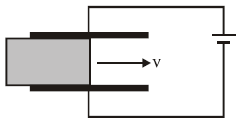
A dielectric slab of area A is inserted between the plates of a capacitor of area 2A with constant speed v as shown in figure. Distance between the plates is d.

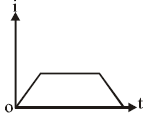
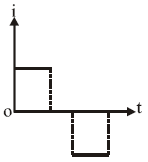
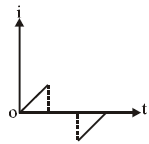
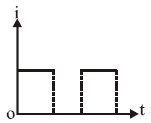
The capacitor is connected to a battery of emf E. The current in the circuit varies with time as

1.
2.
3.
4.
View Answer

To plot a graph for the current

ii

versus time

tt

, let's break the problem into steps:


1. Capacitor with Dielectric Slab

  • Initial Configuration: The capacitor has plates of total area
    2A2A
     

    and plate separation dd 

    . It is connected to a battery with emf EE 

    .

  • Dielectric Slab: A dielectric slab of area
    AA
     

    is inserted at a constant speed vv 

    .


2. Capacitance with Partial Dielectric

When a dielectric is partially inserted into the capacitor, the total capacitance is the sum of two capacitors:

  • One part with the dielectric slab (
    C1C_1
     

    ).

  • One part without the dielectric slab (
    C2C_2
     

    ).

Capacitance of the two regions:

  1. With Dielectric Slab: 

    C1=κε0AdC_1 = \frac{\kappa \varepsilon_0 A}{d}where

    κ\kappais the dielectric constant.

  2. Without Dielectric Slab: 

    C2=ε0(2AA)d=ε0AdC_2 = \frac{\varepsilon_0 (2A - A)}{d} = \frac{\varepsilon_0 A}{d} 

Thus, the total capacitance

CtotalC_{\text{total}}

is:


Ctotal=C1+C2=κε0Ad+ε0AdC_{\text{total}} = C_1 + C_2 = \frac{\kappa \varepsilon_0 A}{d} + \frac{\varepsilon_0 A}{d}


Ctotal=ε0Ad(κ+1)C_{\text{total}} = \frac{\varepsilon_0 A}{d} (\kappa + 1)


3. Change in Capacitance with Time

As the slab moves with speed

vv

, the area covered by the slab changes with time:


Covered area Acovered=vt\text{Covered area } A_{\text{covered}} = v \cdot t


The effective capacitance changes as:


C(t)=κε0(vt)d+ε0(2Avt)dC(t) = \frac{\kappa \varepsilon_0 (v \cdot t)}{d} + \frac{\varepsilon_0 (2A - v \cdot t)}{d}


C(t)=ε0d[κ(vt)+(2Avt)]C(t) = \frac{\varepsilon_0}{d} \left[ \kappa (v \cdot t) + (2A - v \cdot t) \right]


Simplify:


C(t)=ε0d[2A+(κ1)(vt)]C(t) = \frac{\varepsilon_0}{d} \left[ 2A + (\kappa - 1)(v \cdot t) \right]


4. Current in the Circuit

The current in the circuit is related to the rate of change of capacitance:


i(t)=EdCdti(t) = E \cdot \frac{dC}{dt}


Differentiate

C(t)C(t)

with respect to

tt

:


dCdt=ε0d(κ1)v\frac{dC}{dt} = \frac{\varepsilon_0}{d} (\kappa - 1) v


Thus:


i(t)=Eε0d(κ1)vi(t) = E \cdot \frac{\varepsilon_0}{d} (\kappa - 1) v


5. Graph of ii


vs. tt


The current

i(t)i(t)

is constant because it does not depend on

tt

(the rate of capacitance change is constant). Hence, the graph of

ii

vs.

tt

will be a horizontal line at:


i=Eε0d(κ1)vi = E \cdot \frac{\varepsilon_0}{d} (\kappa - 1) v


Question 5: difficult

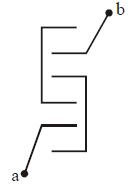
Plates of area A are arranged as shown. The distance between each plate is d, the net capacitance is :

1. \[\frac{\varepsilon_{0}A}{d}\]
2. \[\frac{7\varepsilon_{0}A}{d}\]
3. \[\frac{6\varepsilon_{0}A}{d}\]
4. \[\frac{5\varepsilon_{0}A}{d}\]
View Answer

The arrangement appears to be a system of parallel plates connected alternately to terminals

aa

and

bb

. Let’s determine the net capacitance.

Key Observations:

  1. The plates form a series-parallel combination.
  2. The area of each plate is
    AA
     

    , and the separation between adjacent plates is dd 

    .

  3. The effective configuration can be reduced to find the equivalent capacitance.

Equivalent Capacitance Derivation:

  1. Pairing of Plates:
    • Adjacent plates (connected alternately) act as capacitors.
    • Each capacitor has a capacitance
      C=ε0AdC = \frac{\varepsilon_0 A}{d}
       

      .

  2. Parallel and Series Combination:
    • There are three capacitors in the arrangement, effectively forming a single network.
    • The middle plate shares equal charge with both sides, simplifying to an equivalent capacitance of
      ε0Ad\frac{\varepsilon_0 A}{d}
       

      .

Thus, the net capacitance is:


Cnet=ε0Ad.C_{\text{net}} = \frac{\varepsilon_0 A}{d}.